This herb watering guide helps you use the plant and its root zone—not a fixed calendar—to decide when water is needed.
Use it to check whether a herb needs water, choose the appropriate action and find concise answers to common watering questions.
There is no reliable universal answer to “How many times per week should I water my herbs?”
How quickly a herb uses or loses moisture depends on:
- Herb species.
- Root-zone moisture.
- Container size.
- Growing medium.
- Drainage.
- Plant size.
- Light.
- Temperature.
- Wind.
- Humidity.
- Rainfall.
- Season.
- Whether the herb is indoors or outdoors.
You do not need to calculate every factor each time you pick up a watering can. Use the five-step system, 30-second check and quick-reference answers below to make a practical decision from the conditions in front of you.
The Grow Herb Lab 5-Step Watering System
Step 1 — Know Your Herb
First identify its general moisture preference.
More Consistent Moisture
Examples include:
- Basil.
- Mint.
- Parsley.
- Coriander.
- Chives.
- Dill.
- Lemon balm.
These herbs generally should not be repeatedly allowed to become severely dry.
More Drying Between Waterings
Examples include:
- Rosemary.
- Thyme.
- Oregano.
- Sage.
- Lavender.
- Marjoram.
These herbs generally benefit from greater drying between waterings.
This identifies the level of dryness you are looking for; it does not assign a fixed watering day.
Step 2 — Check the Root Zone
The surface can dry before the deeper root zone. Where practical, check the growing medium approximately 2–3 cm below the surface.
Ask:
Is it wet, moist or dry?
For manageable containers, pot weight can provide another useful clue.
Step 3 — Check the Plant
Look for:
- Wilting.
- Yellowing.
- Crispy foliage.
- Soft growth.
- Leaf drop.
- Healthy new growth.
Use these signs as supporting evidence, but do not diagnose watering requirements from the leaves alone.
Step 4 — Check What Has Changed
Consider whether any recent change could have altered how quickly the herb uses or loses moisture:
- Hot weather?
- A heatwave?
- Strong wind?
- Rain?
- Cooler temperatures?
- Less sunlight?
- A move indoors?
- Repotting?
- Rapid new growth?
Changes in the environment can quickly alter how often a herb needs water.
Step 5 — Water or Wait
Combine what you found in the root zone, the plant and recent conditions.
Appropriately Dry for That Herb?
Water thoroughly and allow excess water to drain.
Still Sufficiently Moist?
Wait and check again later.
Persistently Wet?
Do not add more water. Investigate drainage, growing conditions and potentially the roots.
🌿 The 30-Second Watering Check
For a quick watering decision, use this four-part check:
TOUCH → LIFT → LOOK → DECIDE
TOUCH
Check below the soil surface.
LIFT
For manageable pots, check whether the container feels relatively light or heavy.
LOOK
Observe the plant and recent conditions.
DECIDE
Water only if the evidence supports it.
Repeating this check helps you recognise when each herb needs water without relying on a fixed schedule.
Quick Watering Decision Table
Use the root-zone condition and the plant’s response together to choose the most appropriate action.
| What You Find | What It Usually Means | What to Do |
| Dry root zone + plant beginning to stress | Water may be needed | Water thoroughly |
| Dry root zone + drought-tolerant herb still healthy | More drying may be acceptable | Assess herb preference before watering |
| Slightly moist + moisture-loving herb | Monitor closely | Check again soon |
| Moist + healthy plant | Water not currently required | Wait |
| Wet + healthy plant | Root zone still has substantial moisture | Wait |
| Wet + wilting/yellowing | Possible excess moisture or root stress | Investigate drainage and roots |
| Pot dries unusually quickly | Rapid moisture loss or root congestion | Check pot, roots and environment |
| Pot stays wet unusually long | Slow water use or drainage problem | Check light, pot, mix and drainage |
Frequently Asked Questions
These quick answers address the most common herb-watering questions and should be used alongside the five-step system above.
How Often Should You Water Herbs?
There is no single watering frequency that works for every herb.
Water when the root zone reaches an appropriate level of dryness for the particular herb.
Basil and mint generally prefer more consistent moisture, while rosemary and thyme usually benefit from greater drying between waterings.
Weather, pot size, drainage and growing conditions determine how quickly that point is reached.
Should Herbs Be Watered Every Day?
Not automatically.
Some container herbs may require daily checking during very hot or windy weather, but that does not mean every herb needs daily watering.
Watering every day regardless of soil moisture can keep the root zone excessively wet.
Always check the root zone first and water only when needed.
How Often Should You Water Herbs in Pots?
Potted herbs generally need more frequent moisture checks than established herbs growing in garden beds because containers hold a limited amount of growing medium.
However, actual watering frequency depends on:
- Herb type.
- Pot size.
- Pot material.
- Growing medium.
- Drainage.
- Weather.
- Plant size.
A small terracotta pot in summer may dry quickly, while a large plastic container during cool weather may remain moist for several days.
How Often Should You Water Indoor Herbs?
Indoor herbs should be watered according to root-zone moisture rather than a weekly schedule.
Indoor containers often dry more slowly because they are protected from wind and rain and may receive lower light.
Check the growing medium before watering and ensure drainage water is not accumulating inside decorative outer pots.
How Do I Know When My Herbs Need Water?
Use several clues together:
- Check moisture below the soil surface.
- Check pot weight where practical.
- Observe the plant.
- Consider the herb’s moisture preference.
- Consider recent weather and growing conditions.
Do not use wilting alone as proof that water is required.
How Deep Should I Check the Soil Before Watering?
For many container herbs, checking approximately 2–3 cm below the surface provides a useful starting point.
However, large pots may remain moist deeper in the root zone even when the upper layer feels dry.
Use soil feel together with pot weight, plant condition and knowledge of the herb.
Should I Let Herbs Dry Out Between Waterings?
It depends on the herb.
Mediterranean herbs such as rosemary, thyme, oregano and lavender generally prefer greater drying between waterings.
Leafy herbs such as basil, mint and parsley usually prefer more consistent moisture.
Very few herbs benefit from remaining permanently saturated.
What Is the Best Time of Day to Water Herbs?
Morning is generally a practical time to water outdoor herbs when watering is required.
It allows plants to enter warmer daytime conditions with moisture available.
However, water a severely dry herb when it needs it rather than leaving it stressed until the next morning.
Is It Better to Water Herbs From the Top or Bottom?
Both methods can work.
Top watering is simple and helps moisten the root zone while allowing excess water to drain.
Bottom watering can be useful for seedlings or growing medium that is difficult to rewet evenly.
Do not leave pots permanently standing in water.
Occasional top watering can also help flush accumulated soluble salts from container growing media.
Should Water Come Out of the Bottom of the Pot?
When thoroughly watering a conventional container, seeing some excess water leave through the drainage holes can help confirm that water has moved through the pot.
However, water running out immediately does not always mean the root ball is wet.
Extremely dry growing medium can allow water to bypass the root zone.
Check the pot and growing medium rather than relying on drainage alone.
Is It Better to Give Herbs a Little Water Every Day?
Usually not.
Frequent small amounts can wet only the upper growing medium and encourage an inconsistent root-zone moisture pattern.
A better approach is generally to:
Check first → water thoroughly when required → allow drainage → check again later
How much drying occurs before the next watering depends on the herb.
Can You Overwater a Herb Once?
A single thorough watering is not the same thing as chronic overwatering when the container drains properly.
The greater risk occurs when the root zone remains excessively wet for prolonged periods or is repeatedly watered before sufficient drying occurs.
Overwatering is therefore better understood as a root-zone moisture problem over time.
Can Herbs Recover From Overwatering?
Often, yes, particularly when excessive moisture is corrected before serious root damage occurs.
Stop unnecessary watering, empty any collected drainage water, confirm that the container drains freely and allow the root zone to recover.
If the plant continues declining or roots become soft, dark or decayed, investigate possible root rot.
Related guide: Root Rot in Herbs: The Complete Guide to Diagnosis, Treatment and Prevention
Can Herbs Recover From Underwatering?
Many herbs can recover from temporary dryness if the stress has not become severe.
Water the root zone appropriately and allow the plant time to respond.
Repeated severe dehydration can weaken plants and should not become part of the normal watering cycle.
Why Does My Herb Wilt Even Though the Soil Is Wet?
Wilting while the root zone is wet can indicate that damaged or oxygen-stressed roots are unable to support the plant properly.
Possible causes include:
- Poor drainage.
- Prolonged excess moisture.
- Root damage.
- Root rot.
It can also occur because of heat or transplant stress.
Do not add more water until you have checked the root zone and drainage.
Why Are My Herb Leaves Turning Yellow After Watering?
Yellowing after watering does not necessarily mean the most recent watering caused the problem.
Investigate:
- Whether the root zone remains excessively wet for prolonged periods.
- Drainage.
- Root health.
- Previous watering frequency.
- Light.
- Nutrients.
- Temperature.
- Other plant stresses.
Related guide: Why Are My Herb Leaves Turning Yellow?
How Can I Tell if My Herb Is Overwatered or Underwatered?
Start with the root zone.
More Consistent With Underwatering
- Dry root zone.
- Light container.
- Wilted or crispy foliage.
- Improvement after appropriate watering.
More Consistent With Excess Moisture
- Persistently wet root zone.
- Heavy container.
- Yellowing or wilting despite moisture.
- Weak growth.
- Root deterioration in advanced cases.
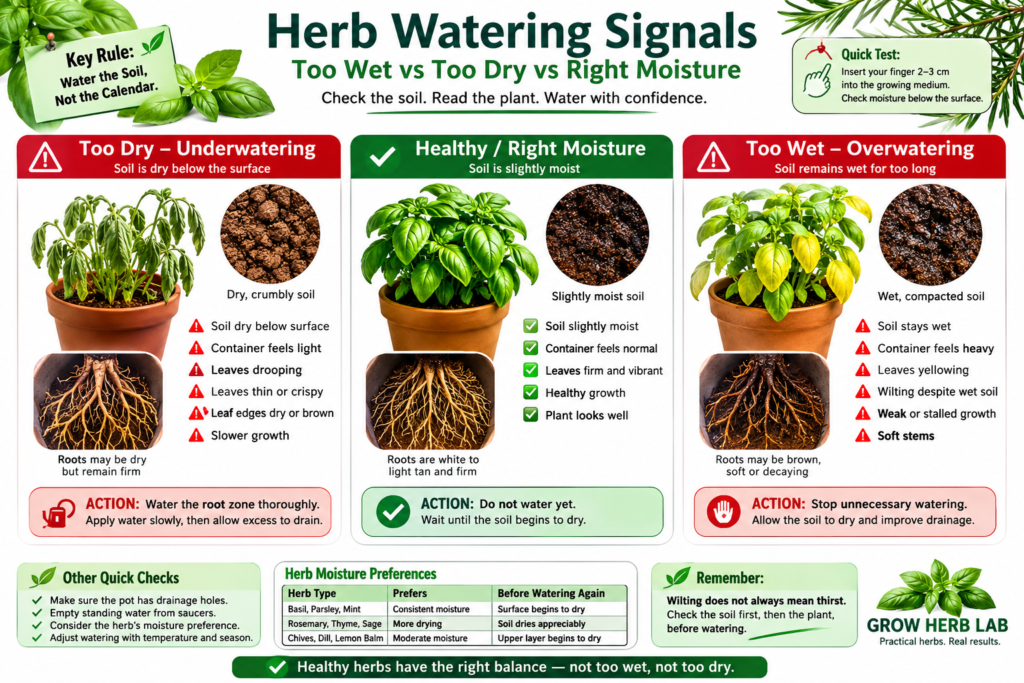
Related guide: Overwatering vs Underwatering Herbs: How to Tell the Difference
Do Rosemary and Basil Need the Same Amount of Water?
Generally, no.
Basil prefers more consistent moisture.
Rosemary generally benefits from considerably more drying between waterings and is particularly vulnerable to prolonged wet root conditions.
Putting both plants on exactly the same watering schedule can therefore create problems.
This is why watering should be based on the herb type and root-zone moisture rather than a shared schedule.
Do Herbs Need Less Water in Winter?
Often, yes.
Cooler temperatures, reduced evaporation and slower plant growth can mean the growing medium takes much longer to dry.
However, herbs should not automatically be left without water throughout winter.
Continue checking the root zone and water when appropriate.
Does Rain Mean I Don’t Need to Water My Potted Herbs?
Not necessarily.
Light rain may wet only the surface, particularly when dense foliage or overhead structures protect the container.
Conversely, prolonged rain may leave exposed pots excessively wet.
After rain, check the growing medium before deciding.
Are Moisture Meters Worth Using?
They can provide useful additional information, particularly in larger containers.
However, inexpensive moisture meters vary in accuracy.
Use the reading alongside:
- Soil feel.
- Pot weight.
- Plant symptoms.
- Drainage.
- Recent conditions.
Treat a moisture meter as a supporting tool, not the sole basis for a watering decision.
What Is the Biggest Watering Mistake?
For many beginner herb growers, the biggest mistake is watering according to a fixed schedule without checking whether the plant actually needs water.
That can produce both overwatering and underwatering as conditions change.
The better system is:
Check regularly. Water individually. Adjust continuously.
🌿 Grow Herb Lab Watering Rule
If you remember only one thing from this guide, remember:
WATER THE SOIL, NOT THE CALENDAR
Do not ask:
“Is today watering day?”
Ask:
“Does this herb need water today?”
That small change turns watering from a routine chore into a simple diagnostic process.
Continue Learning
Use the following guides when you need more detailed help with a specific watering problem or plant stage: