Newly planted herbs need different watering care from established plants. Seeds, young seedlings, recent transplants and freshly repotted herbs all have smaller or disturbed root systems, which means they can dry out quickly — but they can also suffer when the growing medium stays constantly wet.
The key is not simply to water more often. It is to keep moisture appropriate for the plant’s stage of growth while still allowing enough oxygen around developing roots.
In this guide, you’ll learn how to water herb seeds and seedlings, how to manage newly transplanted herbs, how to recognise transplant shock, and how to avoid overwatering herbs after repotting.
The goal is simple: provide enough moisture to support germination and root establishment without keeping developing roots constantly saturated.
Quick Facts
- Keep germinating seeds evenly moist, but not saturated.
- Check seedlings frequently because small containers can dry quickly.
- Water transplants according to root-zone moisture—not wilting alone.
- Reassess watering frequency after moving a herb into a larger pot.
- Ensure excess water can drain at every stage.
How to Water Herb Seeds During Germination
Herb seeds need consistent moisture to germinate successfully. Once germination begins, repeatedly allowing the growing medium to dry out can interrupt the process or prevent young seedlings from establishing.
Aim for even moisture rather than saturated soil.
During germination, aim for growing medium that is:
- Consistently moist.
- Well drained.
- Not waterlogged.
- Not repeatedly drying completely.
- Fine enough to maintain good contact with the seeds.
Small seeds near the surface are particularly vulnerable because the upper layer of growing medium dries first.
Water Herb Seeds Gently
Heavy watering can disturb freshly sown seeds.
It may:
- Wash seeds into one area.
- Bury small seeds too deeply.
- Expose seeds that were lightly covered.
- Compact the growing medium.
- Damage newly emerging seedlings.
Use a gentle watering method that moistens the growing medium without moving or burying the seeds. Depending on the container, suitable methods include:
- A watering can with a fine rose.
- Gentle bottom watering.
- Careful application of water around established seedlings.
Using Humidity Covers for Herb Seed Germination
Clear lids or humidity domes can help slow moisture loss while herb seeds are germinating, making it easier to keep the growing medium evenly moist.
However, once seedlings emerge, prolonged high humidity and overly wet conditions can create problems.
After germination:
- Follow the requirements of the particular herb.
- Introduce appropriate airflow.
- Monitor moisture carefully.
- Avoid keeping the growing medium continuously saturated.
A propagation cover should help manage moisture — not create a continuously wet growing environment.
How to Water Young Herb Seedlings
Young herb seedlings have small, developing root systems, so they have access to less stored moisture than established plants and need closer moisture monitoring.
They need access to moisture, but they also require oxygen.
Keeping the growing medium constantly saturated can reduce oxygen around developing roots and increase the risk of problems such as root decline and damping-off.
Possible warning signs include:
- Seedlings collapsing near the soil line.
- Weak or stalled growth.
- Persistently wet growing medium.
- Discoloured stems near the base.
- Sudden loss of young seedlings.
Young seedlings need closer moisture monitoring — not constantly wet growing medium.
How Often Should You Water Herb Seedlings?
There is no fixed watering schedule that works for every herb seedling.
Seed trays and small seedling containers can dry quickly because they contain relatively little growing medium.
Check the growing medium frequently and use its actual moisture level—not the calendar—to decide when to water.
Water when the growing medium is approaching the appropriate level of dryness rather than waiting for seedlings to become severely wilted.
How quickly this occurs depends on:
- Container size.
- Growing medium.
- Temperature.
- Light.
- Humidity.
- Airflow.
- Seedling size.
- Herb species.
The smaller the container, the faster conditions can change.
Bottom Watering Herb Seedlings
Bottom watering can be useful for seedling trays and small pots.
Place the container in shallow water and allow moisture to move upward through the drainage holes.
Once the growing medium has absorbed sufficient moisture:
Remove the container → allow excess water to drain
Do not leave seedling trays sitting permanently in water.
Bottom watering can reduce disturbance to delicate seedlings, but overwatering is still possible if the growing medium remains saturated for too long.
How to Water Newly Transplanted Herb Seedlings
Transplanting a herb seedling into a larger container or garden bed changes the conditions around its roots.
The seedling may experience temporary transplant stress while its disturbed roots begin establishing in the surrounding growing medium.
After transplanting:
- Water gently and thoroughly enough to settle the growing medium around the roots.
- Ensure excess water can drain.
- Monitor moisture more closely during establishment.
- Avoid severe drying immediately after transplanting.
- Avoid keeping the new root zone constantly saturated.
The objective is to maintain appropriate moisture while the disturbed roots establish—without allowing the new root zone to remain constantly saturated.
How to Tell Transplant Shock From Thirst
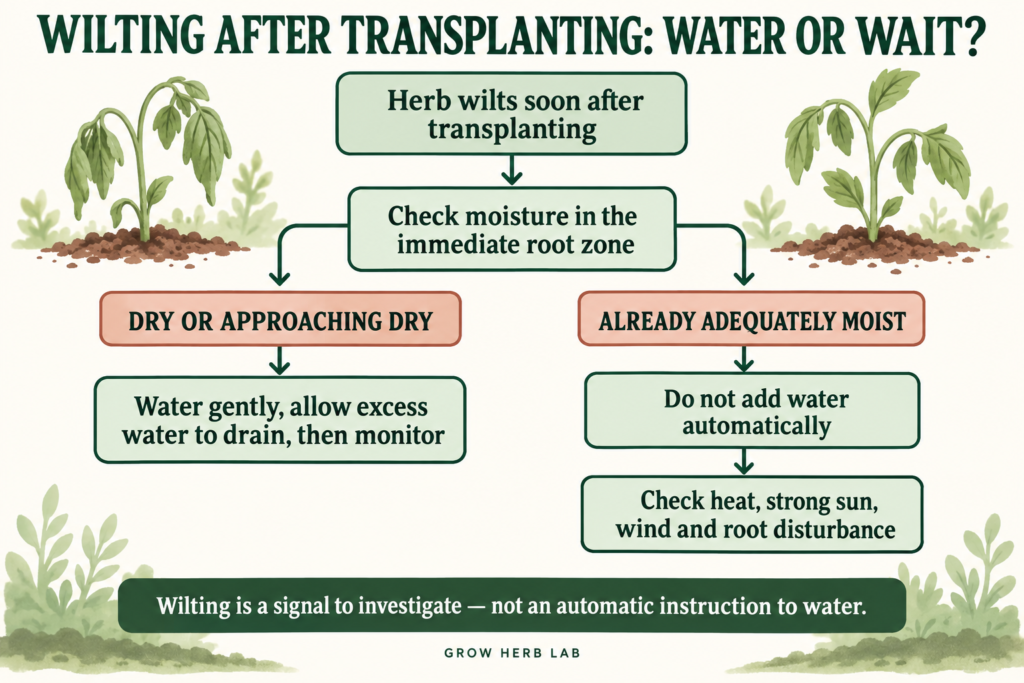
A newly transplanted herb may wilt even when its immediate root zone contains adequate moisture.
Possible causes include:
- Root disturbance.
- Sudden exposure to stronger sunlight.
- Heat.
- Wind.
- Changes in humidity.
- Damage during transplanting.
Automatically adding more water whenever the herb wilts can leave an already-moist root zone saturated and create an overwatering problem.
Before watering a recently transplanted herb, check the moisture in its immediate root zone.
If the root zone is already adequately moist, do not water automatically; investigate transplant stress, heat, light, wind or root damage instead.
Grow Herb Lab Tip
Treat wilting as a signal to investigate—not an automatic instruction to water. Check root-zone moisture and recent environmental changes before acting.
How to Water Newly Planted Herbs in Garden Beds
A newly planted herb cannot yet draw moisture from the surrounding garden soil as effectively as an established plant.
Its roots remain concentrated within or close to the original root ball, so moisture elsewhere in the garden bed may still be beyond their reach.
During establishment:
- Monitor the immediate root zone.
- Prevent severe drying.
- Apply enough water to moisten the original root ball and the adjacent soil into which new roots will grow.
- Avoid permanently saturated conditions.
- Adjust watering according to rainfall and temperature.
As roots spread into the surrounding soil, the plant usually becomes less dependent on frequent intervention.
Check Moisture in the Original Root Ball
When a container-grown herb is transplanted into a garden bed, the original potting mix and surrounding garden soil may behave differently.
For example, the garden soil may feel moist while the original root ball becomes comparatively dry.
The original root ball may also remain wet while the surrounding garden soil dries more quickly.
During early establishment, check moisture in both the original root ball and the adjacent garden soil rather than judging from one area alone.
As roots spread into the surrounding soil, moisture differences between the original root ball and the garden bed generally become less critical.
How to Water Recently Repotted Herbs
Repotting changes several factors simultaneously:
- Container size.
- Volume of growing medium.
- Drainage behaviour.
- Root-to-soil ratio.
- Moisture-holding capacity.
After being moved into a larger pot, a herb that previously dried within two days may remain moist for considerably longer.
Continuing the previous watering schedule can therefore keep the new growing medium wet for too long and lead to overwatering.
After repotting:
Reset your assumptions about watering frequency.
Check the new growing medium and learn how quickly the new container dries.
Why Larger New Pots Can Stay Wet Longer
When a root-bound herb is moved into a larger container, the balance between roots and growing medium changes immediately.
Before repotting, roots occupied much of the container and the limited volume of growing medium dried rapidly.
After repotting, the same root system is surrounded by more fresh growing medium than it can immediately occupy.
With more growing medium but no immediate increase in root uptake, the new container may remain moist for longer.
After increasing the pot size, determine watering frequency from the moisture in the new growing medium—not from the herb’s previous schedule.
Should You Water Immediately After Repotting?
For most healthy herbs undergoing routine repotting, watering afterwards helps settle the fresh growing medium around the roots and removes large air gaps.
However, how much water is appropriate depends on:
- Moisture in the original root ball and the fresh growing medium.
- Herb species.
- Growing medium.
- Container drainage.
- Root condition.
- Reason for repotting.
If a herb was repotted because of severe overwatering or root rot, do not automatically follow the routine watering advice above. Base the next watering decision on the condition of the roots and the recovery guidance for that problem.
Related guide: Root Rot in Herbs: The Complete Guide to Diagnosis, Treatment and Prevention
Avoid Fertilising a Severely Stressed Herb Immediately
Watering and fertilising are separate decisions.
A recently transplanted or repotted herb that looks stressed does not necessarily need fertiliser.
Adding fertiliser will not correct:
- Damaged roots.
- Poor drainage.
- Excessive watering.
- Severe heat stress.
- Inadequate light.
First correct moisture, drainage and environmental stress, then allow the roots time to recover and establish before deciding whether fertiliser is needed.
Hardening Off and Watering
Seedlings raised indoors or under protected conditions need gradual adjustment before being placed permanently outdoors—a process known as hardening off.
Outdoor conditions can expose seedlings to:
- Stronger sunlight.
- Wind.
- Larger temperature fluctuations.
- Faster moisture loss.
As exposure increases, check the growing medium more frequently.
Prevent severe dehydration during hardening off, but do not compensate for increased outdoor exposure by keeping the containers constantly saturated.
Watering Newly Purchased Herbs
A herb purchased from a nursery or supermarket may have been growing under very different conditions, so its watering requirements can change as soon as it reaches your home or garden.
After purchase, the herb may be exposed to:
- Strong sun.
- Dry wind.
- An air-conditioned room.
- A heated windowsill.
These environmental changes can affect how quickly the herb loses water.
During the first week or two, observe the herb closely and check its root-zone moisture before deciding when to water.
Seedlings vs Established Herbs: Watering Differences
Seedlings and newly planted herbs usually need more frequent moisture checks because their root systems are smaller or still establishing—not because they should remain wetter than established herbs.
| Factor | Seedlings and Newly Planted Herbs | Established Herbs |
| Root system | Small or recently disturbed | More developed |
| Access to moisture | Limited | Larger effective root zone |
| Severe drying | Often more damaging | Tolerance varies by species |
| Moisture checks | Usually more frequent | Depends on conditions |
| Risk from prolonged saturation | High, especially around developing or disturbed roots | Significant, particularly where drainage is poor |
| Environmental changes | Often highly sensitive | Usually more resilient |
| Watering approach | Closer monitoring during germination and establishment | Timing based on the herb species, root zone and growing conditions |
Common Watering Mistakes With Young and Newly Planted Herbs
The most common mistakes either keep developing roots too wet or allow them to become severely dry during establishment. Avoid:
- Keeping seed-starting mix permanently saturated.
- Allowing germinating seeds to repeatedly dry completely.
- Using heavy water flow that displaces seeds.
- Leaving seed trays standing continuously in water.
- Assuming every wilted transplant needs water.
- Continuing the old watering schedule after repotting.
- Moving a small herb into an excessively large pot.
- Allowing newly planted herbs to become severely dry before roots establish.
- Applying fertiliser as an automatic response to transplant stress.
- Changing several growing conditions simultaneously when a plant looks stressed.
🌿 Grow Herb Lab Establishment Framework
For seedlings, transplants and recently repotted herbs, think:
MOISTURE → ROOTS → ENVIRONMENT → ADJUST
MOISTURE
Is the growing medium appropriately moist rather than saturated?
ROOTS
Are roots still small, recently disturbed or establishing?
ENVIRONMENT
Have sunlight, wind, temperature or container conditions changed?
ADJUST
Adjust how often you check and water according to the plant’s root stage, moisture level and current environment.
The Establishment Rule
Young plants need closer attention, but they do not necessarily need more water.
Check young and newly transplanted herbs more frequently — but water only when their root zone requires it.
As roots establish and the plant becomes more resilient, watering can increasingly follow the normal requirements of that herb and its growing environment.
Where to Go Next
Once seedlings, transplants and repotted herbs become established, their watering should follow the needs of the herb, its root zone and its growing environment. Use the following guides to diagnose moisture problems and refine your ongoing watering routine.
- How Often Should You Water Herbs? — Build a reliable ongoing watering routine.
- How to Water Herbs in Pots: Indoor & Outdoor Guide — Adjust watering for containers and different growing environments.
- Overwatering vs Underwatering Herbs: Signs & Fixes — Compare the warning signs of soil that is too wet or too dry.
- Root Rot in Herbs: The Complete Guide to Diagnosis, Treatment and Prevention — Diagnose and manage serious root damage caused by prolonged excess moisture.
Final Thoughts
Herb seeds, young seedlings, recent transplants and newly repotted herbs need closer moisture monitoring because their root systems are small, disturbed or still establishing. This does not mean their growing medium should remain constantly wet.
Check the active root zone, consider recent changes in the plant’s environment and water according to current conditions. The goal is consistent access to moisture while preserving the drainage and oxygen that healthy new roots require.