Root Rot in Herbs: How to Identify, Treat and Prevent It
Introduction
Root rot is one of the most serious problems that can affect herb plants, yet it often begins unnoticed beneath the soil surface.
By the time leaves start turning yellow or stems begin collapsing, the roots may already be badly damaged.
The good news is that root rot is usually preventable and, when caught early, many herbs can recover.
This guide explains how to recognise root rot, identify the underlying cause, treat affected plants and prevent the problem from returning.
Whether you’re growing herbs in pots, raised beds or directly in the ground, understanding root health is one of the most valuable gardening skills you can develop.
🌿 Grow Herb Lab Quick Facts
| Feature | Details |
| Problem Type | Root disease / environmental disorder |
| Most Common Cause | Excess moisture around roots |
| Recovery | Possible if treated early |
| Prevention | Excellent drainage and careful watering |
What Is Root Rot?
Healthy roots need three things:
- Water
- Oxygen
- Nutrients
Many gardeners focus only on water.
The missing piece is oxygen.
When soil remains saturated for long periods, the air spaces between soil particles fill with water. Roots can no longer access enough oxygen to function properly.
Stressed roots become weak, and fungi or fungus-like organisms that thrive in wet conditions can invade damaged tissue. As the infection spreads, roots begin to soften, darken and decay, reducing the plant’s ability to absorb water and nutrients.
Ironically, a plant suffering from root rot may wilt even though the soil is soaking wet, because the damaged roots can no longer transport moisture to the leaves.
🌿 Grow Herb Lab Framework
Healthy Roots = Healthy Herbs
Every healthy herb depends on three conditions below the soil surface:
Air + Appropriate Moisture + Healthy Soil = Healthy Roots = Healthy Plant
If any one of these is missing, the entire plant is affected.
This simple principle explains why drainage is just as important as watering.
Why Root Rot Happens
Root rot is rarely caused by a single mistake.
It is usually the result of several conditions combining over time.
The most common causes include:
Overwatering
The leading cause by far.
Watering before the soil has had time to partially dry keeps roots constantly deprived of oxygen.
Poor Drainage
Even perfect watering habits cannot compensate for soil that remains waterlogged.
Common examples include:
- Pots without drainage holes.
- Heavy clay soil.
- Compacted potting mix.
- Containers sitting in water-filled saucers.
Low Temperatures
In cool weather, herbs grow more slowly and use less water.
If watering habits remain unchanged, the soil can stay wet for much longer, increasing the risk of root rot.
Poor Airflow
Poorly ventilated growing areas slow evaporation and keep both soil and foliage damp for extended periods.
Overly Large Pots
A small herb planted into a very large container often struggles because the excess potting mix holds moisture long after the roots have used it.
Choosing an appropriately sized pot reduces this risk.
Herbs and Sensitivity to Persistently Wet Soil
Although almost any herb can develop root rot under poor conditions, some are more vulnerable than others.
| Herb | Sensitivity to Persistently Wet Soil | Comments |
| Rosemary | Very sensitive | Dislikes constantly wet soil |
| Thyme | Very sensitive | Mediterranean herb requiring excellent drainage |
| Sage | Very sensitive | Sensitive to waterlogged conditions |
| Oregano | Very sensitive | Performs best when soil dries between watering |
| Lavender | Very sensitive | Very prone to root problems in heavy soils |
| Basil | Moderately sensitive | Likes moisture but not saturated roots |
| Parsley | Moderately sensitive | Needs even moisture and free drainage |
| Chives | Moderately moisture-tolerant | Tolerates moisture better than many herbs |
| Mint | More moisture-tolerant | Prefers consistently moist soil but can still develop root rot if oxygen is excluded |
Early Warning Signs
Recognising root rot early dramatically improves the chances of saving your plant.
Look for:
- Slower growth than normal.
- Yellowing leaves.
- Wilting despite wet soil.
- Leaf drop.
- Soft stems near the soil line.
- Stunted new growth.
- An unpleasant smell from the potting mix.
These symptoms often appear before severe root damage becomes obvious.
Root Rot Quick Diagnosis
| What you notice | What it may mean |
|---|---|
| Yellowing leaves + persistently wet soil | Root problems are possible |
| Wilting despite wet soil | Roots may be stressed or damaged and unable to function normally |
| Plant declining after repeated watering | Excess moisture or poor drainage should be investigated |
| Brown, soft or mushy roots | Strong evidence of root decay |
| Unpleasant smell from roots or potting mix | Decaying root material may be present |
| Roots remain firm and intact | Significant root rot is less likely |
Important: Do not diagnose root rot from yellow leaves or wilting alone. These symptoms have several possible causes. Check soil moisture, drainage and, where practical, the roots before deciding.
🌱 Beginner Checklist
If you suspect root rot:
☐Pause watering while you investigate.
☐ Check whether the soil is actually wet.
☐ Inspect the drainage holes.
☐ Smell the potting mix.
☐ Carefully inspect the roots if necessary.
☐ Avoid adding fertiliser until the problem is diagnosed.
Diagnosis and Treatment
How to Diagnose Root Rot
One of the biggest mistakes gardeners make is treating root rot without confirming that root rot is actually the problem.
Yellow leaves, wilting and slow growth can also be caused by underwatering, nutrient deficiencies or temperature stress.
Before taking action, work through this simple diagnosis process.
🌿 Grow Herb Lab Framework
Observe → Diagnose → Correct → Prevent
Every troubleshooting guide on Grow Herb Lab follows this same framework.
Step 1 — Observe
Ask yourself:
Which leaves are affected?
Is the soil wet or dry?
Has the weather recently changed?
Is the plant in a pot or the ground?
Has growth slowed?
Avoid making assumptions at this stage.
Step 2 — Diagnose
If the soil has remained wet for several days and the plant is declining despite plenty of moisture, root rot becomes a strong possibility.
The next step is confirming the condition of the roots.
Healthy Roots vs Root Rot
This simple comparison is often enough to diagnose the problem.
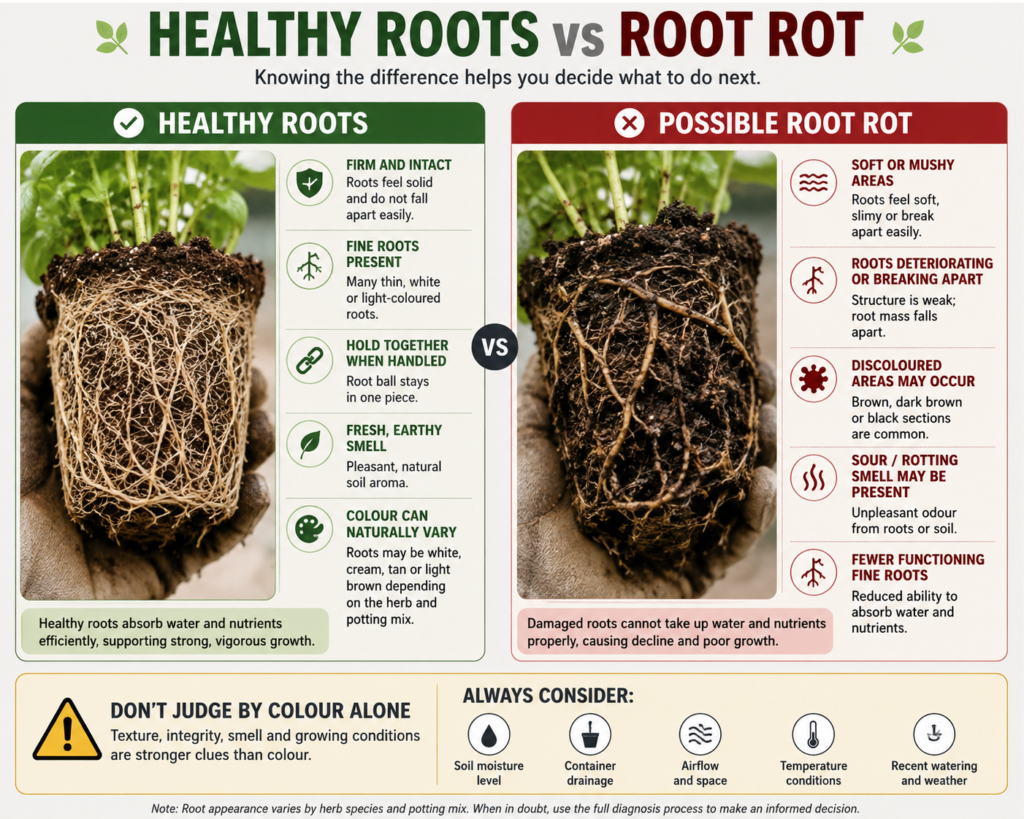
| Healthy Roots | Roots Affected by Root Rot |
|---|---|
| Generally firm and intact; colour varies by herb and growing medium | Discoloured areas may be present, often with soft or decaying tissue |
| Firm | Soft or mushy |
| Fresh earthy smell | Sour or rotten smell |
| Numerous fine roots | Few remaining healthy roots |
| Hold together when handled | Break apart easily |
Grow Herb Lab Tip: Healthy roots are surprisingly firm. If they feel slimy or collapse when touched, they are no longer functioning properly.
How to Inspect the Roots
- Gently support the base of the plant.
- Slide the root ball from the pot.
- Brush away excess soil carefully.
- Inspect the entire root system.
For herbs growing in garden beds:
Dig carefully around the root zone with a hand trowel, disturbing as little of the root system as possible.
Can My Herb Be Saved From Root Rot?
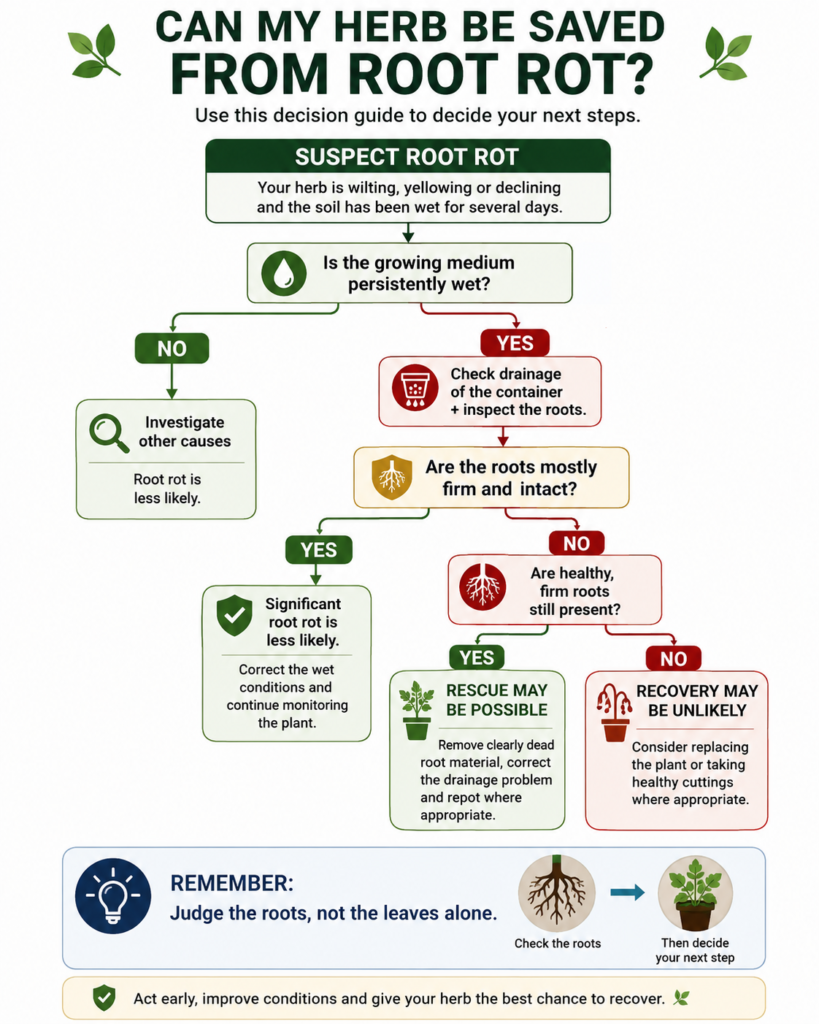
Better signs for recovery
- A meaningful amount of firm, healthy root tissue remains.
- Stems remain firm.
- Some healthy growth remains.
- The crown/base of the plant is not badly decayed.
Poorer signs for recovery
- Most roots are soft, mushy or badly decayed.
- The crown or main stem base is soft.
- The entire plant is collapsing.
- Strong decay is present throughout the root system.
Even in severe cases, it may be worth attempting recovery if the plant has sentimental value or is difficult to replace.
Treating Root Rot
The treatment depends on how advanced the damage is.
Mild Cases
- Stop watering immediately.
- Move the plant to a brighter, well-ventilated location if appropriate.
- Allow the soil to dry slightly.
- Resume watering only when needed.
Many herbs recover at this stage without further intervention.
Moderate Cases
Repotting is usually the best option.
Step-by-Step
- Remove the plant from its pot.
- Gently remove as much contaminated or waterlogged potting mix as practical without unnecessarily damaging healthy roots.
- Sterilise pruning scissors or secateurs.
- Remove all soft, black or mushy roots.
- Retain firm, intact healthy root tissue; root colour naturally varies.
- Repot into fresh, free-draining mix.
- Water lightly after repotting.
- Place the plant in a bright location out of harsh afternoon sun for several days while it recovers.
If most of the root system has died, recovery becomes difficult.
Severe Cases
In some situations, taking healthy stem cuttings and propagating a replacement plant is the best long-term solution.
This is particularly effective for herbs such as:
- Rosemary
- Mint
- Basil
- Oregano
- Thyme
Should You Use Fungicides?
For home gardeners, fungicides are rarely the first solution.
Root rot often begins because environmental conditions allow disease-causing organisms to thrive.
Unless these conditions are corrected, chemical treatments alone are unlikely to solve the problem.
Focus first on:
- Improving drainage.
- Correcting watering practices.
- Removing infected roots.
- Replacing contaminated potting mix where necessary.
Always follow product labels and local regulations if using any fungicide.
Prevention
Preventing root rot is much easier than treating it.
🌱 The Grow Herb Lab Prevention Checklist
- ✓ Use containers with drainage holes.
- ✓ Choose free-draining potting mixes.
- ✓ Water according to soil moisture—not the calendar.
- ✓ Empty saucers beneath pots.
- ✓ Match pot size to plant size.
- ✓ Improve drainage in heavy garden soils.
- ✓ Reduce watering during cool weather.
- ✓ Provide good airflow around plants.
These simple habits prevent the vast majority of root rot cases.
Signs Your Herb Is Recovering
Look for:
- Wilting gradually stabilising rather than worsening.
- Firm stems and crown.
- Healthy new shoots or leaves.
- No further spread of decay.
- Normal water use gradually returning.
- Eventual new root growth.
Recovery time varies. Judge progress by healthy new growth and stabilisation rather than expecting recovery within a fixed number of days.
Frequently Asked Questions
Can herbs recover from root rot?
Yes. Many can recover if the problem is identified early, the cause is corrected and enough healthy root tissue remains.
Should I fertilise after treating root rot?
No. Wait until the plant shows signs of healthy new growth before applying fertiliser. Feeding a stressed root system can make recovery more difficult.
Can root rot spread to other pots?
The organisms associated with root rot can move through contaminated soil, water or tools. Clean pots and sterilise cutting tools before using them on healthy plants.
Is root rot contagious in garden beds?
Disease-causing organisms can spread under favourable conditions, particularly in poorly drained soils. Improving drainage and removing severely affected plants can help reduce the risk.
Where to Go Next
Root rot is rarely an isolated problem. Watering, drainage, soil structure and the needs of the individual herb all work together.
Continue with these Grow Herb Lab guides:
💧 Improve Your Watering
Learn the Grow Herb Lab principle:
Water the Soil, Not the Calendar.
🍂 Diagnose Yellow Leaves
Why Are My Herb Leaves Turning Yellow?
Yellow leaves have several possible causes. Learn how to distinguish watering problems from other common issues.
🪴 Improve Drainage and Container Growing
Container choice, drainage and potting mix play a major role in preventing root problems.
🌱 Apply This to Individual Herbs
- The Complete Guide to Growing Basil
- The Complete Guide to Growing Rosemary
- The Complete Guide to Growing Mint
📥 Free Grow Herb Lab Resources
Keep these guides handy while caring for your herbs.
Final Thoughts
Root rot can quickly become fatal to a herb, but many cases begin with growing conditions that can be corrected.
The most important lesson is not simply to water less. It is to understand what is happening around the roots.
Healthy roots need an appropriate balance of moisture, oxygen and drainage. Learn to check the soil before watering, recognise the early warning signs and investigate the roots before assuming that root rot is the cause.
Correct those conditions early and you give the plant its best chance to recover—and greatly reduce the chance of the problem returning.