Introduction
Yellow leaves on herbs are one of the most common warning signs growers encounter.
They are also one of the easiest symptoms to misdiagnose.
A yellow leaf does not automatically mean your herb needs more water, fertiliser or sunlight. In fact, taking action before identifying the cause can sometimes make the problem worse.
Herb leaves can turn yellow because of:
• Too much water.
• Too little water.
• Poor drainage.
• Root problems.
• Insufficient light.
• Excessive heat or strong sunlight.
• Nutrient problems.
• Temperature stress.
• Pests or disease.
• Natural ageing of older leaves.
The important clue is not simply that a leaf has turned yellow.
It is where the yellowing occurs, how it develops and what else is happening to the plant.
This guide will help you work through those clues systematically so you can identify the most likely cause and decide what to do next.
🌿 Grow Herb Lab Quick Facts
Feature Details
Problem Type Symptom with multiple possible causes
Most Common Causes Watering, drainage, light and root stress
First Thing to Check Which leaves are yellow and whether the soil is wet or dry
Urgency Usually low to moderate, but rapid widespread yellowing requires investigation
Recovery Often possible once the underlying cause is corrected
Key Principle Diagnose the cause before treating the symptom
What Yellow Leaves Actually Mean
Yellowing occurs when a leaf loses or fails to maintain enough chlorophyll, the green pigment involved in photosynthesis.
The process is known as chlorosis.
However, chlorosis describes what is happening to the leaf — not why it is happening.
That distinction is important.
A herb may develop yellow leaves because its roots are sitting in saturated soil and cannot function properly.
Another herb may look almost identical because its soil has become extremely dry.
A third may be receiving insufficient light, while another may simply be shedding an old lower leaf as part of normal growth.
This is why diagnosing yellow leaves from colour alone is unreliable.
🌿 Grow Herb Lab Framework
Yellow Leaves Are a Clue — Not a Diagnosis
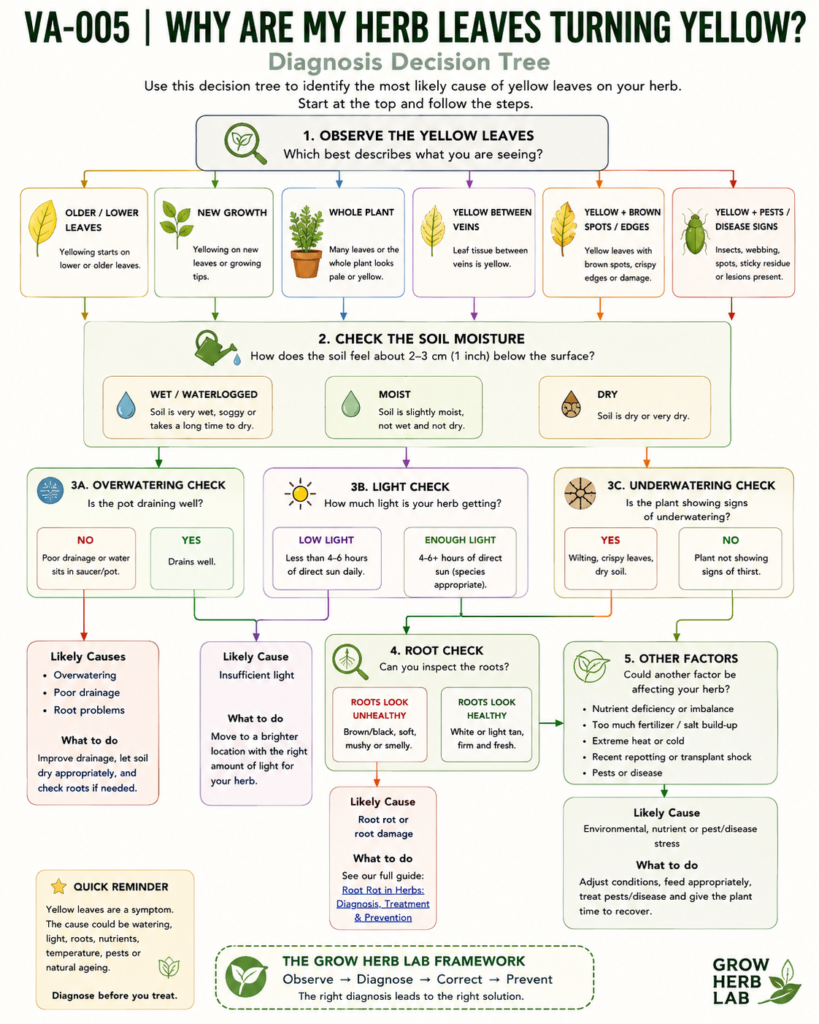
When yellowing appears, work through four stages:
Observe → Diagnose → Correct → Prevent
Before treating the plant, observe:
• Which leaves are turning yellow?
• Are they old leaves or new growth?
• Is the yellowing spreading?
• Is the entire leaf yellow or only certain areas?
• Is the soil wet, moist or dry?
• Are the stems firm?
• Are there brown spots, damaged edges or signs of pests?
• Has anything recently changed — watering, weather, position, potting mix or fertiliser?
The combination of these clues is far more useful than leaf colour by itself.
Grow Herb Lab Tip: Do not immediately water or fertilise a herb simply because its leaves are yellow. Check the plant and growing conditions first.
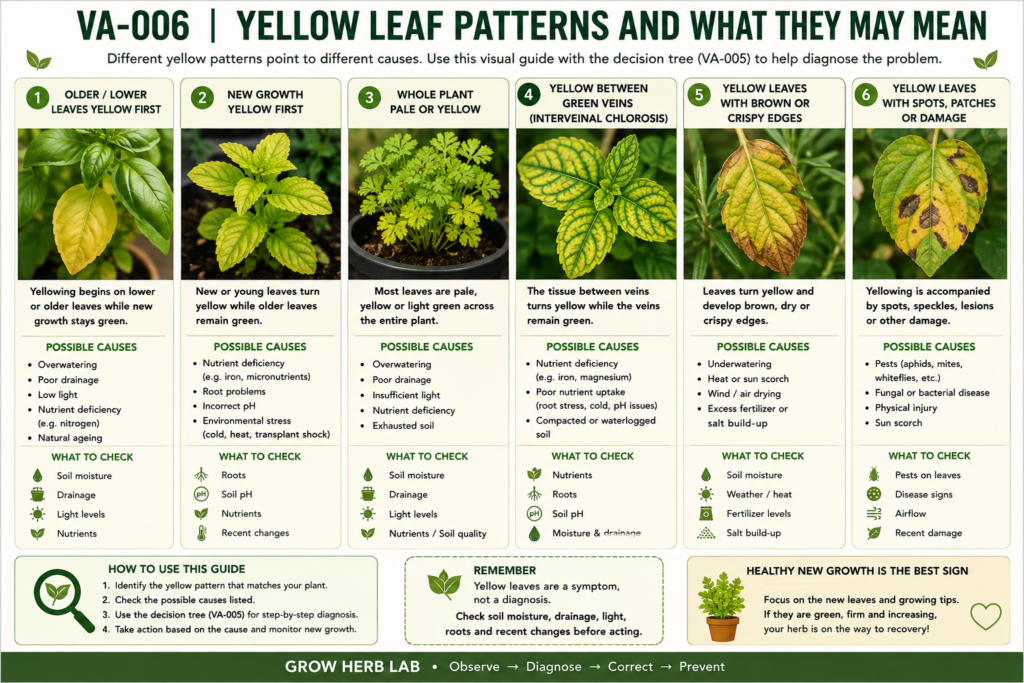
Start With the Yellowing Pattern
Before looking for a treatment, identify where the yellowing began.
This gives us the foundation for the diagnostic section that follows.
For example:
Older lower leaves turning yellow first may point towards natural ageing, prolonged moisture problems, insufficient light or certain nutrient issues.
Young or newly emerging leaves turning yellow can indicate a different group of problems, including nutrient availability, root dysfunction or environmental stress.
Yellowing across much of the plant suggests that the entire plant is under stress rather than a single ageing leaf.
Yellow tissue between greener veins creates another recognisable pattern known as interveinal chlorosis.
Yellow leaves accompanied by spots, damaged tissue, distorted growth or visible insects require us to investigate pests, disease or physical damage rather than assuming watering is responsible.
The pattern therefore becomes our first diagnostic filter.
Yellow Leaf Patterns and What They May Mean
The location and pattern of yellowing can help narrow down the possible cause.
Use the following as a diagnostic starting point rather than a final diagnosis.
| Yellowing Pattern | Possible Causes | What to Check First |
| Older lower leaves yellow first | Natural ageing, overwatering, low light, nutrient problems | Soil moisture, light levels and whether new growth remains healthy |
| New leaves yellow first | Nutrient availability, root problems, unsuitable soil pH or environmental stress | New growth, roots and recent changes |
| Most of the plant becomes pale or yellow | Persistent watering problems, poor drainage, inadequate light, root damage or nutrient problems | Soil moisture, drainage, roots and light |
| Yellow between green veins | Nutrient availability or uptake problems | Growing medium, fertilising history and root health |
| Yellow leaves with brown, dry edges | Underwatering, heat stress, excessive fertiliser or salt accumulation | Soil moisture, recent weather and fertilising |
| Yellow leaves with soft stems or persistently wet soil | Overwatering, poor drainage or root problems | Soil moisture, drainage holes and roots |
| Yellow leaves with spots or damaged patches | Disease, pests, sun damage or physical injury | Both sides of leaves, stems and growing conditions |
| One or two old leaves yellow while the plant remains healthy | Often normal ageing | Whether healthy new growth continues |
Important: These patterns overlap. Always consider the entire plant and its growing conditions before deciding on the cause.
The Most Common Causes of Yellow Leaves on Herbs
1. Overwatering
Overwatering is one of the first possibilities to investigate when herb leaves begin turning yellow.
The problem is not simply the amount of water applied at one time.
It is how long the growing medium remains excessively wet.
Roots need both moisture and oxygen. When soil remains saturated for extended periods, air spaces fill with water and root function can decline.
Possible signs include:
- Yellowing leaves.
- Persistently wet potting mix.
- Wilting despite wet soil.
- Slow or stalled growth.
- Soft stems near the soil surface.
- Leaf drop.
- An unpleasant smell from the growing medium in more advanced cases.
Do not assume every yellow plant is overwatered. Check the soil before deciding.
Grow Herb Lab Tip: If the soil is already wet, adding more water because the plant looks wilted may make the underlying problem worse.
2. Underwatering
Underwatering can also produce yellow leaves, which is one reason watering problems are easily confused.
When a plant cannot obtain enough moisture, it may sacrifice older foliage and reduce growth.
Look for:
- Dry growing medium.
- Wilting or drooping.
- Leaves becoming thin, crisp or brittle.
- Brown leaf margins.
- Pots feeling unusually light.
- Soil pulling away from the sides of the container.
- Rapid improvement in mild cases after appropriate watering.
A severely dried potting mix may also repel water initially, allowing water to run down the sides of the pot without properly moistening the root ball.
Check moisture below the surface rather than judging by appearance alone.
3. Poor Drainage and Root Problems
A herb can be watered at reasonable intervals and still remain too wet if excess water cannot escape.
Common causes include:
- Pots without adequate drainage holes.
- Water remaining in saucers or decorative outer pots.
- Heavy or compacted growing medium.
- Containers that are excessively large for the root system.
- Poorly drained garden soil.
- Compacted soil around the roots.
Persistent waterlogging can eventually damage roots and increase the risk of root rot.
If yellowing occurs alongside wet soil, declining growth, wilting or soft roots, inspect the root system.
Related guide: Root Rot in Herbs: The Complete Guide to Diagnosis, Treatment and Prevention
4. Too Little Light
Herbs require enough light to maintain healthy growth and photosynthesis.
When light levels are inadequate, plants may become:
- Pale or yellow-green.
- Leggy or stretched.
- Weak-stemmed.
- Slow growing.
- Sparse, with increasing gaps between leaves.
Older leaves may also be shed as the plant adjusts to reduced energy production.
Indoor herbs are particularly vulnerable when placed too far from a bright window or when seasonal light levels decline.
Different herbs have different light requirements, so assess the plant according to the species rather than applying one rule to every herb.
5. Excessive Sun and Heat Stress
More sunlight is not always better.
A herb suddenly moved from sheltered conditions into intense direct sun can suffer leaf damage before it has acclimatised.
Possible signs include:
- Pale or bleached areas.
- Yellowing.
- Dry brown patches.
- Crispy leaf edges.
- Wilting during intense heat.
- Damage concentrated on the most exposed leaves.
Recently purchased plants and indoor-grown herbs can be particularly susceptible to sudden exposure.
Gradually acclimatising plants to stronger sunlight reduces the risk.
6. Nutrient Problems
Yellow foliage is often blamed on nutrient deficiency, but fertiliser should not be the first treatment applied automatically.
A plant can have nutrients available in the soil and still struggle to absorb them if its roots are damaged, cold, waterlogged or otherwise stressed.
Possible nutrient-related patterns include:
- General pale growth.
- Older leaves yellowing before younger leaves.
- New leaves becoming unusually pale.
- Yellowing between greener leaf veins.
- Slow or weak growth.
The exact pattern can vary according to the nutrient involved and the herb species.
Before adding fertiliser, check:
- Watering.
- Drainage.
- Root condition.
- Light.
- Recent fertilising history.
Adding fertiliser to a plant with damaged roots can increase stress rather than solve the problem.
7. Overfertilising and Salt Build-Up
Too much fertiliser can also cause yellowing.
Excess soluble salts around the roots can interfere with water uptake and damage sensitive root tissue.
Possible signs include:
- Brown or scorched leaf tips.
- Yellowing.
- Wilting.
- Stunted growth.
- A white or crusty deposit on the soil surface or around the pot.
- Symptoms appearing after fertilising.
Never assume that a pale plant simply needs a stronger dose of fertiliser.
More fertiliser is not always more nutrition.
8. Temperature Stress
Herbs differ considerably in their temperature preferences.
Sudden cold, prolonged cool conditions, extreme heat or rapid temperature changes can interfere with normal growth.
Temperature stress may cause:
- Yellowing.
- Wilting.
- Leaf drop.
- Slower growth.
- Damaged or darkened foliage in severe cold.
Temperature can also affect watering indirectly.
During cooler weather, many herbs grow more slowly and use less water. If watering frequency remains unchanged, the growing medium may stay wet much longer.
9. Transplant or Repotting Stress
Herbs can temporarily develop yellow leaves after transplanting or repotting.
Moving a plant disturbs its root system and changes the conditions around the roots. Even when repotting is necessary, the plant may need time to adjust.
Possible signs include:
• Yellowing shortly after repotting or transplanting.
• Temporary wilting.
• Slower growth.
• Older leaves dropping.
• No obvious signs of pests, disease or severe root rot.
Avoid repeatedly moving, fertilising or repotting the plant while it is recovering. Keep the growing conditions appropriate for the herb and monitor the new growth.
Grow Herb Lab Tip: If yellowing began soon after repotting, consider transplant stress before making further major changes.
10. Natural Leaf Ageing
Not every yellow leaf indicates a problem.
Leaves have a limited lifespan.
An established herb may occasionally allow an older lower leaf to yellow and fall while healthy new growth continues elsewhere.
Natural ageing is more likely when:
- Only a small number of older leaves are affected.
- New growth looks healthy.
- The plant continues growing normally.
- Soil moisture and drainage are appropriate.
- No other symptoms are developing.
Removing an ageing leaf is fine, but there is usually nothing else to treat.
The key distinction is isolated ageing versus progressive yellowing.
11. Pests and Disease
Yellowing can sometimes result from insects, mites or disease.
Look closely for:
- Fine webbing.
- Sticky residue.
- Small insects.
- Distorted new growth.
- Speckled or mottled leaves.
- Brown, black or water-soaked spots.
- Unusual lesions.
- Yellowing concentrated around damaged areas.
Inspect both sides of the leaves as well as stems and growing tips.
Do not assume that every spotted yellow leaf has a disease. Physical injury, sun damage and environmental stress can produce similar symptoms.
🌿 Grow Herb Lab Framework: Diagnose Before You Treat
When a herb develops yellow leaves, resist the temptation to immediately:
- Water it.
- Fertilise it.
- Move it into full sun.
- Repot it.
- Apply a pesticide or fungicide.
Each of those actions can be appropriate when the diagnosis supports it.
The correct first step is:
Observe → Check moisture → Check drainage → Check light → Examine the plant → Investigate the roots if necessary
That sequence eliminates many of the most common causes without guesswork.
Yellow Leaves Quick Diagnosis
| What You Notice | Investigate First |
| Yellow leaves + wet soil | Overwatering and drainage |
| Yellow leaves + very dry soil | Underwatering |
| Yellow leaves + wet soil + wilting | Root stress or root rot |
| Pale, stretched growth | Insufficient light |
| Bleached or crispy exposed leaves | Excessive sun or heat |
| Yellowing after fertilising | Excess fertiliser or salt build-up |
| Yellowing soon after repotting or transplanting | Transplant or repotting stress |
| Older leaves yellowing while new growth is healthy | Natural ageing or growing-condition issue |
| Yellowing between greener veins | Nutrient availability or root uptake |
| Yellowing + insects, webbing or sticky residue | Pests |
| Yellowing + spreading spots or lesions | Disease or environmental damage |
| Rapid yellowing across much of the plant | Investigate watering, roots and environmental stress promptly |
Important: Yellow leaves are a symptom. The combination of leaf pattern + soil condition + root health + growing environment provides the diagnosis.
Yellow Leaves by Herb
Different herbs respond differently to moisture, light and growing conditions. The same yellow-leaf symptom can therefore have very different causes depending on the herb.
Use the following as a quick diagnostic guide.
Basil Leaves Turning Yellow
Basil prefers consistent moisture but dislikes waterlogged soil.
Most likely causes:
- Overwatering or poor drainage.
- Soil remaining constantly wet.
- Insufficient light.
- Nutrient depletion in older potting mix.
- Cold temperatures.
- Root stress after transplanting.
Check first: Feel the soil below the surface. If it is consistently wet and the lower leaves are yellowing, investigate watering and drainage before adding fertiliser.
Basil is particularly sensitive to cold conditions. Sudden yellowing can occur when temperatures drop or plants are exposed to cold draughts.
Related guide: The Complete Guide to Growing Basil
Rosemary Leaves Turning Yellow
Rosemary is considerably more tolerant of dry soil than constantly wet soil.
For this reason, yellowing rosemary should immediately prompt a drainage and moisture check.
Most likely causes:
- Overwatering.
- Poorly draining soil.
- Insufficient sunlight.
- Root problems caused by persistent moisture.
- Excess fertiliser.
Check first: Is the soil staying wet for long periods?
Rosemary roots need excellent drainage and good aeration. Do not automatically water a yellowing rosemary plant unless the soil actually needs it.
If yellowing is accompanied by declining growth and persistently wet soil, inspect for root problems.
Related guide: The Complete Guide to Growing Rosemary
Mint Leaves Turning Yellow
Mint generally tolerates more moisture than Mediterranean herbs such as rosemary and thyme.
However, moisture-tolerant does not mean waterlogged.
Most likely causes:
- Excessively wet or poorly drained soil.
- Severe drying between watering.
- Nutrient depletion.
- Crowded roots.
- Insufficient light.
- Natural ageing of older leaves.
Check first: Determine whether the soil is consistently moist or actually saturated.
Container-grown mint can also become extremely root-bound because of its vigorous growth. If watering and light appear appropriate but growth is declining, inspect the root system.
Related guide: The Complete Guide to Growing Mint
Parsley Leaves Turning Yellow
Parsley prefers reasonably even moisture and can yellow when conditions fluctuate significantly.
Most likely causes:
- Overwatering.
- Repeatedly drying out.
- Poor drainage.
- Nutrient depletion.
- Heat stress.
- Ageing foliage.
Check first: Look for consistency in soil moisture.
Older outer parsley leaves naturally deteriorate over time. A few yellow outer leaves on an otherwise vigorous plant are usually less concerning than widespread yellowing affecting new growth.
Thyme Leaves Turning Yellow
Thyme prefers relatively dry, free-draining conditions.
Persistent moisture is therefore one of the first things to investigate when thyme begins yellowing.
Most likely causes:
- Overwatering.
- Poor drainage.
- Heavy soil.
- Insufficient sunlight.
- Excessive fertiliser.
Check first: Soil moisture and drainage.
Thyme should not be managed using the same watering routine as moisture-loving herbs. Allowing the growing medium to dry appropriately between watering is important.
Oregano Leaves Turning Yellow
Oregano shares many growing preferences with thyme and rosemary.
It generally performs best in strong light and free-draining soil.
Most likely causes:
- Excessive watering.
- Poor drainage.
- Insufficient sunlight.
- Dense or compacted soil.
- Excess fertiliser.
Check first: Whether the root zone remains wet for extended periods.
Established oregano generally copes better with slightly dry conditions than persistently saturated roots.
Sage Leaves Turning Yellow
Sage dislikes prolonged wet conditions and can deteriorate when planted in heavy or poorly drained soil.
Most likely causes:
- Overwatering.
- Waterlogged soil.
- Poor airflow.
- Insufficient sunlight.
- Root disease.
- Natural ageing of older leaves.
Check first: Drainage and soil moisture.
If the plant is yellowing while the soil remains wet, resist the temptation to add more water or fertiliser.
Chive Leaves Turning Yellow
Chives tolerate reasonably moist conditions but still require adequate drainage.
Yellowing can sometimes be part of the plant’s normal growth cycle rather than evidence of a serious problem.
Most likely causes:
- Older leaves naturally dying back.
- Underwatering.
- Excess moisture.
- Nutrient depletion.
- Heat or cold stress.
- Crowded containers.
Check first: Determine whether only older outer leaves are affected.
If fresh growth remains green and vigorous, removing ageing yellow leaves may be all that is required.
Lavender Leaves Turning Yellow
Lavender is particularly sensitive to persistent moisture around its roots.
Yellowing combined with wet soil should therefore be treated as an important warning sign.
Most likely causes:
- Overwatering.
- Poor drainage.
- Heavy soil.
- Insufficient sunlight.
- High humidity combined with poor airflow.
- Root deterioration.
Check first: Soil drainage and moisture.
Lavender generally requires excellent drainage and should not be kept constantly moist.
If the plant is declining rapidly and the root zone remains wet, inspect the roots before assuming it needs fertiliser.
Quick Comparison
| Herb | First Thing to Check | Common Yellowing Cause |
| Basil | Soil moisture | Overwatering |
| Rosemary | Drainage | Persistently wet soil |
| Mint | Moisture balance | Too wet or too dry |
| Parsley | Moisture consistency | Watering stress |
| Thyme | Drainage | Overwatering |
| Oregano | Soil moisture | Excess moisture |
| Sage | Drainage | Waterlogged soil |
| Chives | Which leaves are yellow | Natural ageing/watering |
| Lavender | Drainage | Persistent moisture |
Grow Herb Lab Tip
Do not water every herb according to the same schedule.
A watering routine that keeps basil healthy could leave rosemary, thyme or lavender sitting too wet.
The plant species, growing medium, container, temperature, sunlight and season all influence how quickly the root zone dries.
That is why the better rule remains:
Water the soil, not the calendar.
What to Do When Herb Leaves Turn Yellow
Once you have identified the most likely cause of yellowing, the next step is correcting the growing conditions without creating additional stress.
The key is to change only what needs changing.
Do not automatically water, fertilise or repot a yellowing herb.
Step 1 — Check the Soil Before Watering
Push a finger into the growing medium below the surface.
Ask:
- Is it wet?
- Slightly moist?
- Very dry?
- Has it remained wet for several days?
If the soil is still wet, do not add more water simply because the leaves are yellow.
If it is excessively dry and the plant is wilting, watering may be appropriate.
For container-grown herbs, lifting the pot can also help. A dry pot is usually noticeably lighter than a recently watered one.
Grow Herb Lab Rule: Never diagnose watering problems from the leaves alone. Check the soil.
Step 2 — Check the Drainage
If the soil remains wet for too long, determine why.
Check that:
- The container has drainage holes.
- Drainage holes are not blocked.
- Water is not accumulating in a saucer.
- Decorative outer pots are not holding water.
- The potting mix drains freely.
- The container is not excessively large for the plant.
For herbs growing in the ground, consider whether heavy or compacted soil is trapping water around the roots.
Correcting the drainage problem is more important than simply watering less.
Step 3 — Check the Light
Consider whether the plant is receiving enough light for its species.
A herb growing in inadequate light may:
- Become pale or yellow.
- Produce weak stems.
- Stretch towards a light source.
- Develop increasingly sparse growth.
Move the plant to more suitable conditions gradually.
Do not move a shade-grown or indoor plant immediately into intense afternoon sun. Sudden exposure can scorch foliage and create another problem.
Step 4 — Inspect the Roots When Necessary
You do not need to remove every yellowing herb from its pot.
Root inspection becomes appropriate when:
- The soil remains persistently wet.
- The plant continues declining despite correcting watering.
- Stems are becoming soft.
- The plant has a sour or rotten smell.
- You suspect root rot.
- The container appears severely root-bound.
Healthy roots should generally be firm and intact.
Soft, mushy or badly decayed roots indicate a more serious problem.
Related guide: Root Rot in Herbs: Diagnosis, Treatment & Prevention
Step 5 — Decide Whether Repotting Is Necessary
Repotting can help when the growing medium itself is causing the problem.
Consider repotting if:
- The potting mix remains waterlogged.
- Drainage is inadequate.
- The roots are badly congested.
- Root rot requires removal of damaged tissue.
- The growing medium has deteriorated or compacted.
Do not repot simply because one or two leaves have turned yellow.
Repotting disturbs the roots and can temporarily increase plant stress.
When repotting is necessary, use fresh, appropriate, free-draining growing medium and a container with adequate drainage.
Step 6 — Be Careful With Fertiliser
Yellow leaves often make gardeners reach for fertiliser.
That can be a mistake.
Do not fertilise immediately if the plant is:
- Waterlogged.
- Severely wilted.
- Suffering root damage.
- Recently repotted.
- Experiencing extreme heat or cold.
- Showing signs of fertiliser burn.
Damaged roots may be unable to use additional nutrients effectively.
First correct the environmental problem and allow the plant to stabilise.
If nutrient depletion is genuinely likely, fertilise according to the needs of the individual herb rather than applying an unnecessarily strong dose.
More fertiliser does not mean faster recovery.
Step 7 — Remove Yellow Leaves When Appropriate
A fully yellow leaf will not normally become green again.
Removing badly yellowed, dead or diseased foliage can:
- Improve appearance.
- Improve airflow.
- Make new symptoms easier to monitor.
- Remove badly damaged tissue.
However, there is no need to strip every imperfect leaf from a stressed plant.
If a leaf still contains substantial healthy green tissue, it may still be contributing to photosynthesis.
Use clean scissors or secateurs when removing foliage rather than tearing stems unnecessarily.
Step 8 — Give the Herb Time to Respond
After correcting the likely cause, avoid repeatedly changing the growing conditions.
Do not:
- Water again unnecessarily.
- Add several treatments at once.
- Continually move the plant.
- Fertilise because recovery is not immediate.
- Repot repeatedly.
Instead, monitor the new growth.
Old yellow leaves may remain yellow even after the original problem has been corrected.
The better question is:
What is the plant doing now?
Signs the Herb Is Recovering
Look for:
- New green growth.
- Firm stems.
- Yellowing no longer spreading.
- Normal water use returning.
- Improved leaf firmness.
- Healthy new roots where visible.
Recovery time varies according to the herb, season and severity of the original problem.
Judge progress by stabilisation and healthy new growth rather than expecting damaged leaves to return to normal.
When the Herb May Not Recover
Recovery becomes less likely when:
- Most of the root system has rotted.
- The crown or main stem base is badly decayed.
- Stems are collapsing.
- Very little healthy foliage remains.
- Decay continues spreading after conditions are corrected.
If healthy stem material remains, propagation may sometimes be a better option than trying to save the original root system.
Basil, mint, rosemary, oregano and thyme can often be propagated from suitable healthy cuttings.
Yellow Leaves: Quick Action Table
| What You Find | What to Do |
| Soil very dry | Water thoroughly if appropriate for the herb |
| Soil constantly wet | Stop watering and investigate drainage |
| Water sitting beneath pot | Empty it and correct drainage |
| Plant stretching towards light | Gradually increase appropriate light |
| Roots soft or mushy | Treat as possible root rot |
| Plant severely root-bound | Consider repotting |
| Yellowing after fertilising | Stop fertilising and investigate salt/fertiliser damage |
| Only a few old leaves yellow | Monitor before taking drastic action |
| New growth healthy | Give the plant time to recover |
| Plant continues deteriorating | Reassess diagnosis and inspect roots |
Grow Herb Lab Recovery Principle
When a herb turns yellow, resist the temptation to do everything at once.
The better approach is:
Observe → Diagnose → Correct the cause → Monitor new growth This gives the plant a much better chance of recovery and makes it easier to determine whether your diagnosis was correct.
Preventing yellow leaves is usually easier than correcting a badly stressed herb.
The goal is not to keep every leaf perfectly green forever. Older leaves naturally age and die. The goal is to provide conditions that allow the plant to continually produce healthy new growth.
How to Prevent Yellow Leaves on Herbs
🌱 The Grow Herb Lab Prevention Checklist
✓ Check the soil before watering.
✓ Use containers with adequate drainage holes.
✓ Choose a free-draining potting mix appropriate for the herb.
✓ Never leave pots sitting permanently in water.
✓ Give each herb the appropriate amount of sunlight.
✓ Avoid using the same watering schedule for every herb.
✓ Reduce watering when growth and evaporation slow.
✓ Fertilise according to the plant’s needs rather than automatically.
✓ Inspect leaves regularly for pests and disease.
✓ Remove dead or badly damaged foliage when appropriate.
✓ Provide adequate airflow around plants.
✓ Check roots when a plant continues declining despite apparently correct care.
Small, regular observations usually identify problems before serious yellowing develops.
Seasonal Yellowing: When It May Be Normal
Not every yellow leaf indicates a problem.
Herbs respond to changes in temperature, daylight, growth rate and season.
Cooler Weather
As temperatures fall, many herbs grow more slowly.
Slower growth means:
- The plant may use less water.
- Potting mix may remain wet longer.
- Older foliage may deteriorate.
- Nutrient uptake may slow.
This makes overwatering particularly easy during cooler weather.
A watering routine that worked during summer may be excessive in winter.
Hot Weather
During hot conditions, herbs can lose water rapidly.
Container-grown plants are particularly vulnerable because the relatively small volume of growing medium can dry quickly.
Heat stress may cause:
- Wilting.
- Yellowing.
- Brown leaf edges.
- Leaf drop.
- Slower growth during extreme heat.
Check the soil rather than assuming every wilted plant needs water. Plants can also wilt when roots are damaged by excessive moisture.
Changes in Day Length
Reduced daylight can slow plant growth even when temperatures remain relatively mild.
Indoor herbs are particularly affected by seasonal changes in available light.
Watch for:
- Pale foliage.
- Weak or stretched growth.
- Slower production of new leaves.
- Soil remaining wet longer than usual.
Adjust watering to the plant’s changing growth rate.
When Yellow Leaves Are Normal
A few yellow leaves are not necessarily a reason for concern.
Normal ageing is more likely when:
- Only the oldest leaves are affected.
- New growth remains healthy and green.
- Stems remain firm.
- The plant continues growing normally.
- Yellowing is not rapidly spreading.
Plants continually replace older foliage.
Removing an occasional old yellow leaf is part of normal plant maintenance.
When Yellow Leaves Need Attention
Investigate further when:
- Many leaves turn yellow at once.
- Yellowing spreads rapidly.
- New leaves are affected.
- The plant stops growing.
- Stems become soft or collapse.
- Leaves yellow while the soil remains constantly wet.
- Yellowing is accompanied by spots, pests or distorted growth.
- The plant develops an unpleasant smell around the root zone.
These signs suggest something more significant than ordinary leaf ageing.
Frequently Asked Questions
Should I Remove Yellow Leaves From My Herbs?
Usually, fully yellow, dead or badly damaged leaves can be removed.
They are unlikely to become green again.
However, avoid stripping large amounts of foliage from an already stressed plant. Leaves containing substantial healthy green tissue can still contribute to photosynthesis.
Use clean scissors or secateurs where necessary.
Can Yellow Herb Leaves Turn Green Again?
Usually, a leaf that has become completely yellow will not return to healthy green growth.
Some mild chlorosis caused by a temporary nutrient or environmental problem may improve, but the better indicator of recovery is healthy new growth.
Concentrate on correcting the cause rather than trying to restore individual damaged leaves.
Do Yellow Leaves Mean I Am Overwatering?
Sometimes — but not always.
Overwatering is a common cause of yellow leaves, particularly when the soil remains persistently wet.
However, yellowing can also result from:
- Underwatering.
- Poor drainage.
- Insufficient light.
- Nutrient problems.
- Temperature stress.
- Root damage.
- Pests or disease.
- Natural ageing.
Always check the growing conditions before deciding on treatment.
Can Underwatering Cause Yellow Leaves?
Yes.
Repeated or severe dehydration can cause leaves to yellow, dry and eventually fall.
Underwatered herbs commonly have dry growing medium and may develop wilted, crisp or brittle foliage.
Check the soil before deciding whether lack of water is responsible.
Should I Fertilise a Herb With Yellow Leaves?
Not automatically.
If the plant is waterlogged, root-damaged, recently repotted or otherwise severely stressed, fertilising may make the situation worse.
Correct moisture, drainage and light problems first.
Only fertilise when there is a reasonable reason to suspect nutrient depletion and the root system is healthy enough to use the nutrients.
Why Are the Bottom Leaves of My Herb Turning Yellow?
Older lower leaves naturally yellow and die as plants grow.
However, widespread lower-leaf yellowing can also occur with watering problems, insufficient light or nutrient deficiencies.
Look at the entire plant.
If new growth is vigorous and only an occasional older leaf turns yellow, the plant may simply be replacing old foliage.
Why Are the New Leaves Turning Yellow?
Yellowing new growth deserves closer investigation.
Possible causes include:
- Nutrient availability problems.
- Root stress.
- Incorrect soil conditions.
- Excess moisture.
- Certain pests or diseases.
If the tissue between the veins becomes yellow while the veins remain greener, nutrient availability may be involved.
Do not diagnose a deficiency from leaf colour alone. Check the roots, soil moisture and growing conditions first.
Why Are My Potted Herbs Turning Yellow?
Container-grown herbs commonly yellow because of problems involving the root environment.
Check:
- Soil moisture.
- Drainage holes.
- Water trapped inside an outer pot or saucer.
- Potting mix condition.
- Root congestion.
- Available sunlight.
- Recent fertilising.
Potted plants depend entirely on the environment inside their container, so small problems can become significant relatively quickly.
Why Are My Indoor Herbs Turning Yellow?
Indoor herbs frequently struggle because of insufficient light combined with excessive watering.
Lower indoor light usually means slower growth and slower water use.
As a result, the potting mix may remain wet considerably longer than expected.
Before watering an indoor herb, check the growing medium rather than relying on a fixed schedule.
Is a Yellow Leaf Always Dying?
A completely yellow leaf is usually nearing the end of its useful life.
The important question is not whether one leaf is dying but why it turned yellow.
An occasional ageing leaf is normal.
Multiple yellow leaves appearing together indicate that the plant’s growing conditions deserve investigation.
The Grow Herb Lab Yellow Leaf Rule
When you see yellow leaves, don’t immediately reach for the watering can or fertiliser.
Start with four questions:
Where is the yellowing?
How wet is the soil?
Are the roots draining properly?
What changed recently? Those four checks will eliminate many of the most common causes before unnecessary treatment begins.
Where to Go Next
Yellow leaves are often the first visible sign that something in a herb’s growing environment needs attention.
Once you have identified the likely cause, use the following Grow Herb Lab guides to solve the underlying problem.
💧 Improve Your Watering
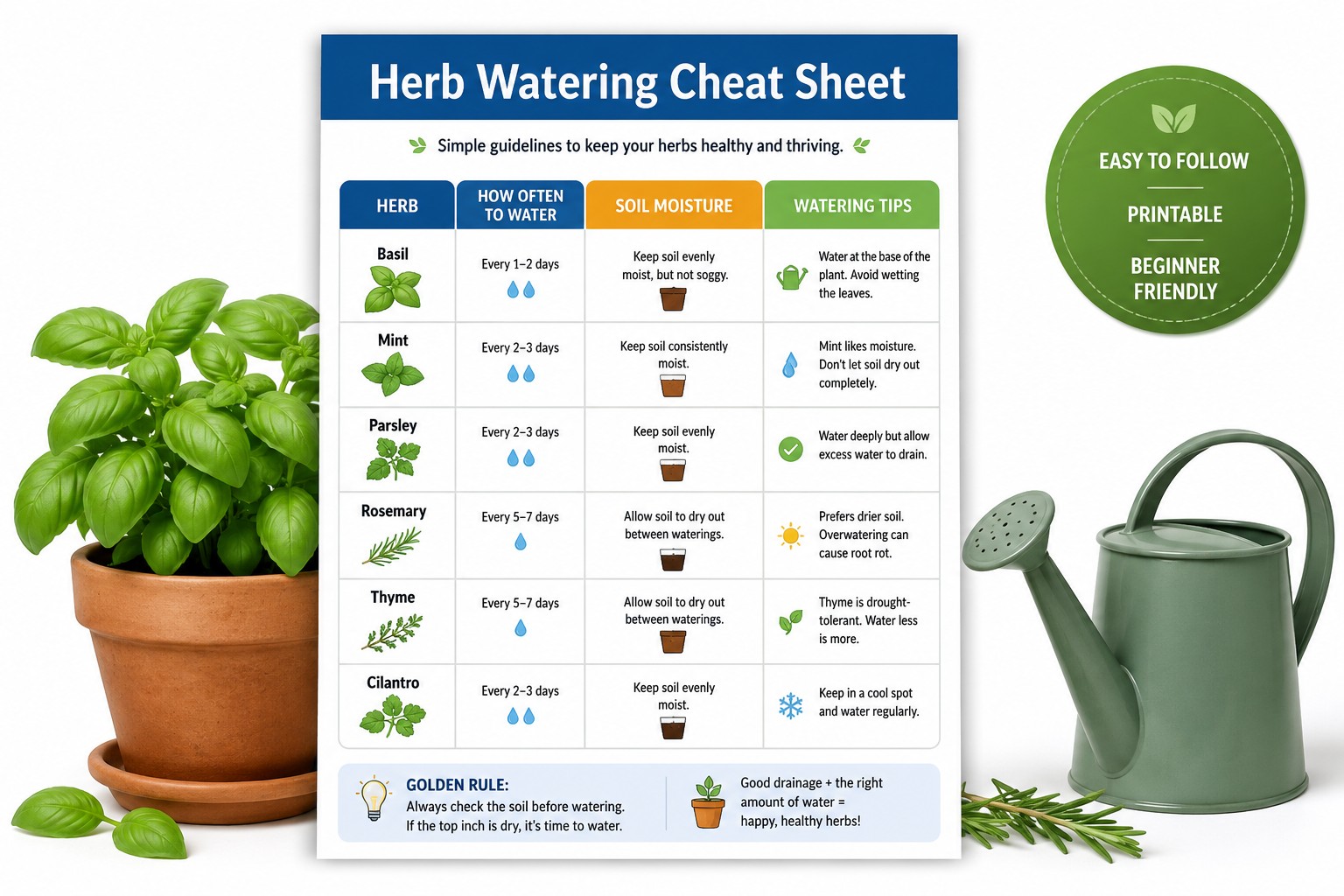
Different herbs have different moisture requirements.
Use the watering reference to understand which herbs prefer consistent moisture and which should dry more between watering.
Remember the Grow Herb Lab principle:
Water the soil, not the calendar.
🌱 Suspect Root Problems?
Root Rot in Herbs: The Complete Guide to Diagnosis, Treatment and Prevention
If your herb has yellow leaves combined with persistently wet soil, wilting, soft roots or declining growth, investigate the root system.
The Root Rot guide explains how to:
- Distinguish healthy roots from damaged roots.
- Inspect a plant safely.
- Decide whether the herb can be rescued.
- Treat mild, moderate and severe root problems.
- Prevent the problem from returning.
🪴 Improve Container Growing
Poor container drainage, inappropriate pot size and unsuitable potting mix can all contribute to yellow leaves.
Use the container-growing guide to improve the environment around the roots.
🌿 Diagnose Your Individual Herb
Growing requirements vary considerably between herbs.
Continue with the relevant Grow Herb Lab authority guide:
- The Complete Guide to Growing Basil
- The Complete Guide to Growing Rosemary
- The Complete Guide to Growing Mint
📥 Free Grow Herb Lab Resources
Use the resources currently available on Grow Herb Lab:
Keep these guides handy while caring for your herbs.
Final Thoughts
Yellow leaves are useful warning signs, but they do not tell you the cause by themselves.
The biggest mistake is reacting immediately:
More water. More fertiliser. More sunlight. A bigger pot.
Any of those actions could help the right plant — or make the wrong diagnosis worse.
Instead, look at the evidence.
Start with the pattern of yellowing.
Check the soil.
Check drainage.
Consider the light, temperature and recent changes.
Inspect the roots when the symptoms justify it.
Then correct the most likely underlying cause and monitor new growth rather than expecting damaged leaves to become perfect again.
The central lesson is simple:
Yellow leaves are a clue — not a diagnosis.
Learn to read that clue and you will not only become better at rescuing struggling herbs; you will become better at recognising problems before serious damage occurs.