Introduction
Overwatering and underwatering can produce surprisingly similar symptoms in herbs.
A wilted plant may look desperately thirsty, but adding more water can make the problem worse if its roots are already sitting in saturated soil. Yellow leaves can develop when a herb is too wet, but they can also appear when the root zone has become excessively dry.
That is why diagnosing watering problems from the leaves alone is unreliable.
The key is to examine the plant and root zone together.
Look at:
- How wet or dry the growing medium actually is.
- Whether the pot drains freely.
- How long the soil has remained wet or dry.
- Whether leaves feel soft, limp, dry or crispy.
- Whether stems remain firm.
- Whether roots appear healthy.
- Recent heat, sunlight, rain or temperature changes.
- Whether the symptoms improve or worsen after watering.
This guide will help you distinguish between an underwatered herb and an overwatered herb, so you can respond appropriately instead of making the problem worse.
Grow Herb Lab Principle: Never diagnose a watering problem from wilting or yellow leaves alone. Check the root zone first.
Quick Facts — Overwatering vs Underwatering Herbs
| Question | Quick Answer |
|---|---|
| Can overwatering and underwatering look similar? | Yes. Both can cause wilting, yellowing, leaf drop and poor growth. |
| What should I check first? | Check moisture below the soil surface before adding more water. |
| What usually suggests underwatering? | Very dry growing medium, a light pot, dry or crispy foliage and improvement after appropriate watering. |
| What usually suggests overwatering? | Persistently wet growing medium, a heavy pot, soft or yellowing growth, declining root health or worsening symptoms despite wet soil. |
| Can an overwatered herb wilt? | Yes. Waterlogged roots can lose the ability to function properly, causing the plant to wilt even though moisture is present. |
| Should I water a wilted herb immediately? | No. Check the growing medium first. |
| Are yellow leaves proof of overwatering? | No. Yellow leaves have several possible causes and need to be diagnosed with other symptoms. |
| Should I repot an overwatered herb immediately? | Not automatically. Repotting can add further stress and is most useful when drainage, growing medium or root health requires intervention. |
| Can hot weather cause confusing symptoms? | Yes. Heat stress can cause temporary wilting even when soil moisture is adequate. |
| What is the main diagnostic rule? | Soil moisture + root condition + plant symptoms + recent conditions provide the diagnosis. |
Why Too Much Water Can Look Like Too Little Water
Herb roots require both moisture and oxygen.
When growing medium remains saturated for too long, the air spaces around the roots fill with water. Root function can decline, reducing the plant’s ability to take up the moisture and nutrients it needs.
The result can be confusing:
The soil is wet, yet the plant wilts.
A grower sees the wilting and assumes:
“It needs more water.”
More water is added.
The root zone remains saturated for longer.
The plant declines further.
Underwatering creates a different problem—the roots simply do not have enough available moisture—but some of the visible symptoms can look remarkably similar.
That is why the first question should not be:
“Does this plant look thirsty?”
It should be:
“What is happening in the root zone?”
Signs a Herb May Be Underwatered
Possible signs include:
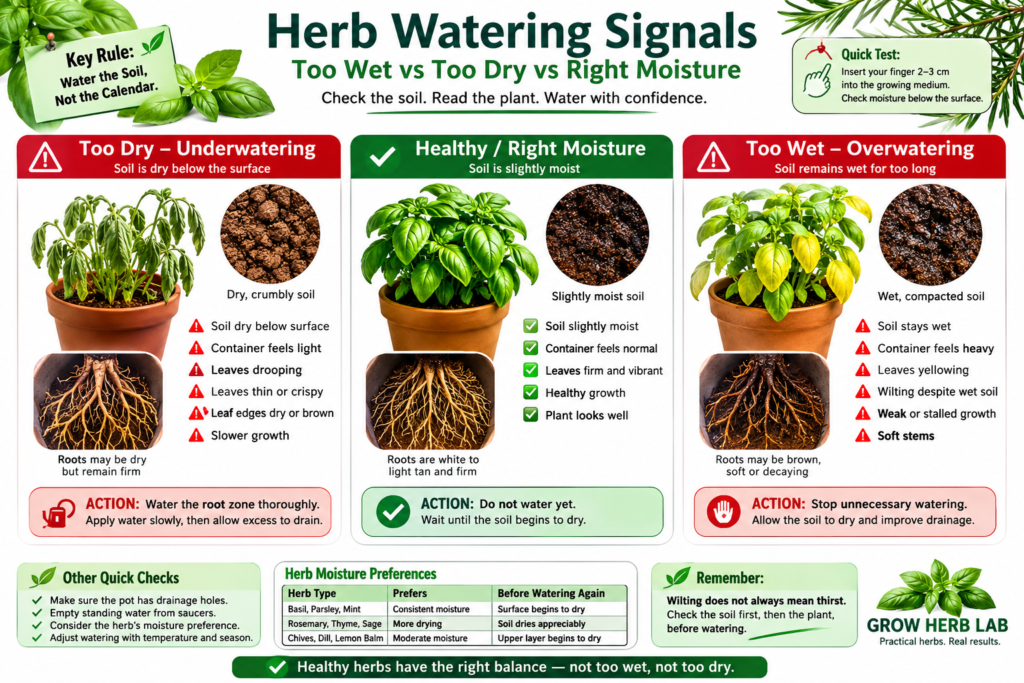
- Dry growing medium below the surface.
- A container that feels unusually light.
- Drooping or wilting leaves.
- Leaves becoming thin or limp.
- Dry or crispy leaf edges.
- Brown leaf margins.
- Slower growth.
- Leaf drop during prolonged stress.
- Potting mix pulling away from the container edges.
- Rapid improvement after appropriate watering.
The strongest clue is usually the combination of plant stress and a genuinely dry root zone.
Signs a Herb May Be Overwatered
Possible signs include:
- Growing medium remaining wet for prolonged periods.
- A container that stays unusually heavy.
- Yellowing leaves.
- Wilting despite wet soil.
- Weak or stalled growth.
- Soft leaves or stems.
- Leaf drop.
- Algae or persistent moisture on the growing-medium surface.
- An unpleasant or sour smell from the potting mix in advanced cases.
- Soft, brown, darkened or deteriorating roots.
Again, no single symptom proves overwatering.
The condition of the root zone is critical.
Too Wet vs Too Dry — Quick Comparison
| What to Check | Too Dry | Too Wet |
| Growing medium | Dry below surface | Persistently moist, wet or saturated |
| Pot weight | Light | Heavy for an extended period |
| Wilting | Common | Also possible |
| Leaves | May become thin, dry or crispy | May become yellow, soft or weak |
| Leaf edges | Often dry or brown | No consistent edge pattern; assess with other symptoms |
| Growth | Slows during prolonged drought | Weak, stalled or declining |
| Stems | Usually remain firm initially | May soften in advanced cases |
| Roots | May become dry or stressed but often remain firm | May become brown, soft or decayed |
| Smell | Usually normal | Sour/unpleasant smell may occur |
| After watering | Often improves if damage is not severe | Additional watering may worsen symptoms |
Important: Symptoms vary between herb species and according to how advanced the problem has become.
Use this table as a diagnostic guide rather than a definitive test.
The Soil Test Comes First
If a herb is wilting, your first response should not be:
Water it.
Your first response should be:
Check the soil.
If the root zone is dry
Underwatering becomes more likely.
Consider:
- How dry the growing medium has become.
- Whether the container feels light.
- Whether weather has recently become hotter or windier.
- Whether the herb prefers consistent moisture.
- Whether the pot is too small for the plant.
If the evidence supports dryness, water appropriately.
If the root zone is wet
Do not automatically add more water.
Investigate:
- Drainage holes.
- Standing water.
- Pot size.
- Growing-medium structure.
- Recent rainfall.
- Reduced light or temperature.
- Root condition if symptoms are serious.
Persistent wetness combined with declining plant health requires further investigation.
Check the Roots When the Evidence Points Below Ground
You do not need to remove every slightly wilted herb from its pot.
Unnecessary disturbance can create additional stress.
However, inspecting the roots may be justified when a plant is deteriorating and you see several warning signs together, such as:
- Persistent wet soil.
- Increasing yellowing.
- Wilting despite moisture.
- Soft stems.
- Declining growth.
- Unpleasant smell.
- Suspected root rot.
Healthy roots vary between species, but they should generally be firm and structurally intact.
Damaged roots may appear:
- Brown or darkened.
- Soft.
- Mushy.
- Fragile.
- Decayed.
- Unpleasant smelling.
If significant root decay is present, the problem has progressed beyond simply adjusting the next watering.
Related guide: Root Rot in Herbs: The Complete Guide to Diagnosis, Treatment and Prevention
What to Do If a Herb Is Too Dry
If the evidence indicates underwatering:
1. Water the root zone thoroughly
Apply water slowly so the growing medium can absorb it.
2. Make sure the root ball is actually becoming wet
Extremely dry potting mix can repel water or allow it to run down gaps around the edge of the container.
If necessary, water gradually in several passes.
3. Allow excess water to drain
Correcting underwatering does not require leaving the pot submerged.
4. Give the plant time to respond
Avoid making several major changes at once, such as fertilising, repotting and relocating the plant
Allow it to recover.
5. Identify why it became excessively dry
Consider:
- Hot weather.
- Wind.
- Small container size.
- Root-bound growth.
- Inadequate watering.
- Hydrophobic potting mix.
- A sudden change in location.
Correct the underlying cause rather than simply watering more frequently forever.
What to Do If a Herb Is Too Wet
If the growing medium is excessively wet:
1. Stop unnecessary watering
Allow the root zone to begin drying to a level appropriate for the herb.
2. Remove standing water
Empty saucers and decorative outer pots.
3. Check drainage
Make sure drainage holes are open and excess water can escape.
4. Consider recent conditions
Cool weather, low light, rain or moving a plant indoors may have dramatically reduced water use.
5. Monitor the plant
If the plant begins to recover as excess moisture drains and the root zone regains adequate aeration, further intervention may not be necessary.
6. Investigate persistent decline
If the herb continues deteriorating despite correcting moisture conditions, inspect for root damage and other causes.
Do Not Try to “Dry Out” Wet Soil With More Sun
Moving a stressed, waterlogged herb suddenly into intense sunlight is not a reliable treatment.
The plant may already have impaired roots and can experience additional heat or light stress.
Instead, correct the actual problem:
- Stop unnecessary watering.
- Remove standing water.
- Ensure drainage.
- Provide appropriate light for the herb.
- Allow the root zone to recover.
Do Not Automatically Repot an Overwatered Herb
Repotting can be necessary when:
- Drainage is fundamentally inadequate.
- The growing medium has badly deteriorated or compacted.
- Significant root rot requires treatment.
- The container itself is unsuitable.
But a plant that has been overwatered once does not necessarily need immediate repotting.
Unnecessary repotting adds root disturbance at a time when the plant may already be stressed.
Diagnose first. Intervene second.
Overwatering Is About Duration, Not Just Volume
Imagine two identical pots.
Pot A
It is watered thoroughly until excess water drains away.
The growing medium then gradually dries and the plant is watered again when appropriate.
Pot B
It receives smaller quantities of water much more frequently.
The root zone never gets an opportunity to lose excess moisture and regain adequate aeration.
Pot B may develop moisture problems even though less water was applied during each individual watering.
Therefore:
Overwatering is primarily about keeping the root zone excessively wet for too long — not simply about the amount poured from the watering can.
When Yellow Leaves Are Part of the Problem
Yellow leaves can occur with both too much and too little water.
The colour itself does not reveal which condition is responsible.
Check the accompanying evidence.
Yellow leaves + persistently wet soil
Investigate:
- Overwatering.
- Poor drainage.
- Root stress.
- Root rot.
Yellow leaves + very dry soil
Investigate:
- Underwatering.
- Heat stress.
- Small or root-bound containers.
- Rapid moisture loss.
Related guide: Why Are My Herb Leaves Turning Yellow?
Can an Overwatered Herb Recover?
Often, yes — particularly when the problem is recognised before serious root damage develops.
Recovery depends on:
- How long the root zone remained excessively wet.
- Whether roots have been damaged.
- The herb species.
- Temperature and growing conditions.
- Whether drainage problems are corrected.
- Whether secondary disease has developed.
A mildly overwatered plant may recover simply through corrected watering and drainage.
Advanced root rot requires more substantial intervention.
Can an Underwatered Herb Recover?
Many herbs recover well from temporary dryness if treated before permanent damage occurs.
However, repeated severe wilting can weaken plants.
Some herbs tolerate temporary dryness much better than others.
Mediterranean herbs generally cope with drying better than moisture-loving leafy herbs.
Young plants and recently transplanted herbs are often more vulnerable because their root systems are limited.
The objective is not to repeatedly rescue plants from severe dehydration.
It is to learn to water before damaging stress develops.
🌿 Grow Herb Lab Framework: Wet or Dry?
When a herb appears stressed, use this sequence:
1. CHECK THE ROOT ZONE
Wet or dry?
2. CHECK THE PLANT
Wilting? Yellowing? Crispy? Soft? Growing normally?
3. CHECK RECENT CONDITIONS
Heat? Rain? Wind? Cold? Repotting? Location change?
4. CHECK DRAINAGE
Can excess water escape?
5. THEN ACT
Dry root zone + compatible symptoms → Water appropriately
Wet root zone + compatible symptoms → Do not add more water; investigate drainage and roots
The Most Important Rule
When faced with a wilted herb:
Never use the symptom alone to decide whether to water.
Check what is happening around the roots.
That single habit prevents both sides of the watering problem:
watering an already waterlogged plant and failing to water a genuinely dry one.
Where to Go Next
Correct watering starts with identifying what is actually happening around the roots.
If your herb is still struggling after correcting its watering, continue with the guide that best matches the symptoms:
- Yellow leaves: Why Are My Herb Leaves Turning Yellow?
- Suspected root damage: Root Rot in Herbs: Diagnosis, Treatment & Prevention
- For everyday watering decisions: How Often Should You Water Herbs?
The goal is not to water more often or less often. It is to give each herb the moisture it needs at the right time.