Introduction
Watering herbs sounds simple until you try to decide exactly how often they need water.
Advice such as “water every day” or “water twice a week” can cause problems because herbs do not use water at a fixed rate. A basil plant growing in a small pot during hot weather can dry much faster than rosemary growing in a large container during cool conditions.
The better approach is to check the plant and its root zone rather than follow a rigid schedule.
The core Grow Herb Lab rule is simple: Water the soil, not the calendar.
How quickly a herb needs water depends on several interacting factors, including:
- the herb species;
- pot size and material;
- growing medium;
- drainage;
- temperature and sunlight;
- wind and humidity;
- whether the herb is growing indoors or outdoors;
- season and weather; and
- the size and maturity of the plant.
In this guide, you’ll learn how to tell when herbs actually need water, how to check moisture properly, how different herbs and growing conditions affect watering, and how to build a reliable watering routine without depending on a fixed timetable.
🌿 Grow Herb Lab Quick Facts
| Question | Quick Answer |
|---|---|
| How often should you water herbs? | There is no universal schedule. Water when the root zone reaches the appropriate level of dryness for that herb. |
| Should herbs be watered every day? | Usually not. Check frequently during hot or drying conditions, but only water when the plant actually needs it. |
| How do you know when herbs need water? | Check moisture below the surface in the active root zone. Consider the herb’s moisture preference, the container and current growing conditions before deciding to water. |
| Do all herbs need the same amount of water? | No. Basil, mint and parsley generally prefer more consistent moisture, while rosemary, thyme and similar Mediterranean herbs prefer more drying between waterings. |
| What affects watering frequency? | Herb type, pot size and material, soil mix, drainage, sunlight, temperature, wind, humidity, season and plant size. |
| What is the most important watering rule? | Water the soil, not the calendar. |
Water the Soil, Not the Calendar
One of the most common herb-watering mistakes is following a fixed schedule.
Advice such as:
- water every day;
- water every second day;
- water twice a week; or
- water every Sunday
sounds convenient, but it ignores what is actually happening around the plant’s roots.
A calendar tells you how much time has passed. It does not tell you whether the root zone is wet, moist or dry.
The same herb may need water much sooner during hot, sunny or windy weather than it does during a cool, cloudy week. A small terracotta pot may also dry considerably faster than a large plastic container.
That is why watering frequency should change with growing conditions.
What Actually Determines When a Herb Needs Water?
How quickly the root zone dries depends on several interacting factors:
- Herb type — different herbs tolerate different levels of dryness.
- Pot size — small containers generally dry faster than large ones.
- Pot material — porous materials such as terracotta can lose moisture faster than plastic or glazed containers.
- Growing medium — some mixes retain much more water than others.
- Drainage — poor drainage can leave the root zone wet for too long.
- Sunlight — brighter conditions generally increase water use and evaporation.
- Temperature — warmer conditions usually increase drying.
- Wind — moving air can accelerate moisture loss.
- Humidity — dry air generally increases moisture loss.
- Plant size and growth — larger, actively growing herbs can use more water.
- Season and weather — watering needs can change substantially throughout the year.
This is why two pots sitting only a few metres apart may not need watering at the same time.
The Better Watering Routine
Instead of asking:
“Is today my watering day?”
ask:
“Does this herb need water today?”
Check the root zone first. Then consider the herb and the conditions it has experienced since you last watered.
Over time, you will begin to recognise how quickly each container or garden area normally dries. That gives you a useful checking routine without turning it into a rigid watering schedule.
Grow Herb Lab Rule: Build a schedule for checking your herbs, not a schedule that automatically tells you to water them.
Frequent checking can be appropriate without automatically meaning frequent watering.
There Is No Universal Herb Watering Schedule
Even under identical growing conditions, different herbs should not automatically be watered at the same time.
The reason is simple: different herbs prefer different levels of root-zone moisture.
Herbs That Prefer More Consistent Moisture
Leafy herbs such as:
- basil;
- mint;
- parsley;
- coriander;
- chives;
- dill; and
- lemon balm
generally perform best when they are not repeatedly allowed to become severely dry.
That does not mean keeping their soil permanently wet. Their roots still need oxygen, drainage and periods when excess water can leave the growing medium.
The goal is more consistent moisture without prolonged saturation.
Herbs That Prefer More Drying
Mediterranean herbs such as:
- rosemary;
- thyme;
- oregano;
- sage;
- lavender; and
- marjoram
generally tolerate—and often benefit from—greater drying between waterings.
Keeping these herbs continually wet can create more problems than allowing the root zone to dry appropriately before watering again.
Moisture Preference Is Not a Watering Schedule
These categories do not mean:
“Water basil every two days.”
or:
“Water rosemary once a week.”
They tell you something more useful:
how dry you should generally allow the root zone to become before considering another watering.
The actual time required to reach that point still changes with the pot, soil, weather, season and growing environment.
Grow Herb Lab Tip: Learn the moisture preference of the herb first. Then use the condition of the root zone to decide when to water.
How to Tell When Herbs Need Water
The most reliable way to decide whether to water is to check the root zone rather than judge the plant from the soil surface alone.
The surface can look dry while moisture remains lower in the pot. Equally, a plant can wilt for reasons other than lack of water.
Use several clues together.
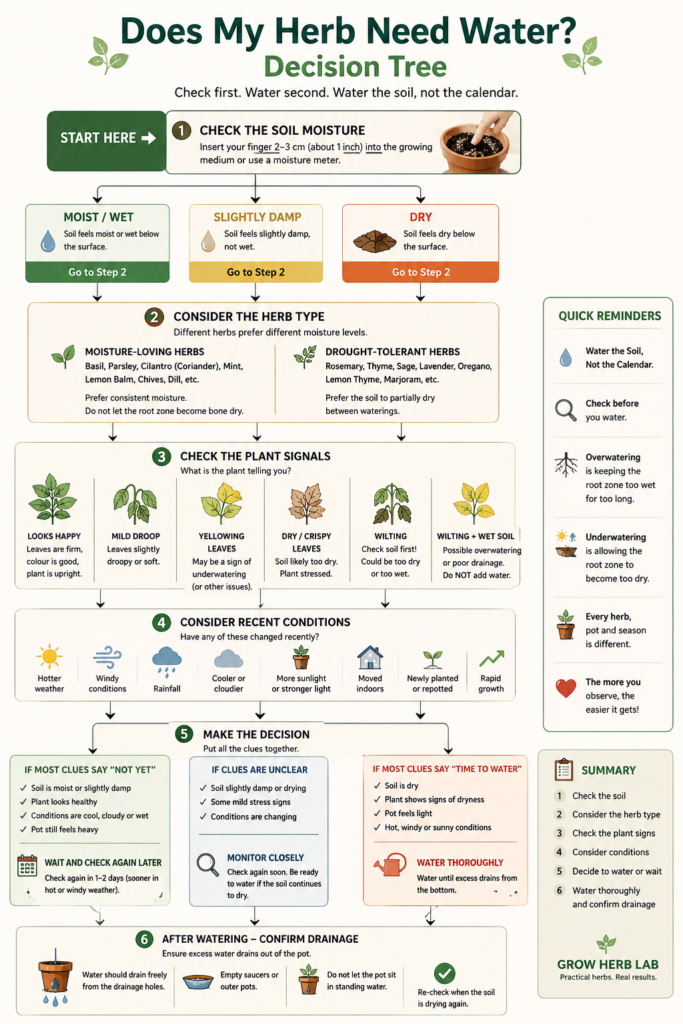
1. Check the Soil Below the Surface
For container herbs, check below the surface and into the part of the growing medium where the active roots are taking up moisture.
Ask:
- Does the soil feel wet?
- Does it still feel noticeably moist?
- Is it beginning to feel dry?
- How does that compare with the moisture preference of this particular herb?
For herbs that prefer consistent moisture, you may water before the root zone becomes very dry.
For rosemary, thyme and other herbs that prefer greater drying, waiting longer may be appropriate.
The exact depth is not a universal rule. Large or deep containers can remain moist well below the point you can easily reach with a finger.
2. Learn the Pot-Weight Method
For container herbs, pot weight is an excellent second check.
Lift the container after it has been watered thoroughly and notice how heavy it feels.
Check it again as the growing medium dries.
With experience, the difference becomes surprisingly easy to recognise:
heavier pot → generally more moisture remains
lighter pot → generally less moisture remains
This is particularly useful when the soil surface dries quickly and gives a misleading impression of conditions deeper in the container.
3. Look at the Plant — But Don’t Diagnose From Appearance Alone
Leaves and stems can provide useful clues.
A herb that needs water may become:
- softer;
- less upright;
- limp; or
- wilted.
But wilting does not automatically mean underwatering.
Roots that remain excessively wet can also become stressed and lose their ability to function properly, producing similar above-ground symptoms.
That is why the correct order is:
observe the plant → check the root zone → then decide whether to water.
Never automatically water a wilted herb without checking the growing medium first.
4. Consider What Has Happened Since the Last Watering
Finally, consider recent conditions.
Has it been:
- unusually hot?
- sunny?
- windy?
- dry?
- cool and cloudy?
- humid?
- raining?
- several days since you last checked?
Also consider whether the plant has recently grown substantially or become root-bound, because these changes can alter how quickly a container dries.
The purpose is not to calculate a perfect watering interval.
It is to understand why the root zone may be drying faster or slower than usual.
A Simple Decision
Before watering, combine the evidence:
Soil moisture + herb preference + pot weight + plant condition + recent growing conditions
If those clues indicate that the root zone has reached an appropriate level of dryness for that herb, water it.
If the root zone still contains adequate moisture, wait and check again later.
Grow Herb Lab Rule: Plant symptoms are clues. Root-zone moisture is the evidence you should check before changing your watering.
How to Water Herbs Properly
Knowing when to water is only half of the process. Once your checks show that a herb needs water, the aim is to moisten the root zone properly without leaving it unnecessarily waterlogged.
Water the Root Zone Thoroughly
Apply water to the growing medium around the roots rather than giving the plant frequent tiny amounts.
For container herbs, water gradually until the growing medium has been thoroughly moistened and excess water begins to drain from the bottom of the pot.
This helps water reach more of the active root zone.
Avoid Frequent Small Sips
Repeatedly adding only a small amount of water can wet the upper layer while leaving deeper parts of the root zone relatively dry.
Instead:
- Check whether the herb actually needs water.
- If it does, water the root zone thoroughly.
- Allow excess water to drain.
- Wait until the root zone reaches the appropriate level of dryness before watering again.
This creates a much better distinction between watering thoroughly and watering frequently.
Water Slowly Enough for the Growing Medium to Absorb It
Pour water at a controlled rate.
If water is applied faster than the growing medium can absorb it, it may run across the surface or down gaps around the edge of the pot without evenly moistening the root zone.
If that happens, slow down and allow the water time to soak in.
Do Not Leave Container Herbs Standing in Water
After watering, allow excess water to escape.
If water collects in a saucer or outer container, empty it rather than routinely leaving the pot standing in water.
Good watering should provide moisture to the roots and then allow excess water to drain away.
Grow Herb Lab Rule: When a herb needs water, water thoroughly—but do not confuse thorough watering with keeping the root zone constantly wet.
When Watering Does Not Behave Normally
Sometimes the problem is not simply how often you water.
For example, water may:
- run straight through the pot;
- pool on the surface;
- drain unusually slowly;
- leave the growing medium wet for days; or
- fail to keep the root zone moist for very long.
These patterns can point to problems with the container, growing medium, drainage or root system.
Rather than automatically watering more or less often, identify why the water is behaving abnormally and correct the underlying problem.
For detailed diagnosis and solutions, use the dedicated Herb Watering Problems troubleshooting guide.
Does Where and When You Water Matter?
Once a herb actually needs water, where you apply that water and when you do it can make watering more effective.
Should You Water Herb Leaves?
When watering manually, aim to moisten the growing medium throughout the active root zone rather than routinely soaking the foliage.
Wet leaves are not automatically harmful—outdoor herbs naturally experience rain—but foliage that remains damp for long periods can create conditions favourable to some diseases, particularly where airflow is poor.
The priority is therefore simple:
Water the root zone first.
What Is the Best Time of Day to Water Herbs?
For outdoor herbs, morning is often a practical time to water when watering is actually needed.
It provides moisture before the warmer part of the day and gives wet foliage or surfaces time to dry.
However, plant need is more important than the clock.
If a herb is severely dry during the afternoon, do not leave it dehydrated until the following morning simply because morning watering is preferred.
Water when necessary.
For indoor herbs, the exact time of day is generally less important than maintaining appropriate root-zone moisture, drainage, light and airflow.
Watering Herbs in Garden Beds
Herbs growing in garden beds behave differently from herbs growing in containers.
Garden soil usually provides a much larger moisture reservoir, and established roots may extend well beyond the immediate base of the plant.
When irrigation is genuinely required, established herbs generally benefit from watering that penetrates into the active root zone rather than frequent light sprinkling.
How quickly garden soil dries depends on factors including:
- soil type;
- rainfall;
- temperature;
- wind;
- sun exposure;
- mulch;
- plant maturity; and
- herb species.
A sandy soil may dry considerably faster than a moisture-retentive clay soil.
So the same principle still applies:
There is no universal weekly watering schedule. Check the soil and the plant before deciding to water.
Special Situations That Change How Often You Need to Check
Some herbs need closer moisture monitoring because their root systems or growing environment have recently changed.
Newly Planted Herbs
Recently planted herbs generally need closer monitoring than established plants.
Their roots have not yet spread far into the surrounding soil, so they initially have access to a smaller reservoir of moisture.
During establishment:
- check the root zone regularly;
- avoid allowing the immediate root area to become severely dry;
- avoid keeping it continuously saturated; and
- gradually adjust watering as the roots establish.
This is particularly important after transplanting container-grown herbs into garden beds.
The original potting mix can dry at a different rate from the surrounding garden soil, so check conditions around the developing root zone rather than relying on a fixed schedule.
Mulch Changes How Quickly Soil Dries
A suitable mulch can reduce evaporation from garden soil and help moderate soil-temperature fluctuations.
That usually means the soil beneath mulch dries more slowly than exposed soil.
If you add mulch but continue watering according to the previous routine, the root zone may remain wetter than expected.
Check the soil underneath the mulch before deciding to water.
Keep heavy mulch away from direct contact with sensitive crowns or stems where persistent moisture could create problems.
Grow Herb Lab Tip: Whenever you change the growing environment—repotting, transplanting, adding mulch or moving a plant—temporarily increase how often you check moisture rather than automatically increasing how often you water.
How Much Water Should You Give Herbs?
There is no useful universal measurement such as:
“Give every herb one cup of water.”
The amount required depends on the size of the root zone, container or garden area, growing medium and how dry it has become.
A small herb in a compact pot obviously requires less water than a mature plant growing in a large container or garden bed.
For Herbs in Containers
When a container herb genuinely needs water, the aim is usually to moisten the root zone thoroughly, rather than measure out an arbitrary volume.
Apply water gradually so the growing medium can absorb it.
For containers with appropriate drainage, continue until the root zone has been adequately moistened and some excess water begins escaping from the drainage holes.
Then allow the container to drain.
Do not interpret this as:
“The more water, the better.”
Once the root zone has been properly moistened, continuing to pour water through the container provides little benefit.
For Herbs in Garden Beds
The same principle applies in the ground.
When watering is required, aim to moisten the active root zone rather than repeatedly wetting only the soil surface.
How much irrigation is necessary will depend heavily on:
- soil type;
- existing soil moisture;
- rainfall;
- root depth;
- plant size; and
- weather conditions.
This is another reason fixed quantities are unreliable.
Frequency and Quantity Are Different Decisions
Keep these two questions separate:
1. Does the herb need water?
Determine this by checking the root zone, herb and growing conditions.
2. How should I water it?
Apply enough water to moisten the active root zone appropriately, then allow excess water to drain where applicable.
Grow Herb Lab Rule: Do not replace a rigid watering schedule with a rigid quantity. Check first, then water according to the plant and root zone.
Common Herb Watering Mistakes
Most watering problems begin with a few predictable habits.
Avoid:
- Watering automatically on a particular day rather than checking the root zone.
- Giving frequent small amounts of water instead of watering appropriately when the herb genuinely needs it.
- Watering wilted plants without checking the soil first.
- Assuming every herb needs the same moisture level.
- Continuing the same routine when weather or growing conditions change.
- Ignoring drainage or allowing containers to remain standing in water.
- Treating the soil surface as proof that the entire root zone is dry.
- Keeping drought-tolerant herbs continuously wet.
- Assuming more water will solve every struggling-herb problem.
The better routine is:
CHECK → DECIDE → WATER THOROUGHLY → DRAIN → CHECK AGAIN LATER
Grow Herb Lab Watering Principle: Correct herb watering requires two separate decisions. First decide whether the herb needs water. Only then decide how to water it properly.
How Often Do Different Herbs Need Water?
Different herbs can have very different watering needs, even when they are growing side by side.
A herb’s general moisture preference provides a useful starting point, but it does not determine a fixed watering frequency.
Basil and other herbs that prefer more consistent moisture may need checking sooner than rosemary and other herbs that tolerate greater drying between waterings. But pot size, growing medium, weather, plant size and location can change how quickly either plant actually dries.
The practical rule remains:
Learn how much drying the herb generally prefers, then check the root zone before watering.
For a quick comparison of common herbs, use the Herb Watering Reference Chart.
How Containers and Growing Location Change Watering Frequency
Even when two herbs have similar moisture preferences, their growing environments can cause them to dry at very different rates.
Pot Size
Small containers contain less growing medium and therefore hold a smaller reservoir of available moisture.
They can dry particularly quickly during:
- hot weather;
- strong sunlight;
- windy conditions; and
- periods of rapid plant growth.
Large containers generally hold moisture for longer, but bigger is not automatically better. An unnecessarily large volume of moisture-retentive growing medium can remain wet around a small root system for too long.
Choose a container appropriate for the plant and make sure it drains effectively.
Container Material
The material of the pot can also influence drying.
Terracotta and other porous containers allow moisture to escape through their walls, so the growing medium may dry faster.
Plastic and glazed containers generally lose less moisture through the container itself and may therefore remain moist for longer.
Neither type is automatically better; what matters is recognising how the container affects drying and adjusting your moisture checks accordingly.
The important point is to recognise that changing the container can change how frequently the root zone needs checking.
Indoor vs Outdoor Herbs
Location can substantially affect how quickly a herb uses and loses water.
Indoor herbs are usually protected from rain and wind and may receive lower light levels. As a result, their growing medium can sometimes remain moist considerably longer.
Outdoor herbs may experience:
- stronger sunlight;
- higher temperatures;
- wind;
- rainfall; and
- larger day-to-day weather changes.
These conditions can make drying much less predictable.
Do not assume that an indoor herb needs water every week or that an outdoor herb needs water every day.
In both situations:
Check the root zone and respond to the conditions the plant is actually experiencing.
How Weather and Seasons Change Herb Watering
A herb’s watering needs are not fixed throughout the year.
Even when the plant, pot and growing medium remain unchanged, temperature, sunlight, wind, humidity and rainfall can substantially alter how quickly the root zone dries.
The key principle is:
Adjust how often you check according to current growing conditions—not according to what worked last month.
Hot Weather and Heatwaves
Higher temperatures generally increase moisture loss, and container herbs can dry particularly quickly because their roots are confined to a relatively small volume of growing medium.
During hot weather:
- check container herbs more frequently;
- pay particular attention to small pots;
- monitor herbs exposed to afternoon sun or reflected heat;
- check plants exposed to strong wind;
- prioritise newly planted herbs; and
- check the root zone before adding water.
During extreme heat, some containers may need daily checking.
But remember:
Daily checking does not automatically mean daily watering.
Water when the root zone indicates that the herb needs it.
Wind and Strong Sun Can Accelerate Drying
Wind can increase moisture loss from foliage and containers, sometimes causing herbs to dry faster than temperature alone would suggest.
Strong sunlight can also increase plant activity and heat the container itself.
Pay particular attention to herbs growing:
- on balconies;
- on exposed patios;
- in hanging baskets;
- near reflective paving, walls or glass; and
- in small containers.
When exposure changes—for example, when a pot is moved into a sunnier position—expect its watering needs to change too.
Humidity Also Matters
Humidity influences how readily plants lose moisture to the surrounding air.
Hot, dry and windy conditions can produce rapid moisture loss.
Warm, humid and sheltered conditions may slow drying considerably.
This is why temperature alone cannot tell you how often to water.
What Rain Means for Outdoor Herbs
Rain does not automatically mean every outdoor herb has received enough water.
Light rainfall may wet only the upper surface of:
- dense containers;
- large pots;
- hanging baskets; or
- soil protected by thick foliage.
After rain, check how deeply moisture has penetrated before deciding whether additional watering is necessary.
The opposite problem can occur during prolonged wet weather.
If pots remain saturated:
- stop unnecessary irrigation;
- empty standing water from saucers or outer pots;
- make sure drainage holes remain clear; and
- continue checking the root zone before watering again.
Rain should change your watering decision, not simply be added on top of your normal routine.
Cooler Weather and Winter
As temperatures fall and plant growth slows, many herbs use water more slowly.
Growing medium that dried rapidly during summer may remain moist considerably longer during cooler conditions.
This makes continuing a summer watering routine into winter a common mistake.
During cooler periods:
- check moisture before watering;
- expect longer intervals between waterings;
- reduce watering frequency as plant growth slows; and
- pay particular attention to Mediterranean herbs that dislike prolonged wet conditions.
Winter does not mean stop watering completely.
Evergreen and actively growing herbs may still require water, especially container plants protected from rainfall.
The principle remains the same throughout the year:
Check first. Water according to current root-zone conditions.
Watering Herbs in Pots
Container herbs usually need closer moisture monitoring than established herbs growing in garden beds.
A pot creates a limited root environment. How quickly it dries depends on factors including:
- pot size;
- container material;
- drainage;
- growing medium;
- root congestion;
- sunlight;
- temperature;
- wind; and
- plant size.
Small pots, hanging baskets and exposed containers can dry surprisingly quickly. Large or moisture-retentive containers may stay wet for much longer.
Drainage Is Essential
Most container-grown herbs should be grown in pots with effective drainage.
After watering, excess moisture needs somewhere to escape.
Check that:
- drainage holes are present and unobstructed;
- the growing medium drains appropriately;
- water is not being left standing in saucers or decorative outer pots; and
- the container is not positioned so drainage holes are permanently blocked.
Adding gravel to the bottom of an ordinary container is not a substitute for suitable growing medium and effective drainage holes.
Watch the Individual Pot
Do not assume several containers need watering simply because they sit beside each other.
Different herbs and containers can dry at very different rates.
This is especially important for:
- hanging baskets;
- small pots;
- self-watering containers;
- pots exposed to strong sun or wind; and
- containers protected from or exposed to rainfall.
Check each root zone individually.
When Water Behaves Strangely
If water immediately runs down the sides of a pot, pools on the surface, drains unusually slowly or the container remains wet for days, do not simply compensate by changing the watering frequency.
If water runs straight through, pools on the surface or the container stays wet for unusually long periods, investigate the growing medium, drainage and root condition before changing how often you water.
Grow Herb Lab Container Rule: The pot changes how quickly moisture is lost, but the decision remains the same—check the individual root zone before watering.
Watering Herbs Indoors
Indoor herbs follow the same basic watering principle as outdoor herbs:
Check the root zone before watering rather than following a fixed schedule.
The difference is that indoor conditions can change how quickly the growing medium dries.
Important factors include:
- light levels;
- room temperature;
- heating and air conditioning;
- humidity;
- airflow;
- container size and material;
- growing medium;
- seasonal changes; and
- the herb’s natural moisture preference.
Why Indoor Herbs Can Be Easy to Overwater
Indoor herbs often receive less intense light and experience less airflow than plants growing outdoors.
Under these conditions, plants may use water more slowly and containers may remain moist for longer.
This makes automatic calendar watering particularly risky indoors.
A pot that needed watering every few days during bright, warm conditions may need considerably longer between waterings when light levels fall or temperatures change.
Light, Heating and Air Conditioning
Indoor location matters.
A herb beside a bright window may dry considerably faster than the same herb growing farther into the room.
Heating can increase moisture loss, while air conditioning can alter both temperature and humidity.
Windows can also create localised conditions that are much warmer or cooler than the rest of the room.
Whenever the indoor environment changes, check moisture more frequently until you understand the new drying pattern.
Indoor Pots Still Need Drainage
Indoor containers should not remain standing in excess water.
After watering:
- allow excess water to drain;
- empty significant standing water from saucers or outer pots; and
- make sure decorative containers are not hiding accumulated water.
A decorative outer pot can make a correctly drained inner pot behave like a poorly drained container if water is allowed to collect around it.
Different Indoor Herbs Still Have Different Needs
Do not water every indoor herb together simply because they share the same windowsill.
Each herb still retains its own moisture preference indoors, regardless of where it is positioned.
Check each herb’s root zone individually before deciding whether to water.
The herb determines its moisture preference. The indoor environment determines how quickly that moisture is lost.
What About Misting?
Misting foliage is not a substitute for watering the root zone.
If a herb needs water, apply moisture to the growing medium where the roots can access it.
Likewise, misting should not be used to compensate for a persistently dry root zone or unsuitable growing conditions.
A Simple Indoor Watering Routine
For most indoor herbs:
- Check the root zone.
- Consider the herb’s moisture preference.
- If watering is needed, moisten the root zone appropriately.
- Allow excess water to drain.
- Remove significant standing water.
- Check again when conditions suggest the root zone may be approaching the appropriate level of dryness.
Grow Herb Lab Indoor Watering Rule: Water the soil, not the calendar. Let the herb and its current indoor environment determine when it needs checking again.
Troubleshooting Herb Watering Problems
Even with a good watering system, herbs can develop symptoms that appear to be caused by moisture.
Common warning signs include:
- wilting despite recent watering;
- soil remaining wet for several days;
- unusually rapid drying;
- water running straight through the pot;
- water pooling on the surface;
- yellow, brown or crispy leaves;
- repeated drooping;
- mould or algae on the growing medium; and
- declining growth.
The important point is that one symptom rarely identifies the cause by itself.
A wilted herb may be too dry, but wilting can also occur when the root zone remains excessively wet or when roots are damaged.
Likewise, yellow leaves can be associated with watering problems, but they can also result from light, temperature, nutrition, pests, disease or natural ageing.
Diagnose Before You Change the Watering Routine
When a herb begins declining:
- Check the root zone.
- Check drainage and the container.
- Consider recent weather or environmental changes.
- Look at the roots if persistent symptoms justify it.
- Only then decide whether the watering routine needs changing.
For detailed diagnosis, use the appropriate Grow Herb Lab troubleshooting guide:
- Overwatering vs Underwatering — when you cannot determine whether the root zone is too wet or too dry.
- Yellow Leaves in Herbs — when yellowing is the main symptom.
- Root Rot in Herbs — when persistent wetness and deteriorating roots suggest root damage.
Grow Herb Lab Troubleshooting Rule: Diagnose the growing conditions first. Change the watering routine only when the evidence shows that watering is actually the problem.
The Grow Herb Lab 5-Step Watering System
When you are unsure whether a herb needs water, use this simple sequence.
Step 1 — Know the Herb
Start with its general moisture preference.
Does it usually prefer:
- more consistent moisture;
- moderate drying between waterings; or
- considerably drier conditions?
This gives you a starting point — not a fixed schedule.
Step 2 — Check the Root Zone
Check below the surface rather than judging moisture from the top layer alone.
Ask:
Is the root zone actually dry enough for this herb to need water?
Step 3 — Check the Plant
Look at the plant as supporting evidence.
Consider:
- wilting or drooping;
- leaf condition;
- recent growth;
- signs of prolonged wetness; and
- signs of excessive drying.
Plant symptoms should support the diagnosis, not replace the soil check.
Step 4 — Check What Has Changed
Consider whether current conditions have altered how quickly the root zone is drying.
Examples include:
- hotter or cooler weather;
- stronger sunlight;
- wind;
- rain;
- indoor heating or air conditioning;
- seasonal change;
- recent repotting; and
- increased plant growth.
Step 5 — Water or Wait
If the herb needs water, water the root zone thoroughly and allow excess water to drain.
If sufficient moisture remains, wait and check again later.
Do not water simply because a particular number of days has passed.
The 30-Second Watering Check
Before reaching for the watering can, ask:
1. What does this herb generally prefer?
2. What is the root-zone moisture right now?
3. What growing conditions could have changed its water use?
Then make one decision:
Water — or wait.
Grow Herb Lab Watering Principle: Know the herb. Check the root zone. Check the conditions. Water only when the evidence says it is needed.
Frequently Asked Questions
Should herbs be watered every day?
Usually, no. Herbs should be watered according to their moisture needs and current growing conditions rather than automatically every day. Check the root zone first and water when it has reached an appropriate level of dryness for that herb.
How often should you water herbs in pots?
There is no universal schedule. Small pots, porous containers and pots exposed to heat, sun or wind may dry quickly, while larger or less exposed containers may remain moist much longer. Check each pot individually.
How often should you water indoor herbs?
Indoor watering frequency depends on light, temperature, humidity, airflow, container size and the herb itself. Indoor pots can dry more slowly than expected, particularly under lower light, so check the growing medium rather than watering according to the calendar.
How do I know when my herbs need water?
Check the root zone below the surface. Consider the herb’s normal moisture preference and current growing conditions as well as the condition of the plant. Do not rely on wilting or dry-looking surface soil alone.
Should I let herbs dry out between waterings?
It depends on the herb. Rosemary, thyme, oregano and similar Mediterranean herbs generally tolerate more drying, while basil, mint and parsley usually prefer more consistent moisture. Appropriate drying does not mean allowing every herb to become severely dehydrated.
What is the best time of day to water herbs?
Morning is often convenient for outdoor herbs, but plant need is more important than the clock. If a herb is genuinely becoming dehydrated later in the day, do not delay necessary watering simply because morning has passed.
Is it better to water herbs from the top or bottom?
Both methods can work. Top watering is usually the simplest approach because you can apply water gradually, observe how the growing medium absorbs it and confirm that excess water drains from the pot. Bottom watering can also be useful, particularly when the growing medium is difficult to rewet, but the pot should not be left standing indefinitely in water.
Can herbs recover from overwatering or underwatering?
Often they can, particularly when the problem is identified before serious root or tissue damage develops. Recovery depends on how severe and prolonged the stress has been and whether the underlying cause is corrected.
Why does my herb wilt even though the soil is wet?
Wet soil does not guarantee that roots are functioning normally. Prolonged saturation can reduce oxygen around the roots and may eventually contribute to root damage. Persistent wilting with wet soil should be investigated rather than treated with more water.
What is the biggest herb watering mistake?
The most damaging general mistake is watering by routine without checking whether the herb actually needs water.
Different herbs, containers and growing conditions dry at different rates.
Check first. Water second.
Beginner Herb Watering Checklist
Use this checklist whenever you are unsure whether a herb needs water.
Before Watering
- Identify the herb’s general moisture preference.
- Check the root zone rather than judging only the surface.
- Consider whether the pot feels unusually light or heavy.
- Check whether drainage is working properly.
- Consider recent heat, rain, wind, sunlight or seasonal changes.
- For indoor herbs, consider changes in light, heating, air conditioning and airflow.
- Look for symptoms that suggest a problem beyond ordinary watering.
If the Herb Needs Water
- Apply water to the growing medium so moisture reaches the active root zone.
- Water thoroughly enough to moisten the appropriate root area.
- Apply water slowly enough for the growing medium to absorb it.
- Allow excess water to drain.
- Empty significant standing water from saucers or decorative outer pots.
After Watering
- Give the plant time to respond.
- Do not automatically water again according to a fixed schedule.
- Check the root zone before the next watering.
- Watch for unusually rapid drying or prolonged wetness.
- Investigate persistent wilting, yellowing or decline rather than repeatedly adding water.
Avoid These Common Watering Mistakes
- Watering on a fixed schedule without checking.
- Treating every herb the same.
- Assuming every wilted plant is thirsty.
- Judging moisture only from the soil surface.
- Giving frequent small splashes instead of appropriately watering the root zone.
- Leaving containers standing in water.
- Ignoring drainage.
- Failing to adjust for weather and seasonal changes.
- Trying to solve every plant-health problem by changing the watering routine.
Grow Herb Lab Beginner Rule: Know the herb → check the root zone → consider current conditions → water thoroughly when needed → allow drainage → check again later.
Where to Go Next
Watering connects with almost every part of herb health.
If this guide has helped identify a problem, use the appropriate Grow Herb Lab resource below to continue troubleshooting.
💧 Use the Herb Watering Reference Chart
For a faster herb-by-herb comparison, use the:
It provides a practical reference for comparing the general moisture preferences of common herbs.
This is the best companion resource when you already understand the principles in this guide and simply need a quick reminder for a particular herb.
🌱 If Your Herb Has Yellow Leaves
Watering problems are only one possible cause of yellow foliage.
Use:
Why Are My Herb Leaves Turning Yellow?
The guide walks through watering, drainage, roots, light, nutrients, temperature, pests and other common causes.
🪴 If You Suspect Root Rot
If your herb has:
- Persistently wet soil.
- Yellowing alongside persistent wetness or other root-damage symptoms.
- Wilting despite moisture.
- Weak growth.
- Soft or deteriorating roots.
- An unpleasant smell from the root zone.
continue with:
Root Rot in Herbs: The Complete Guide to Diagnosis, Treatment and Prevention
That guide covers diagnosis, treatment and prevention in greater depth.
🌿 Improve Your Container Growing
If watering problems appear to be connected with:
- Pot size.
- Drainage.
- Growing medium.
- Root congestion.
- Container choice.
continue with:
Container design and watering behaviour are closely connected.
🌱 Diagnose Your Individual Herb
For species-specific growing instructions, continue with the relevant Grow Herb Lab Foundation Herb guide.
Start with the guide for the herb you are growing:
Basil
How to Grow Basil: Complete Beginner-to-Harvest Guide
Rosemary
How to Grow Rosemary: Complete Beginner-to-Harvest Guide
Mint
How to Grow Mint: Complete Beginner-to-Harvest Guide
These guides provide broader care instructions beyond watering alone.
📥 Free Grow Herb Lab Resources
For quick-reference growing help, use the:
and:
These resources are designed to complement the detailed guides in the Grow Herb Lab knowledge library.