Quick answer
Powdery mildew usually appears as white to grey, flour-like patches on the surfaces of leaves and sometimes stems. A few patches on an otherwise vigorous herb do not automatically mean the whole plant is lost. Confirm what you are seeing, remove badly affected leaves where practical, give the plant more light and space for air to move, and check new growth over the following days. If much of a small herb is covered or growth is failing, replacing the plant may be more useful than repeated treatment.
Australian parsley exception: If the plant is parsley and you suspect powdery mildew, photograph it and report the suspected disease to the Exotic Plant Pest Hotline on 1800 084 881. Agriculture Victoria states that powdery mildew of parsley had not been reported in Australia at its August 2026 update. Do not assume a white mark on parsley is this disease; seek identification rather than treating it as routine powdery mildew.
Quick diagnosis
| What you see | More likely explanation | Next check |
|---|---|---|
| White or grey powdery patches spreading over leaf surfaces or stems | Possible powdery mildew | Check several leaves, including new and older growth; photograph the pattern. |
| Yellow patches above, with greyish or purplish growth chiefly beneath the leaf, particularly on basil | Possible downy mildew | Inspect the underside. This is a different disease and needs a different diagnosis. |
| A uniform pale, felt-like coating that is part of the leaf’s normal appearance | Natural leaf hairs or colour | Compare healthy leaves on the same plant and the variety’s normal appearance. |
| Irregular pale residue after spraying or watering | Possible surface deposit | Check when it first appeared and whether it expands on new growth. |
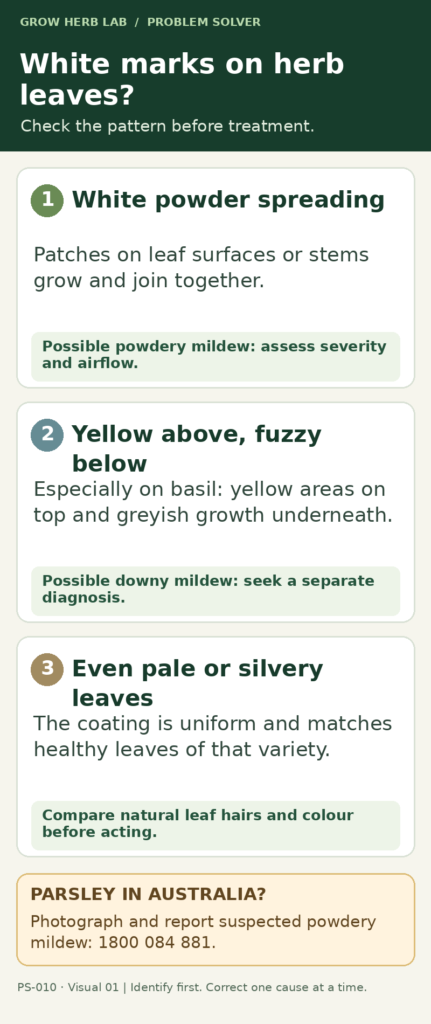
These are clues, not a laboratory diagnosis. Look at the whole plant and recent conditions. If the appearance is unusual, particularly on parsley in Australia, seek local plant-health advice.
What powdery mildew is
Powdery mildew is a group of fungal diseases. The visible powder is fungal growth and spores on the plant surface; spores can move in air. Different powdery mildew fungi have different host ranges, so a mark on one herb does not prove every nearby herb has the same infection.
A damp-looking leaf is not required for powdery mildew to develop. Some species infect without free water on the leaf. Crowded, shaded growth and weak airflow can favour disease within a plant canopy. Warm days and cooler, humid nights can also be favourable. This is why the practical first response is to inspect, open up the canopy and monitor, rather than automatically watering less or spraying everything.
Powdery mildew and downy mildew are different. Basil downy mildew often shows yellowing on the upper leaf surface and darker, fuzzy growth underneath. Do not diagnose basil from the word “mildew” alone.
What to do today
1. Confirm the pattern
Examine the top and underside of several leaves. Note which parts of the plant are affected, whether the white growth is spreading and whether new shoots remain healthy. Take clear photographs before cutting anything off. For suspected parsley powdery mildew in Australia, report the finding using the hotline above.
2. Judge severity
A few patches, healthy new growth: Remove the most affected leaves if this can be done without stripping the herb. Improve spacing and light, then inspect new growth regularly. A small amount of disease may be tolerable while the plant remains productive.
Several branches affected: Remove badly affected material in stages, avoiding a severe prune that weakens the plant. Check whether neighbouring plants are crowding it. Move a pot to a suitable brighter position if the herb tolerates that light; avoid an abrupt move into harsh sun for a shade-grown plant.
Most foliage covered, plant weak or harvest poor: Consider replacing a short-lived or inexpensive herb. There is little value in repeatedly spraying old, damaged leaves: fungicides do not restore them. Clean up heavily affected debris and choose a less crowded position for the replacement.
3. Improve the growing conditions
Space pots so leaves do not press together. Thin only enough growth to let air and light through the canopy, using pruning appropriate to the herb. Avoid pushing lush, soft growth with excessive nitrogen fertiliser. Water according to the root zone’s needs; powdery mildew is not a reliable sign that the soil is too wet or too dry. Keep the plant’s ordinary water needs in mind, particularly in hot weather.
4. Check the next growth
Recheck the plant every few days. Existing marks may remain; the more useful sign is whether fresh leaves stay healthy and the plant continues growing. If symptoms accelerate despite better conditions, seek a reliable identification before choosing a treatment.
Should you spray an edible herb?
Start with identification, pruning where appropriate and better growing conditions. A spray is not a cure for leaves already infected, and a product labelled for ornamental plants is not automatically suitable for a culinary herb.
If a product is considered, check the current Australian label for the exact edible crop or permitted crop group, the disease, application directions, temperature or plant-injury precautions and the withholding period before harvest. Follow that label. Do not substitute a homemade mixture or an overseas recommendation for an Australian label. Where the herb is harvested frequently, replacing a badly affected plant may be simpler.
Can you eat leaves with powdery mildew?
For a practical kitchen rule, do not harvest leaves visibly covered in fungal growth or damaged by disease. Select only sound, unaffected leaves from a plant that has not been treated contrary to its product label, wash them before use and follow any applicable withholding period. If identification is uncertain or much of the edible growth is affected, leave the harvest and seek local advice. This rule does not turn an unverified white coating into a food-safety diagnosis.
How to reduce recurrence
- Choose a position with the light the particular herb needs; many Mediterranean herbs prefer strong sun, while a newly moved plant may need gradual adjustment.
- Give each plant room to reach its mature size. Divide, move or replace crowded pots rather than continually trimming around an unsuitable position.
- Prune selectively to maintain air movement without removing too much productive foliage at once.
- Avoid excessive nitrogen feeding that produces vulnerable soft growth.
- Inspect leaf surfaces regularly, especially in crowded growth, so an early patch is noticed before most leaves are affected.
- Remove heavily affected fallen material and clean tools after pruning. Follow local advice if a suspected unusual disease must be reported.
- Do not mistake a disease-management change for a new watering schedule. Check soil and plant demand separately.
Common mistakes
Treating every white mark as powdery mildew. Natural leaf hairs, spray deposits and other diseases can look similar at a glance. Check the pattern on both sides of the leaf and compare with healthy growth.
Confusing it with basil downy mildew. Yellow patches above and fuzzy growth beneath basil leaves need a separate diagnosis.
Assuming dry soil caused it. Powdery mildew can develop without liquid water on leaves. Root-zone moisture still needs its own assessment.
Expecting a spray to clean up old leaves. The aim of any appropriately labelled protective treatment is to protect healthy growth; damaged tissue will not become new again.
Applying an ornamental product to edible herbs. The crop and harvest directions on the Australian label matter.
Treating suspected parsley powdery mildew as ordinary. In Australia, report the suspicion for identification.
Frequently asked questions
Will powdery mildew kill my herb?
A light infection may be mostly cosmetic, but a severe infection can reduce growth and harvest. Judge the plant’s new growth, overall vigour and how much usable foliage remains.
Does it spread to every herb nearby?
Spores can travel in air, but powdery mildew is caused by multiple fungi with differing host ranges. Inspect neighbouring plants without assuming they will all become infected.
Should I water less or stop wetting leaves?
Do not reduce watering simply because you see powdery mildew. Check the soil and the herb’s normal needs. Unlike many leaf diseases, powdery mildew does not require free water on the leaf to infect. Airflow, light and plant spacing are more useful first checks.
Should I remove every marked leaf?
Remove the worst affected leaves if the herb will still have enough healthy foliage to grow. If most leaves are involved, consider whether replacement is more practical than stripping the plant.
Is a white coating on parsley in Australia ordinary powdery mildew?
Do not assume so. Agriculture Victoria says parsley powdery mildew had not been reported in Australia as of August 2026 and asks that suspected symptoms be reported to the Exotic Plant Pest Hotline on 1800 084 881. Take photos and seek identification.
Continue learning
Once you have identified the leaf problem, use the relevant published guide for the next growing decision:
- Why Are My Herb Leaves Turning Yellow? for causes of yellowing beyond mildew.
- Why Your Herbs Keep Dying for a broader diagnostic path.
- Herb Watering Guide to assess the root zone independently of leaf marks.
- How to Grow Sage for light, spacing and pruning in a Mediterranean herb.
Final thought: Identify the mark first, respond to the amount of disease actually present, and judge recovery by healthy new growth. For suspected powdery mildew on parsley in Australia, report it rather than treating it as a routine case.