🌿 Quick Answer
Is sage easy to grow?
Yes.
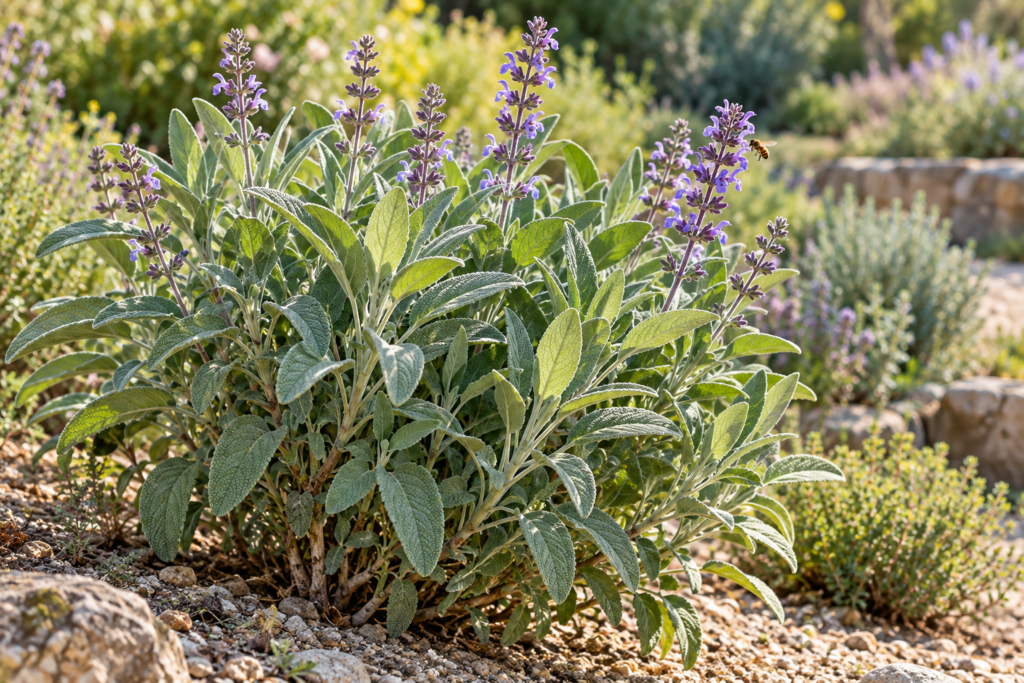
Common sage (Salvia officinalis) is one of the easiest perennial herbs to grow provided it receives full sun, excellent drainage and moderate watering.
Once established, it is drought tolerant, highly productive, attractive in the garden and useful in the kitchen.
Most problems occur because gardeners overwater the plant or grow it in soil that remains wet for extended periods.
🌱 Can I Grow Sage?
Almost certainly.
Sage grows successfully in:
✅ Garden beds
✅ Raised beds
✅ Containers
✅ Courtyards
✅ Balconies
✅ Small gardens
It performs particularly well anywhere rosemary and thyme already thrive.
🌿 Is Sage Worth Growing?
Absolutely.
Few herbs offer as many advantages.
Sage provides:
- Beautiful silver-green foliage.
- Attractive flowers for pollinators.
- Excellent drought tolerance.
- Years of harvests from one plant.
- Outstanding culinary flavour.
- Strong ornamental value.
Many gardeners originally grow sage for cooking but continue growing it because it becomes one of the most attractive plants in the herb garden.
🌿 In This Guide
By the end of this guide you’ll understand:
✅ Which sage variety to choose.
✅ Where sage grows best.
✅ How to plant it successfully.
✅ How to water correctly.
✅ How to prune for maximum production.
✅ How to harvest.
✅ How to solve common problems.
✅ How to keep plants productive for years.
Introduction
Sage has earned a reputation as one of the classic Mediterranean herbs, and for good reason.
It combines beauty, resilience and practicality in a way that few herbs can match.
Its soft grey-green leaves create contrast in the garden, its flowers attract bees and other pollinators, and its aromatic foliage has been valued in cooking and traditional herbal practices for centuries.
Like rosemary and thyme, sage evolved in regions where summers are warm, rainfall is limited and soils drain quickly.
Understanding this natural environment is the key to growing healthy plants.
Beginners sometimes assume that because sage has soft leaves it requires frequent watering.
In reality, established sage prefers conditions that are much drier than many people expect.
Once you understand that principle, growing sage becomes surprisingly straightforward.
🌿 Grow Herb Lab Quick Facts
| Feature | Details |
|---|---|
| Botanical Name | Salvia officinalis |
| Common Name | Common Sage |
| Family | Lamiaceae (Mint Family) |
| Plant Type | Woody perennial subshrub; often evergreen in mild climates |
| Difficulty | ⭐⭐☆☆☆ (Easy) |
| Sunlight | Full sun |
| Water Requirements | Low once established |
| Soil | Free-draining |
| Mature Height | 40–70 cm |
| Mature Width | 50–80 cm |
| Pot Friendly | ✅ Excellent |
| Indoor Friendly | ⚠️ Only with excellent light |
| Pollinator Friendly | ✅ Excellent |
| Edible Parts | Leaves and flowers |
🌿 Grow Herb Lab Insight
Sage teaches the same lesson as rosemary and thyme:
Mediterranean herbs usually suffer more from kindness than neglect.
Too much water.
Too much fertiliser.
Too much attention.
Healthy sage is often the result of knowing when to leave it alone.
Why Grow Sage?
1. It is exceptionally hardy
Once established, sage tolerates drought, heat and periods of neglect remarkably well.
2. It is productive
A single healthy plant can provide regular harvests for many years.
3. It supports pollinators
Flowering sage attracts bees and many other beneficial insects that contribute to a healthy garden ecosystem.
4. It is ornamental
The silvery foliage contrasts beautifully with green herbs such as basil, parsley and chives.
5. It has outstanding culinary value
Fresh or dried leaves complement:
- Roast meats.
- Stuffing.
- Pumpkin dishes.
- Pasta.
- Butter sauces.
- Bread.
Is Sage Right for You?
Sage is ideal if you:
✔ Enjoy low-maintenance gardening.
✔ Have a sunny position.
✔ Want a long-lived perennial.
✔ Cook regularly.
✔ Appreciate plants that attract pollinators.
Consider another herb first if your garden:
✘ Remains waterlogged.
✘ Receives very little direct sunlight.
✘ Has extremely humid conditions with poor airflow.
Even then, containers often provide a simple solution.
🌱 Beginner Checklist
Before planting:
☐ Choose the sunniest available location.
☐ Check that water drains freely.
☐ Avoid overcrowding.
☐ Use premium free-draining potting mix for containers.
☐ Leave room for the plant to mature.
At-a-Glance Care Guide
| Care Factor | Recommendation |
|---|---|
| Sunlight | Full sun (6–8+ hours) |
| Water | Deeply, then allow soil to partially dry |
| Soil | Free-draining |
| Fertiliser | Light feeding in spring if needed |
| Pruning | Light, regular pruning |
| Harvest | Throughout active growth |
| Frost | Tolerates light frost |
Seasonal Calendar
Australia
| Season | Tasks |
|---|---|
| Spring | Plant, feed lightly, begin harvesting |
| Summer | Harvest regularly, monitor during prolonged heat |
| Autumn | Shape plants after flowering |
| Winter | Reduce watering and protect young plants in severe frost |
Northern Hemisphere
| Season | Tasks |
|---|---|
| Spring | Plant and encourage new growth |
| Summer | Peak harvest season |
| Autumn | Light pruning and continued harvesting |
| Winter | Protect container plants in colder regions |
🌿 Sage Care Framework: Sun, Drainage and Airflow
Healthy sage depends on three conditions:
☀️ Plenty of sunlight.
🪨 Soil that drains freely.
🌬 Good airflow around the plant.
If these are present, many common problems become much less likely.
Evidence Note
Modern botanical classification places culinary sage within the genus Salvia, one of the largest genera in the mint family. Many ornamental salvias share similar floral structures, although their growth habits and culinary value differ.
Common Beginner Mistakes
❌ Watering too frequently.
❌ Planting in heavy clay without improving drainage.
❌ Overcrowding neighbouring plants.
❌ Applying excessive fertiliser.
❌ Cutting deeply into old woody stems.
Choosing the Right Sage Variety
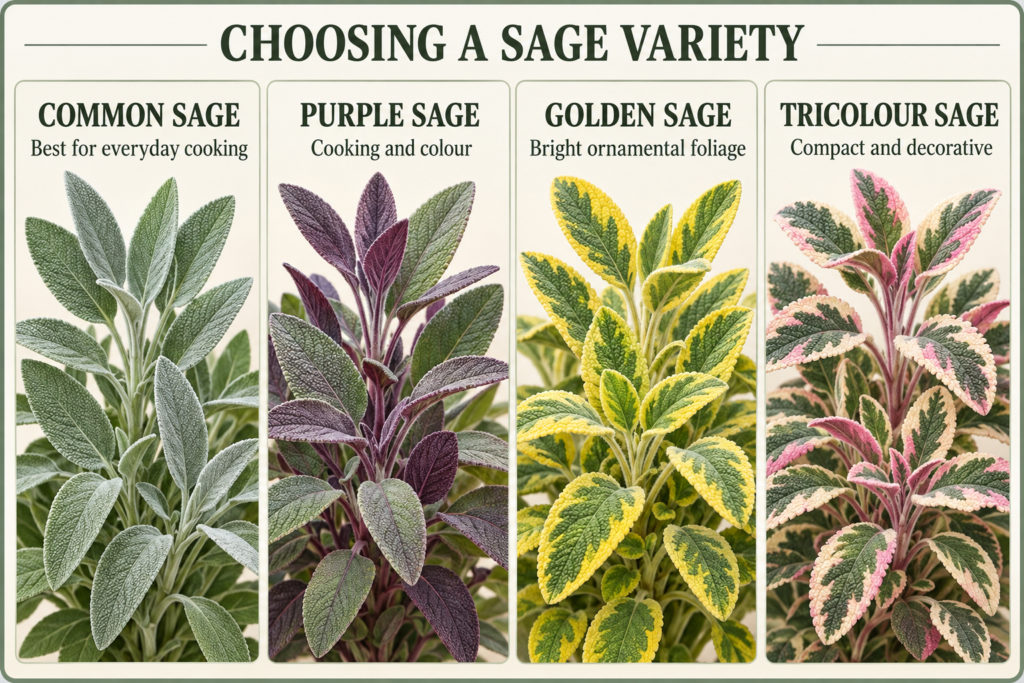
There are hundreds of sage species and cultivars, but not all are grown for the same purpose.
Some are prized for cooking, while others are valued primarily for their ornamental flowers or colourful foliage.
If your goal is to grow sage for the kitchen, choosing the right variety from the beginning will save disappointment later.
Common Sage Varieties
| Variety | Best For | Growth Habit | Culinary Use |
|---|---|---|---|
| Common Sage (Salvia officinalis) | Everyday cooking | Upright shrub | ⭐⭐⭐⭐⭐ Excellent |
| Purple Sage | Cooking & ornamental | Upright | ⭐⭐⭐⭐ Very Good |
| Golden Sage | Decorative gardens | Bushy | ⭐⭐⭐ Good |
| Tricolour Sage | Ornamental containers | Compact | ⭐⭐⭐ Good |
| Pineapple Sage (Salvia elegans) | Flowers & teas | Large shrub | Specialty use; not a substitute for common sage |
🌿 Grow Herb Lab Recommendation
If you’re planting your first sage, choose Common Sage (Salvia officinalis).
It is:
- Easy to grow.
- Highly productive.
- Widely available.
- The standard culinary variety used throughout the world.
Climate
Sage naturally thrives in climates with:
- Warm summers.
- Plenty of sunshine.
- Low to moderate rainfall.
- Good air circulation.
Like other Mediterranean herbs, it dislikes prolonged humidity combined with wet soil.
In humid climates, increasing airflow around plants often makes more difference than applying treatments after problems appear.
Growing Zones
Australia
Sage performs well throughout much of Australia, including:
- Victoria.
- Tasmania.
- South Australia.
- New South Wales.
- Western Australia.
- Cooler inland regions.
In tropical and subtropical climates, avoid crowded planting and ensure excellent drainage.
Northern Hemisphere
Common sage generally grows well outdoors in approximately USDA Zones 4–8, depending on local conditions and winter severity.
Container plants can be moved to sheltered locations where winters are particularly harsh.
Sunlight
Sage performs best in full sun, with about 6–8 hours of direct sunlight each day. In very hot inland or heat-prone climates, light afternoon shade can reduce extreme heat stress, but the plant should still receive strong light for most of the day.
Benefits include:
- Stronger stems.
- Better flavour.
- Compact growth.
- Improved flowering.
- Reduced disease pressure.
Plants grown in shade often become open, weak and less aromatic.
🌿 Grow Herb Lab Insight
Adequate sunlight supports compact growth and strongly aromatic foliage. Plants grown in insufficient light often become weak and less flavourful, although variety, watering and harvest timing also influence flavour.
Soil
Sage is forgiving about fertility.
It is not forgiving about drainage.
Ideal soil should be:
✔ Well-drained.
✔ Moderately fertile.
✔ Slightly sandy or loamy.
✔ Open and airy.
Avoid locations where water stands after heavy rain.
If necessary, grow sage in raised beds or containers rather than fighting unsuitable soil.
For help choosing and improving soil for different herbs, see our Best Soil for Herbs guide.
Planting Sage in Garden Beds
Step 1
Choose a position that receives abundant sunlight.
Avoid shaded fences or dense shrubs that reduce airflow.
Step 2
Prepare the soil.
If the soil is heavy clay or stays wet after rain, do not rely on adding compost to the planting hole. Improve drainage across a broad area, plant on a raised mound or raised bed, or grow sage in a container with free-draining potting mix.
Step 3
Plant at the same depth as the nursery pot.
Never bury the woody crown.
Space common sage plants about 45–60 cm apart, adjusting for the variety’s expected mature width. Allow extra space in humid climates to improve airflow.
Step 4
Water thoroughly once after planting.
This settles soil around the roots.
Step 5
Check the soil below the surface before watering again. During establishment, water when the upper few centimetres begin to dry, keeping the root zone lightly moist but never constantly wet. As new growth shows that the plant is establishing, gradually increase the time between waterings.
Young plants need consistent moisture while establishing, but the soil should never remain constantly wet.
Growing Sage in Pots
Sage is exceptionally well suited to containers.
In fact, container growing often provides better drainage than many garden beds.
Container Size
Start with a pot approximately 30 cm wide that has unrestricted drainage holes. Avoid placing a small plant in an excessively large container, because the extra potting mix may remain wet for too long.
Move the plant into a slightly larger container only when roots have filled most of the existing pot. Never leave the container standing in collected water.
Potting Mix
Choose a premium herb or vegetable potting mix with excellent drainage.
Do not simply reuse old potting mix if it has become compacted, water-repellent or slow to drain. When repotting, replace it or thoroughly refresh it with suitable new mix so the root zone remains open and free-draining.
Position
Place containers in the brightest available location.
Rotate pots occasionally if one side receives noticeably more sunlight than the other.
Watering Sage
One of the most common mistakes is watering too often.
Instead of following a weekly schedule, learn to assess the soil.
🌿 Sage Watering Framework: Check Before You Water
Ask yourself three questions.
Is the soil still moist?
↓
Yes
↓
Don’t water yet.
Is the plant actively growing?
↓
Yes
↓
Monitor more frequently.
Has the weather been hot and windy?
↓
Yes
↓
Check again before watering.
This approach is far more reliable than watering by habit.
For a broader guide to checking moisture and adjusting watering to growing conditions, see the Herb Watering Guide.
Fertilising
Sage is a light feeder. In reasonably fertile garden soil, established plants often need no routine fertiliser.
If growth is weak during spring, first rule out poor drainage, insufficient light and root problems. If feeding is justified, apply a light dose of balanced fertiliser or a thin layer of compost around—but not against—the plant.
Container-grown sage may need occasional light feeding as nutrients in the potting mix decline. Avoid frequent or high-nitrogen feeding, which can produce soft growth with weaker flavour.
Mulching
Mulch can reduce weeds and moisture loss, but thick moisture-retentive mulch may keep sage too wet in rainy or humid conditions.
Where mulch is useful, apply a thin layer and keep it several centimetres away from the woody crown and stems. In wet climates or poorly drained sites, use little or no mulch until drainage and airflow are reliable.
Growing Sage Indoors
Can sage grow indoors?
Yes.
But it is more demanding than many people expect.
Indoor success depends on:
☀️ Bright sunlight.
🌬 Good airflow.
🪴 Free-draining potting mix.
💧 Careful watering.
If natural light is limited, consider using a quality grow light to maintain healthy growth.
Mediterranean Herb Framework
One of the most useful gardening shortcuts is recognising that several popular herbs share almost identical growing requirements.
| Herb | Sun | Water | Soil | Feeding |
|---|---|---|---|---|
| Rosemary | Full | Low | Free-draining | Light |
| Thyme | Full | Low | Free-draining | Light |
| Sage | Full | Low | Free-draining | Light |
| Oregano | Full | Low–Moderate | Free-draining | Light |
| Lavender | Full | Low | Free-draining | Very Light |
🌿 Grow Herb Lab Insight
Once you understand one Mediterranean herb, you’ve already learned about five.
That’s why we teach gardening by plant families and growing behaviour, not simply one species at a time.
Understanding patterns is far more powerful than memorising instructions.
Common Growing Mistakes
❌ Growing sage in heavy, poorly drained soil.
❌ Watering because the calendar says it’s time.
❌ Feeding heavily throughout the season.
❌ Planting too closely together.
❌ Choosing shade instead of full sun.
Expert Tips
💡 Replace very old woody plants every few years if growth declines significantly.
💡 Allow some stems to flower to attract pollinators.
💡 Harvest regularly rather than removing large amounts at once.
💡 Pair sage with rosemary and thyme to create a low-maintenance Mediterranean herb garden.
Pruning Sage
Sage naturally becomes woody with age.
Without regular pruning, plants often become open, sparse and less productive.
Fortunately, maintaining a compact sage plant is simple once you understand one important rule.
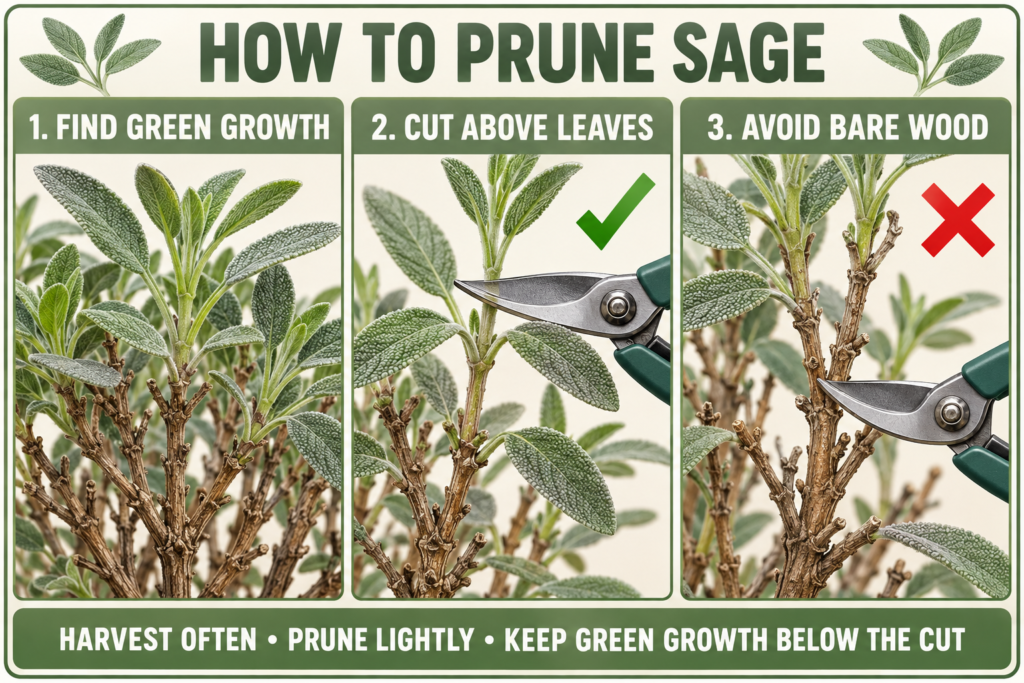
Never remove all the green growth.
Like rosemary, sage does not reliably regenerate from old, leafless wood.
Always leave healthy green shoots below your pruning cuts.
Why Prune Sage?
Regular pruning helps to:
- Encourage fresh shoots.
- Maintain a compact shape.
- Improve airflow.
- Increase harvesting opportunities.
- Extend the productive life of the plant.
Best Time to Prune
Light Pruning
Throughout the growing season while harvesting.
Shaping
Shape established sage in spring once active growth has begun, or trim lightly after flowering. Allow enough warm growing time for the plant to recover before cold weather.
Avoid
Avoid heavy pruning in late autumn or winter, and never cut deeply into bare woody stems unless healthy green growth remains below the cut.
🌿 Sage Pruning Framework: Little and Often Wins
Many gardeners wait until a plant becomes overgrown before pruning.
A better approach is:
Harvest regularly.
Shape lightly.
Repeat.
Small, regular pruning produces healthier plants than occasional heavy cutting.
Harvesting Sage
Sage rewards regular harvesting.
Frequent harvesting encourages fresh growth while supplying leaves for the kitchen.
Best Time to Harvest
Harvest during the morning after dew has dried.
At this time the leaves usually contain their highest concentration of aromatic oils.
How Much Should You Harvest?
As a guide:
Never remove more than one-third of the plant during a single harvest.
Young plants should only be harvested lightly during their first growing season.
🌿 Grow Herb Lab Insight
The best sage plants rarely look freshly pruned.
They simply look naturally full.
That’s because regular harvesting quietly shapes the plant throughout the year.
Drying Sage
Sage is one of the easiest herbs to preserve.
Because the leaves are naturally thicker than herbs such as basil, they retain flavour particularly well during drying.
Air Drying
- Harvest healthy stems.
- Tie into small bunches.
- Hang upside down in a warm, dry location.
- Keep out of direct sunlight.
- Allow the leaves to dry completely until they feel crisp and no moisture remains.
- Strip the leaves from the stems and store them in a clean airtight container away from heat and light.
Discard any leaves that develop mould, dark wet patches or an unpleasant odour during drying.
Properly dried sage can remain highly aromatic for many months.
Freezing Sage
Fresh sage also freezes successfully.
Options include:
- Whole leaves.
- Chopped leaves.
- Butter portions.
- Olive oil cubes.
Freezing retains more of the fresh flavour than drying but requires freezer space.
Using Sage in the Kitchen
Sage has a strong, earthy flavour, so begin with a small amount and add more if needed. Dried sage is more concentrated than fresh sage and should generally be used more sparingly.
Sage pairs particularly well with:
- Pumpkin and other roasted vegetables.
- Poultry and pork.
- Stuffing.
- Beans and lentils.
- Pasta and gnocchi.
- Butter sauces.
- Bread and savoury baking.
Fresh leaves can be finely sliced, added during cooking or gently fried until crisp. Remove tough stems before serving.
Propagating Sage
The easiest propagation methods are:
Stem Cuttings
The preferred option for most gardeners.
Choose healthy, non-flowering stems.
Remove lower leaves.
Insert into a free-draining propagation mix.
Keep lightly moist until roots develop.
Division
Older clumps may occasionally be divided if healthy.
Seed
Possible.
However, seed-grown plants take considerably longer to reach harvest size than cuttings.
Common Sage Problems
Fortunately, sage suffers relatively few problems when grown under suitable conditions.
| Problem | Likely Cause | Solution |
|---|---|---|
| Yellow leaves | Often excess moisture; sometimes natural ageing or another stress | Check soil moisture and drainage before watering or fertilising |
| Root rot | Prolonged wet soil and oxygen-starved roots | Stop routine watering, correct the drainage problem and inspect the roots; repot salvageable plants into fresh free-draining mix |
| Sparse growth | Insufficient sunlight | Move to a brighter position |
| Woody plant | Natural ageing | Regular light pruning or replacement |
| Powdery mildew | Poor airflow | Increase spacing and improve air circulation |
| Weak flavour | Shade or excessive fertiliser | Increase sunlight and reduce feeding |
Decision Tree
My Sage Doesn’t Look Healthy
↓
Is the soil wet?
Yes
↓
Reduce watering.
Inspect roots.
No
↓
Does the plant receive full sun?
No
↓
Move gradually into brighter conditions.
Yes
↓
Inspect for pests, disease or natural ageing.
🌿 What Success Looks Like
A healthy sage plant should have:
✅ Firm upright stems.
✅ Compact bushy growth.
✅ Silvery-green leaves.
✅ Strong aroma when touched.
✅ Regular new shoots.
✅ Flowers that attract bees.
If your plant looks like this…
You’re doing it right.
Frequently Asked Questions
Can sage survive drought?
Yes.
Established sage tolerates dry periods much better than constantly wet soil.
Should I let sage flower?
Yes.
Flowering benefits pollinators.
Simply trim spent flower stems afterwards if you wish to encourage fresh leafy growth.
Why are my sage leaves turning yellow?
Persistent yellowing is often linked to soil remaining wet for too long, particularly when lower leaves yellow and growth weakens. However, individual older leaves can yellow naturally, while drought stress, root damage and other growing problems may produce similar symptoms. Check soil moisture, drainage and the root zone before watering or applying fertiliser.
Can sage stay in the same pot forever?
No.
Eventually plants benefit from:
- Fresh potting mix.
- Root pruning if required.
- Repotting into a slightly larger container.
Is sage a perennial?
Yes.
Common sage is a perennial that can remain productive for many years with appropriate care.
Is common sage safe around pets?
The ASPCA lists common sage (Salvia officinalis) as non-toxic to dogs, cats and horses. However, eating plant material may still cause digestive upset, so pets should not be encouraged to consume large amounts. Concentrated sage essential oil is different from the garden plant and requires separate safety precautions. Contact a veterinarian if a pet becomes unwell.
Botanical Reference
| Feature | Information |
|---|---|
| Botanical Name | Salvia officinalis |
| Family | Lamiaceae |
| Native Range | Mediterranean Basin |
| Plant Type | Woody perennial subshrub; often evergreen in mild climates |
| Height | 40–70 cm |
| Width | 50–80 cm |
| Flowers | Blue, purple, pink or white depending on variety |
| Pollinator Value | Excellent |
| Culinary Use | Outstanding |
🌿 Key Takeaways
✓ Sage is one of the easiest perennial herbs for beginners.
✓ Full sun and excellent drainage are the foundation of success.
✓ Harvest regularly instead of heavily.
✓ Never prune deeply into old leafless wood.
✓ Drying preserves flavour exceptionally well.
✓ Most problems originate below the surface—in the root zone.
✓ Understanding Mediterranean herbs makes growing several species much easier.
Continue Learning
🌱 Build Your Mediterranean Herb Garden
If you’ve mastered sage, the next logical guides are:
Complete Growing Guides
Together, these herbs share similar growing requirements and make an excellent low-maintenance herb garden.
Reference Handbook
Deepen your understanding with:
These resources explain the principles behind successful herb gardening.
Problem Solver
If your sage develops problems, continue with:
Free Grow Herb Lab Resources
Download the free Beginner Herb Growing Kit, which combines practical starter checklists with watering, sunlight and harvesting reference sheets in one printable resource.
Final Thoughts
Sage is more than a culinary herb.
It’s one of the best teachers in the herb garden.
It demonstrates a principle you’ll encounter repeatedly throughout Grow Herb Lab:
Healthy herbs rarely need constant attention—they need the right conditions.
Once you understand those conditions, gardening becomes simpler, more enjoyable and far more successful.
Rather than memorising individual instructions, learn to recognise patterns.
That’s the skill that turns beginners into confident gardeners.