🌱 Quick Answer
What is the best soil for herbs?
Most herbs grow best in well-drained soil that holds enough moisture for healthy root growth without remaining waterlogged.
The exact mix depends on the herb:
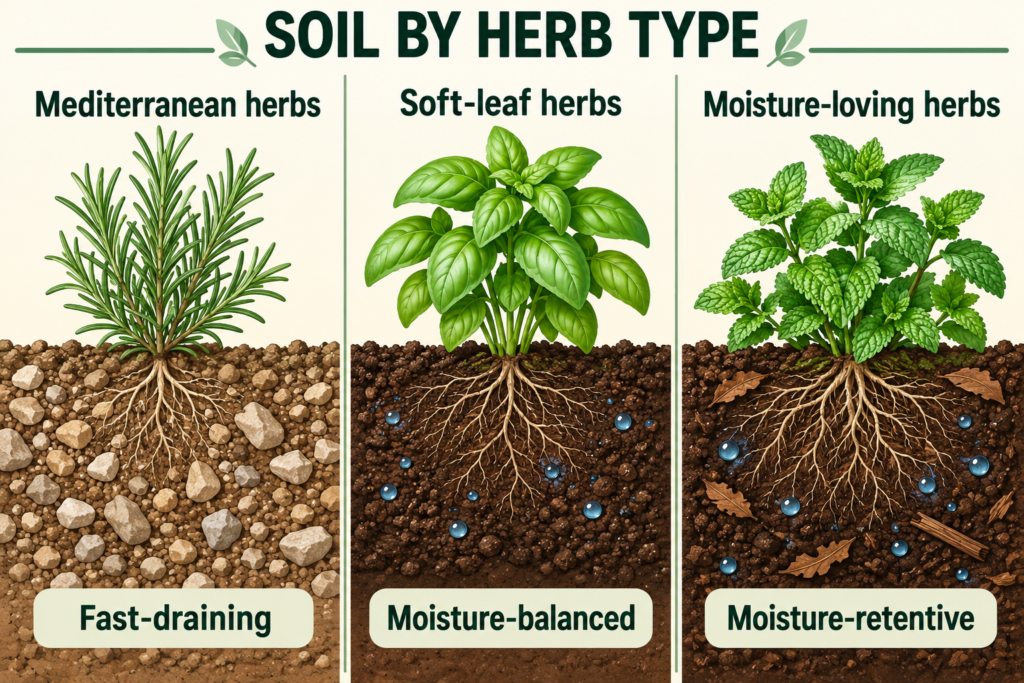
- Mediterranean herbs (rosemary, thyme, sage, oregano and lavender) prefer lean, free-draining soil.
- Soft-leaf herbs (basil, parsley and chives) prefer richer soil that retains moderate moisture.
- Moisture-loving herbs (mint and lemon balm) enjoy consistently moist but well-aerated soil.
Choosing the right soil is one of the easiest ways to prevent common problems such as root rot, yellow leaves and slow growth.
🌿 In This Guide
By the end of this guide you’ll understand:
- ✅ What healthy herb soil looks like.
- ✅ Why drainage matters more than many gardeners realise.
- ✅ The differences between soil for Mediterranean and soft-leaf herbs.
- ✅ How to improve poor garden soil.
- ✅ How to choose the best potting mix.
- ✅ When to add compost.
- ✅ How soil affects watering.
- ✅ How soil influences flavour and plant health.
Why the Right Soil Matters for Herbs
Many gardeners assume that soil is simply something plants grow in.
In reality, soil is a living system that supplies support, water, oxygen and nutrients to every root.
Healthy soil does far more than hold a plant upright—it determines how well roots breathe, how efficiently nutrients are absorbed and how resilient herbs become during heat, drought or heavy rain.
That’s why two gardeners can water their herbs the same way and achieve completely different results.
The difference is often hidden beneath the surface.
Understanding soil is one of the biggest steps you can take towards growing healthier herbs.
🌿 Grow Herb Lab Quick Facts
| Feature | Details |
|---|---|
| Topic | Soil for culinary herbs |
| Difficulty | Beginner |
| Importance | ⭐⭐⭐⭐⭐ |
| Applies To | Every herb |
| Most Common Mistake | Soil that stays wet for too long |
| Related Guides | Watering, Root Rot, Sunlight, Complete Growing Guides |
🌿 Grow Herb Lab Root-Health Framework
Healthy Soil = Healthy Roots = Healthy Herbs
Everything begins underground.
Healthy Soil → Healthy Roots → Healthy Plant → Better Harvest
Every gardening decision eventually affects the roots.
Healthy roots support healthy leaves, stronger growth and more productive harvests.
What Makes Good Herb Soil?
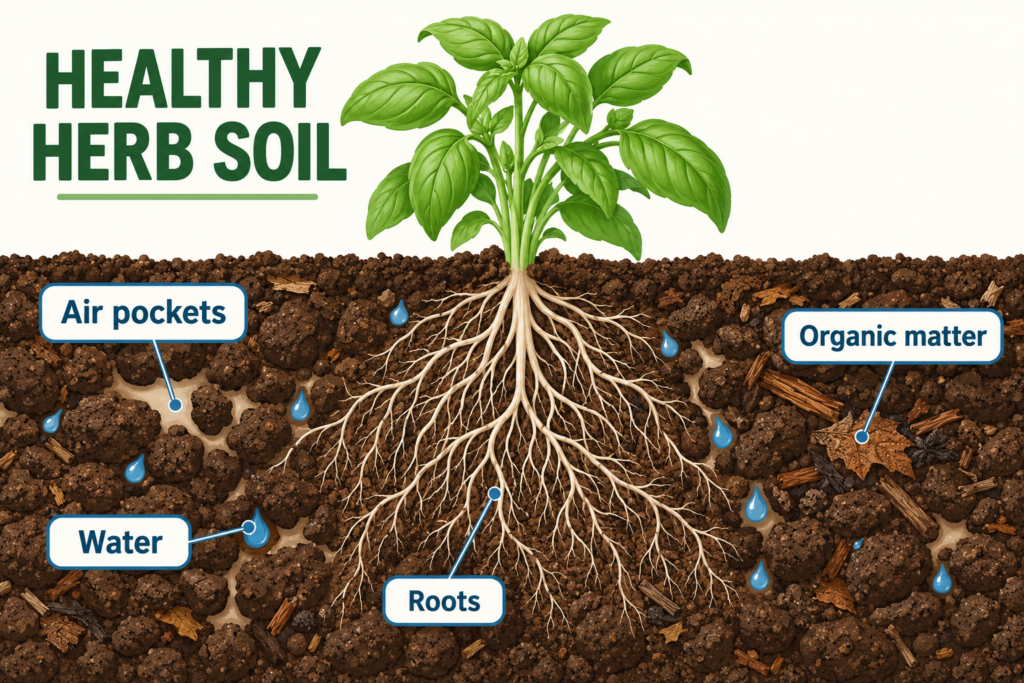
Excellent herb soil balances four essential characteristics:
🌬 Air
Roots need oxygen to survive.
Compacted or constantly wet soil limits oxygen and increases the risk of root diseases.
💧 Moisture
Good soil holds enough water for roots to use but drains away excess moisture before it becomes harmful.
🌱 Organic Matter
Organic matter improves soil structure, supports beneficial microorganisms and gradually releases nutrients.
The goal is balance—not excessive richness.
🪨 Structure
Well-structured soil contains a mixture of particle sizes that create spaces for both air and water.
This balance is one of the reasons loamy soils perform so well for many herbs.
🌿 Grow Herb Lab Insight
Many gardeners believe roots grow into soil.
In reality, roots mostly grow through the tiny spaces between soil particles.
Those spaces contain both water and oxygen.
When they fill completely with water, roots begin to struggle.
This is why drainage is every bit as important as watering.
Why Mediterranean Herbs Need Different Soil
One of the most common mistakes beginners make is treating every herb as though it has identical soil requirements.
Nature tells a different story.
Rosemary, thyme, sage, oregano and lavender evolved in rocky, free-draining environments.
Their roots are adapted to soils that dry relatively quickly.
Growing them in rich, constantly moist soil often leads to weak growth, poor flavour and an increased risk of root rot.
Soft-Leaf Herbs Prefer More Moisture
Basil, parsley, coriander and chives produce rapid leafy growth.
That growth requires more consistent access to water and nutrients.
Their soil should still drain well—but it should retain moisture for longer than the soil used for Mediterranean herbs.
Choosing the Right Soil
Not all herbs grow equally well in the same soil.
Instead of searching for one “perfect” mix, think about the natural environment each herb evolved in.
🌿 Mediterranean Herbs
Examples:
- Rosemary
- Thyme
- Sage
- Oregano
- Lavender
Best Soil
- ✔ Excellent drainage.
- ✔ Moderate fertility.
- ✔ Slightly sandy or gravelly texture.
- ✔ Never waterlogged.
Grow Herb Lab Insight
If the position drains quickly and does not remain wet after rain, Mediterranean herbs are likely to suit it. Unlike cacti, however, they still need regular watering while establishing.
🌱 Soft-Leaf Herbs
Examples:
- Basil
- Parsley
- Chives
- Coriander
- Dill
Best Soil
- ✔ Rich in organic matter.
- ✔ Moist but not soggy.
- ✔ Well-drained.
- ✔ Nutrient-rich.
These herbs produce rapid leafy growth and appreciate a steadier supply of moisture than Mediterranean herbs.
💧 Moisture-Loving Herbs
Examples:
- Mint
- Lemon Balm
- Vietnamese Mint
Best Soil
- ✔ Moisture-retentive.
- ✔ Rich in compost.
- ✔ Excellent structure.
- ✔ Never stagnant.
Although these herbs enjoy more moisture, they still need oxygen around their roots.
Decision Guide
Which Soil Matches Your Garden?
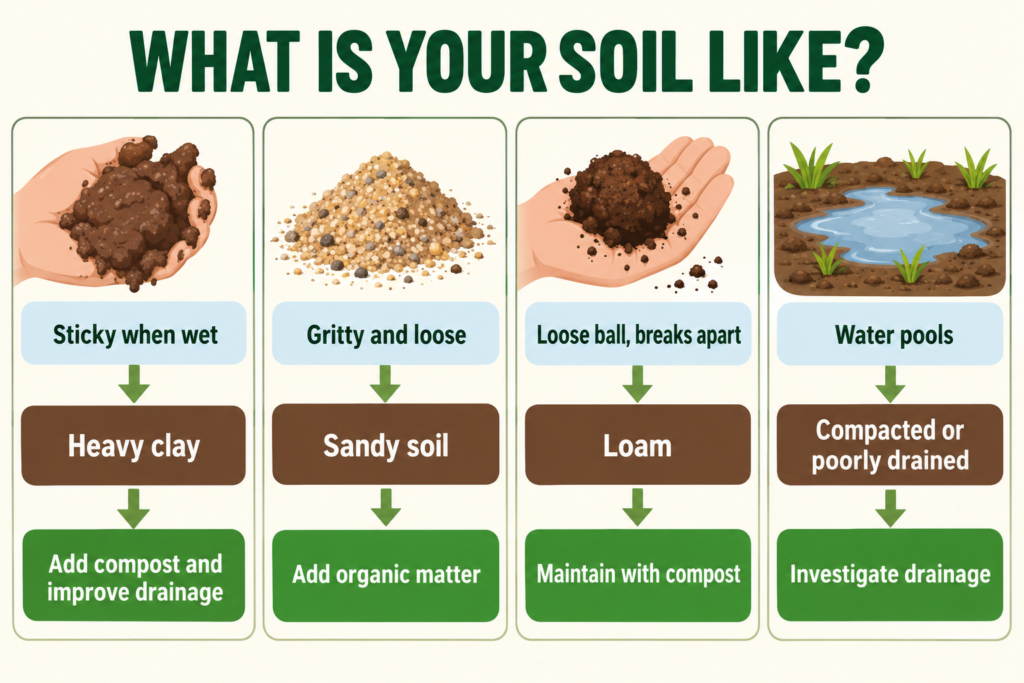
Wet soil feels sticky and mouldable, then dries into hard clods.
Likely: Heavy clay.
Best action: Improve drainage before planting Mediterranean herbs.
Moist soil feels gritty and will not hold together when gently squeezed.
Likely: Very sandy soil.
Best action: Increase organic matter to improve moisture retention.
Moist soil forms a loose ball but breaks apart with light pressure.
Likely: Well-structured loam.
Best action: Maintain with compost and mulch.
Water pools on the surface.
Likely: Compaction or poor drainage.
Best action: Investigate drainage before planting.
Garden Soil vs Potting Mix
| Garden Soil | Potting Mix |
|---|---|
| Used in garden beds | Designed for containers |
| Naturally supported by surrounding ground | Must provide all structure within the pot |
| Drains through surrounding soil | Relies entirely on container drainage |
| Can become compacted | Formulated to remain lighter |
This is an area that often confuses beginners.
Garden soil and potting mix are not interchangeable.
Never fill pots with soil dug directly from the garden.
It usually becomes compacted, reducing airflow and increasing the risk of root problems.
Improving Poor Soil
The good news is that very few soils are beyond improvement.
Heavy Clay
Symptoms:
- Sticky when wet.
- Hard when dry.
- Water drains slowly.
Improve by:
- ✔ Adding mature compost in moderate amounts over time.
- ✔ Avoiding small amounts of sand, which can make clay soil denser.
- ✔ Growing drainage-sensitive herbs in raised or mounded beds.
Avoid cultivating clay while it is very wet, as this can worsen compaction.
Sandy Soil
Symptoms:
- Dries rapidly.
- Nutrients wash away easily.
- Plants require frequent watering.
Improve by:
- ✔ Adding compost regularly.
- ✔ Applying mulch.
- ✔ Building organic matter over time.
Compacted Soil
Symptoms:
- Poor drainage.
- Weak root growth.
- Water pooling.
Improve by:
- ✔ Avoiding unnecessary foot traffic.
- ✔ Incorporating organic matter.
- ✔ Gently loosening the soil where appropriate.
Choosing Potting Mix
A good potting mix is one of the best investments you can make.
Look for products that are:
- ✔ Formulated specifically for containers.
- ✔ Suitable for herbs or vegetables.
- ✔ Free-draining while still holding some moisture.
- ✔ Loose and evenly textured, not compacted or water-repellent.
Avoid old, exhausted mixes that have lost structure.
Indoor herb containers
Indoor pots usually dry more slowly because they receive less wind and direct sun. Use a clean, lightweight potting mix that drains freely, ensure every pot has a drainage hole and empty excess water from saucers.
For broader indoor setup and care guidance, see the Indoor Herb Garden guide.
Outdoor herb containers
Outdoor pots can dry quickly in sun, heat and wind. Use quality potting mix with enough moisture retention for the herb type, then check the soil regularly rather than watering on a fixed schedule.
For more on container size, drainage holes and pot selection, see Growing Herbs in Pots.
Should You Add Compost?
Compost is useful in most garden beds, but more is not always better. Add moderate amounts to poor soil or use it as a surface amendment. In containers, begin with quality potting mix and add only small amounts of compost, as too much can reduce aeration and drainage.
Compost improves:
- Soil structure.
- Water-holding capacity.
- Biological activity.
- Nutrient availability.
However, constantly adding rich compost around Mediterranean herbs can encourage soft growth at the expense of flavour.
Balance is the goal.
🌿 Grow Herb Lab Soil-Feeding Framework
Feed the Soil First
Healthy plants begin with healthy soil.
Instead of asking:
“What fertiliser does my herb need?”
Ask:
“How can I improve the soil?”
Healthy soil supports beneficial organisms, better root development and more resilient plants.
Soil and Water Work Together
One of the biggest lessons in herb gardening is that watering and soil cannot be separated.
A watering schedule that works perfectly in sandy soil may drown herbs growing in heavy clay.
This is why Grow Herb Lab always teaches:
Water the Soil, Not the Calendar.
The soil determines how quickly water moves, how long it remains available to roots and when the next watering is actually needed.
For practical moisture checks and watering methods, use the Herb Watering Guide.
Common Soil Mistakes
- ❌ Using garden soil in containers.
- ❌ Choosing potting mix solely because it is cheap.
- ❌ Planting Mediterranean herbs into heavy clay without improving drainage.
- ❌ Assuming compost can fix every soil problem.
- ❌ Ignoring drainage after heavy rain.
🌿 Grow Herb Lab Insight
The best gardeners don’t memorise watering schedules.
They learn to read the soil.
That one skill improves almost every aspect of herb growing.
Healthy Garden Soil Is Alive
One of the biggest misconceptions in gardening is that soil is simply “dirt.”
Healthy soil is actually a living ecosystem.
Healthy garden soil contains vast communities of organisms, including bacteria, fungi, small invertebrates and earthworms. Together, they help break down organic matter, recycle nutrients and support the structure that allows roots to grow.
You don’t need to become a soil scientist to grow herbs successfully, but understanding that healthy soil is alive changes how you care for it.
Every time you improve your soil, you’re supporting an entire underground ecosystem that works on your behalf.
🌿 Grow Herb Lab Insight
Think of healthy soil as a community rather than a material.
The healthier the community below the ground, the healthier the plant above it.
Understanding Soil Structure
Soil is made up of tiny particles.
The size of those particles influences:
- How quickly water drains.
- How much oxygen reaches the roots.
- How easily roots can grow.
- How well nutrients are retained.
Clay Soil
Small particles packed closely together.
Benefits:
- Holds nutrients well.
- Retains moisture.
Challenges:
- Drains slowly.
- Compacts easily.
- Can reduce oxygen around roots.
Sandy Soil
Large particles with wide spaces between them.
Benefits:
- Excellent drainage.
- Good aeration.
- Easy root penetration.
Challenges:
- Dries quickly.
- Nutrient loss through leaching.
- Requires more organic matter.
Loam
A balanced mixture of sand, silt and clay.
Benefits:
- Good drainage.
- Good moisture retention.
- Strong root development.
- Excellent overall structure.
Loam is an excellent starting point for many herbs, although Mediterranean herbs may still need improved drainage in wet climates or low-lying sites.
🌿 Grow Herb Lab Long-Term Soil Framework
Build Soil Gradually
Healthy soil isn’t created in one afternoon.
It develops over months and years through consistent care.
Every season you can improve it by:
- ✔ Adding compost.
- ✔ Avoiding unnecessary compaction.
- ✔ Keeping living roots in the soil where practical.
- ✔ Protecting the surface with mulch when appropriate.
Small improvements compound over time.
Raised Beds
Raised beds are one of the easiest ways to overcome difficult soil.
They are especially useful when:
- Garden soil is heavy clay.
- Drainage is poor.
- You want greater control over soil quality.
For Mediterranean herbs, well-designed raised beds can provide better drainage, provided the growing mix is free-draining and excess water has somewhere to escape.
Containers vs Garden Beds
| Containers | Garden Beds |
|---|---|
| Greater control over soil | Larger root zone |
| Easier to improve drainage | Less frequent watering once established |
| Portable | Better long-term stability |
| Ideal for balconies and patios | Excellent for larger herb gardens |
Neither approach is universally better.
Each has advantages.
Choose the method that best suits your available space and gardening style.
Soil pH
Many beginners worry about pH far too early.
For most home herb gardens, it is not the first thing to optimise.
Most culinary herbs grow well in slightly acidic to neutral soil, commonly around pH 6.0–7.0. Some Mediterranean herbs also tolerate mildly alkaline conditions.
If you suspect a pH problem, test the soil before adding lime, sulphur or other pH-adjusting products.
Unless you know your soil has an extreme pH, focus first on:
- Drainage.
- Structure.
- Organic matter.
These factors usually have a greater impact on success.
Common Questions
Is compost enough for every herb?
No.
Compost improves many soils, but Mediterranean herbs still require good drainage.
Should I replace all my garden soil?
Rarely.
Most soils can be improved gradually rather than replaced completely.
How often should I replace potting mix?
Check the mix each year rather than replacing it on a rigid schedule. Refresh or replace it when it has collapsed, become compacted or water-repellent, drains poorly or no longer supports healthy growth. Many permanently potted herbs benefit from partial renewal every one to two years.
Can I reuse old potting mix?
Yes, if the previous plant was healthy and the mix is not infested, badly compacted or water-repellent. Remove old roots and blend it with fresh potting mix before reuse. Discard mix from plants affected by root disease or persistent pests.
🌿 Key Takeaways
- ✓ Healthy soil supports healthy roots.
- ✓ Good structure is often more important than high fertility.
- ✓ Loam provides an excellent balance for many herbs.
- ✓ Mediterranean herbs require particularly good drainage.
- ✓ Improving soil is usually more effective than replacing it.
- ✓ Healthy soil becomes better over time with consistent care.
Continue Learning
🌱 Your Next Steps
Now that you understand soil, continue building your herb-growing skills.
📚 Reference Handbook
- Herb Watering Guide
- Herb Sunlight Guide
Soil, water and light form the foundation of successful herb gardening.
🛠 Problem Solver
Many plant problems become much easier to solve once you understand how soil influences root health.
🌿 Complete Growing Guides
Apply these soil principles to:
You’ll see how different herbs prefer different soil conditions while sharing the same fundamental need for healthy roots.
📥 Free Resources
Download:
Keep them nearby as practical references while gardening.