Growing lavender starts with choosing a plant that suits your climate, then giving it full sun and soil that drains freely. Water carefully while it establishes, check moisture rather than following a fixed calendar, and prune within leafy growth to keep the plant compact. Lavender in a pot needs closer attention than an established plant in the ground.
The familiar purple flowers are only part of its appeal. Lavender brings fragrant foliage, flowers for picking and food for visiting pollinators. Its success depends more on the right position and steady maintenance than on frequent feeding.
| Quick facts | What to know |
|---|---|
| Plant type | Aromatic, evergreen shrub in the mint family; size varies by species and cultivar. |
| Position | Full sun, with room for air to move through and around the plant. |
| Soil | Freely draining soil; avoid ground that stays waterlogged. |
| Water | Monitor new plants and containers; established garden plants generally need less frequent attention. |
| Feeding | Modest needs; check the soil or potting mix before adding fertiliser. |
| Pruning | Trim while retaining leafy growth below each cut. |
| Uses | Garden flowers, dried stems and sachets; identified food-grown English lavender for culinary use. |
What lavender is and why grow it
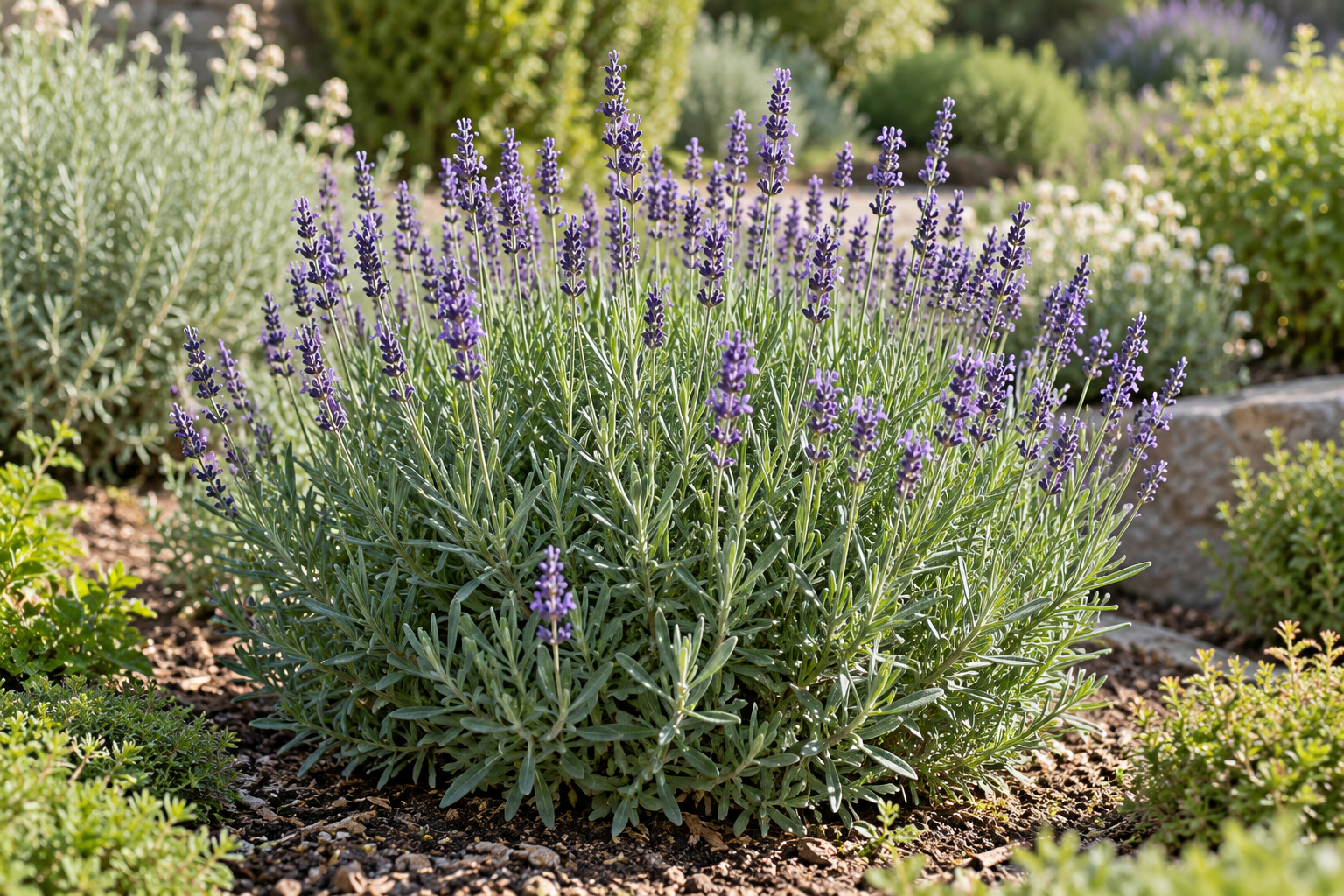
Lavender belongs to the genus Lavandula. Its stems become woody as the plant matures, while leaves and fresh shoots grow around the outer part of the shrub. This explains why regular shaping helps, and why cutting an old plant back to a bare framework can leave it unable to recover.
Choose lavender for a sunny border, a container near a path or a small flower garden where you can enjoy its scent. Bees visit the flowers, and stems can be picked for indoor arrangements. If cooking is your main aim, choose an identified culinary plant rather than assuming every lavender on a nursery bench has the same use.
Choose the right lavender
Common names can be confusing. In Australia, French lavender usually means Lavandula dentata, while some overseas guides use “French” for Lavandula stoechas. Check the botanical name and the cultivar label before comparing advice.
| Lavender group | Typical features | What to check before buying |
|---|---|---|
| English lavender — Lavandula angustifolia | Narrow leaves, scented flower spikes and many compact cultivars; identified varieties are used in cooking. | Local summer humidity, mature size and the cultivar’s frost tolerance. Often a good candidate for cooler, drier conditions. |
| French or toothed lavender — Lavandula dentata | Toothed leaves; can form a substantial shrub and flower over a long period in suitable conditions. | Available space and exposure to frost; do not assume the nursery plant will remain small. |
| Spanish or Italian lavender — Lavandula stoechas | Distinctive flower heads topped by conspicuous petal-like bracts. | Local weed advice and restrictions before selecting it; this species can escape into natural areas. |
| Lavandin — Lavandula × intermedia | A hybrid group often forming larger plants with long flower stems. | Mature width, intended use and flowering pattern; it may outgrow a small border or container. |
There is no single best lavender for every Australian beginner. Ask a local nursery which named cultivars perform reliably in your area, then match that advice to your own site. A plant suited to a dry inland garden may struggle in a humid coastal one.
For L. stoechas, check your state or territory weed authority and local council. Weeds Australia describes its environmental impacts. Local advice matters; a plant being offered for sale does not establish that it is a suitable choice near bushland.
Match lavender to your climate and position
Choose an open position receiving full sun. Six or more hours of direct sun is a useful benchmark, but observe the actual site across the season. A spot shaded by summer foliage or a nearby wall may receive less light than it appears to in winter.
Cooler and temperate gardens
English lavender is generally more cold tolerant than French or toothed lavender, although individual cultivars differ. Choose plants with hardiness suited to your local frosts. Avoid a low point where water collects during winter, even if the position is sunny.
Plant when the soil is workable and conditions allow the roots to establish before severe weather. Use local frost and rainfall patterns rather than a single planting month for all of Australia.
Hot, dry gardens
Dry air and good drainage suit many lavenders, but a newly planted shrub still needs help through hot weather. Avoid planting immediately before a heatwave. A small nursery root ball can dry out while surrounding soil remains moist, so check both during establishment.
Rosemary, thyme and sage may suit a similar sunny setting. Plan their mature widths and watering needs before grouping them; sharing a border does not guarantee pest protection or better growth.
Humid and subtropical gardens
Heat and humidity are different challenges. A plant tolerating dry heat is not automatically suited to warm nights, frequent rain and persistently damp foliage. In humid areas, give lavender generous space, an open position and especially good drainage. A container may make drainage easier to manage, but it will not remove the effects of humid weather.
Choose a locally proven cultivar and watch how it performs through the wet season before planting a large group. Crowding several plants into a sheltered corner makes airflow harder to maintain.
Prepare the soil and plant carefully
Lavender needs water to move away from its roots. Heavy soil is not automatically unusable, but a planting hole that fills with water is a poor starting point. Assess the whole growing area after rain, including any runoff from roofs, paths or higher ground.
Where drainage is unsuitable, consider a broad raised planting area, a raised bed or a container. Adding a little sand or gravel to one hole does not reliably fix the surrounding ground. Likewise, stones on the surface cannot correct waterlogged soil underneath.
Many lavenders suit neutral to alkaline soil. If you are considering lime, test the soil first and check the needs of the chosen plant. Do not add it routinely: changing pH unnecessarily can create another growing problem.
Use this planting sequence:
- Inspect the plant. Choose healthy foliage and check that the root ball is moist enough to handle, with no obvious signs of prolonged saturation or severe drying.
- Prepare enough space. Allow for the labelled mature width and access for trimming. Keep neighbouring plants from closing over the lavender.
- Check drainage across the site. Resolve pooling or runoff before planting, rather than hoping a deeper hole will help.
- Keep the existing planting level. Set the root ball so the stem base is not buried below its former level. Gently firm the soil around it.
- Water in and reassess. Wet the root ball and adjacent soil, let excess water drain, then monitor both as the plant establishes.
For broader soil choices, use the guide to soil mixes for herbs. Keep heavy compost applications and moisture-holding material away from the stem base; lavender does not need a rich, permanently damp bed.
Grow lavender in pots
A container is useful where garden drainage is poor or you need to move a plant to a sunnier position. Choose drainage holes, a suitable outdoor potting mix and enough room for the selected cultivar. A pot around 30–40 cm across can be a starting point for a suitable plant, rather than a minimum or final size for every lavender.
Check the mature size on the label. A large French lavender or lavandin may need substantially more space than a compact English cultivar. Pot size, plant size and exposure also affect how quickly the mix dries.
Use a mix intended for containers, and check its fertiliser content before adding anything else. Avoid relying on a fixed homemade recipe for every climate. Make sure water can leave the pot, and empty a saucer if it holds standing water. Position the container where you can check moisture and trim the plant easily.
The guide to growing herbs in pots explains the broader container setup and maintenance decisions.
Water and feed according to the growing stage
Newly planted lavender
Young roots need moisture while they grow beyond the nursery root ball. Check beneath the surface near the root ball and in the surrounding soil; the two can dry at different rates. Surface colour alone is not a reliable guide.
If the root zone is drying, water slowly enough to wet it rather than repeatedly dampening only the surface. Allow excess water to drain. If the soil remains wet, investigate drainage before adding more. Recent rain, wind, temperature and plant size all affect the next watering decision.
Do not wait for a new plant to collapse or let its root ball become completely dry simply because lavender is described as drought tolerant.
Established plants in the ground
Established lavender in suitable soil usually needs less supplementary water. During prolonged dry weather, check the root zone and the plant’s condition before deciding whether to irrigate. Wilting by itself does not prove thirst: damaged roots in wet soil can also leave a plant wilted.
Keep watering decisions separate from feeding decisions. Slow growth or yellow foliage calls for a check of light, drainage, roots and recent weather before fertiliser. Lavender generally has modest feeding needs, and excessive nutrition can encourage leafy growth at the expense of flowers.
Container plants
Potted lavender relies on a limited volume of mix and may need more frequent watering checks, especially in warm or windy weather. Check below the surface, water the root zone when needed and let surplus water escape. Do not apply a garden-bed watering interval to every pot.
Potting mix may already contain fertiliser. Check the label, the age of the mix and the plant’s condition before adding more; follow the product directions if feeding is warranted. Routine annual compost or fertiliser is not a requirement for every lavender.
Use the herb watering guide for moisture checks and fertiliser guidance for herbs when deciding whether feeding is needed.
Prune lavender and manage woody growth
Remove spent flowers
Use clean, sharp secateurs to remove faded flower stems, cutting above healthy leafy growth. This tidies the plant without removing large amounts of foliage. Look at where the flower stem meets the leafy part of the shrub before making the cut.
Shape a healthy plant
The position of the cut matters more than a fixed fraction: leave healthy leafy growth below every shaping cut. Look beneath the outer foliage before trimming. If the proposed cut would leave a bare woody stem, move it higher.
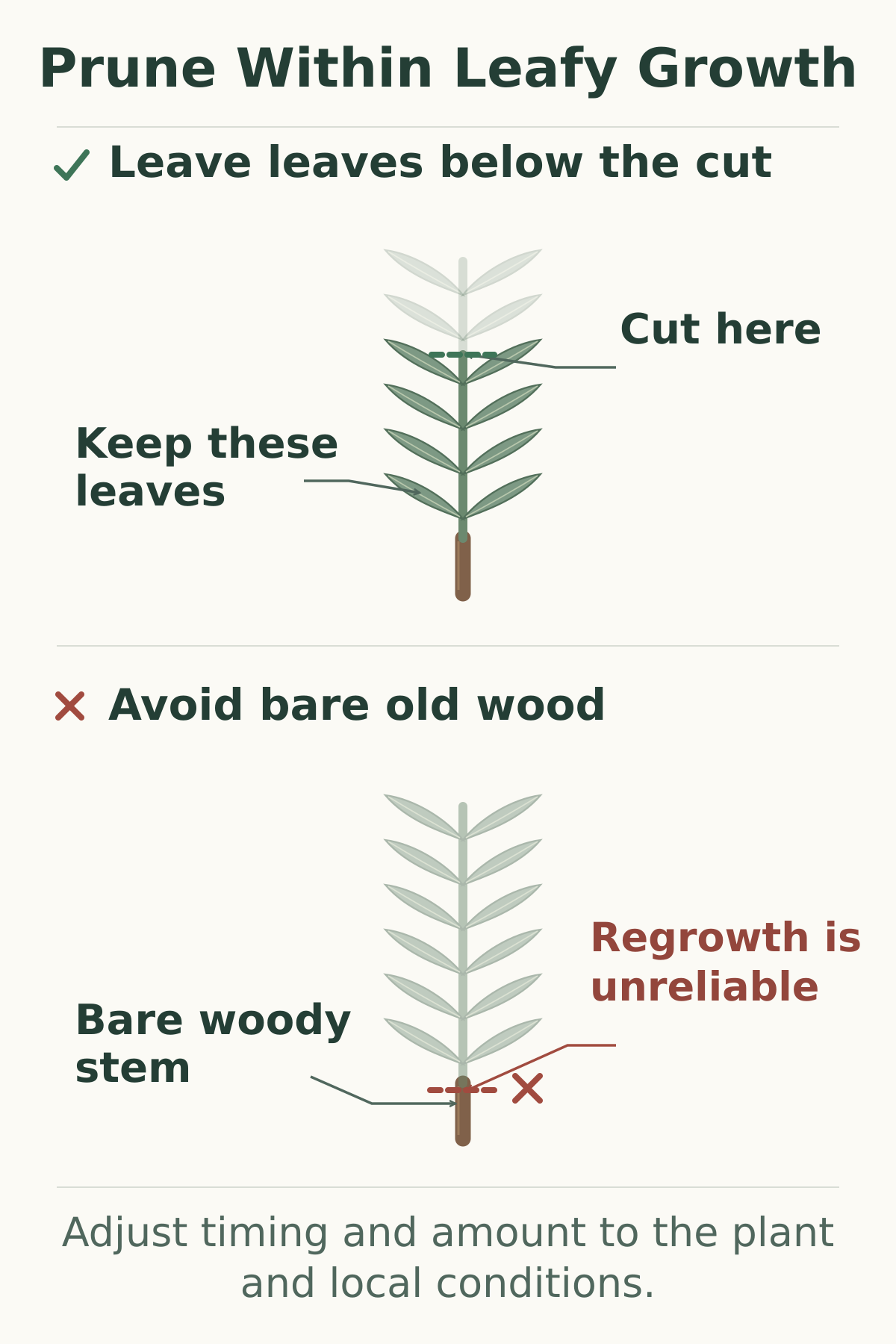
After a flowering cycle, trim suitable leafy shoots to maintain a compact outline. Adapt timing to the type of lavender, its current growth and local frost risk. Avoid a hard trim just before severe cold, or during stress from heat, drought or waterlogging. Some plants need only a light tidy; others have enough fresh growth for more shaping.
Regular attention from a young age is easier than correcting years of untrimmed growth. It helps manage shape but does not stop lavender from becoming woody. Gardening Australia’s pruning demonstration shows a light maintenance approach.
Assess an older woody plant
Check where living leafy shoots remain. Do not cut an old shrub to a bare stump expecting reliable regrowth. Large gaps, split stems and extensive leafless wood can make replacement more practical than a drastic rescue prune.
If healthy shoots remain, take cuttings before replacing the parent. You can then establish a young plant while deciding whether the old one still contributes enough flowers or shape to keep.
Propagate lavender from cuttings or seed
Cuttings are useful when you want another plant with the parent’s characteristics. Select healthy, non-flowering shoots during suitable active growth. Use clean tools to take a shoot tip about 10 cm long, making the lower cut just below a leaf joint.
Remove the lower leaves so they will not be buried. Insert the prepared stems into a clean, freely draining propagation medium and firm gently. Keep the medium lightly moist rather than saturated, and place the cuttings in bright, sheltered light away from harsh direct sun.
Check regularly for drying, decay and new growth. Roots develop at different rates, so do not rely on a fixed deadline. Once rooted, pot the plants on and gradually introduce them to their final outdoor conditions. New leaves alone are not proof that a cutting has a strong root system.
Seed is another option for suitable types, but plants may vary from the parent and take longer to reach flowering size. Follow the seed supplier’s instructions for the named variety. If a particular flower colour, habit or scent matters, cuttings from a known plant are the more predictable route.
Diagnose common lavender problems
Start with the conditions around the plant. Check the moisture below the surface, drainage, light, recent weather and the stem base before deciding on treatment. Several problems can produce similar symptoms.
| What you see | What to check | First action |
|---|---|---|
| Yellowing foliage or general decline | Root-zone moisture, drainage, light, recent feeding and the pattern of affected leaves. | Correct a clear growing-condition problem before feeding or spraying. |
| Wilting while the soil is wet | Persistent saturation, blocked drainage and signs of root or stem-base damage. | Stop adding water to wet soil; improve drainage and assess root health. |
| Wilting with a dry root ball | Whether water reaches the roots, especially after planting or in a pot. | Water the root ball carefully, allow drainage and monitor recovery. |
| Few flowers | Sun exposure, plant age, flowering season, pruning history and excessive feeding. | Check the expected flowering pattern and improve the limiting condition. |
| Woody gaps, sprawling or split growth | Where healthy leaves remain and whether stems are structurally sound. | Trim only within leafy growth; consider cuttings and replacement for a badly deteriorated plant. |
| Visible insects or damaged shoots | Pest identity, extent of damage and beneficial insects visiting the plant. | Inspect closely and choose a proportionate response to the identified problem. |
Persistently wet conditions can favour root disease, but a wilted plant is not automatically a case of root rot. If decline continues, the root rot guide helps with the next checks. A severely damaged plant may not recover simply because watering has been reduced.
If you identify aphids clustered on soft growth, follow the aphids on herbs guide. Avoid treating an unidentified insect with a routine spray, particularly around flowers being visited by pollinators.
Harvest, dry and use lavender flowers
Choose stems according to their purpose. For dried flowers, harvest when the first flowers on a spike are opening, before the whole head has finished blooming. For a fresh decorative arrangement, you may prefer more open flowers. Pick after dew has dried, and cut above retained leafy growth.
Dry stems in small bundles or spread them in a single layer in a dry, shaded, well-ventilated place. Dense bundles and damp rooms slow drying. Check the material through the process rather than sealing it away on a set day.
Once thoroughly dry, store flowers in a clean, airtight container away from moisture and strong light. Keeping damp flowers in sealed storage can spoil the harvest. Dried flowers can be used in sachets, small arrangements and other craft projects.
For food, use correctly identified English lavender grown for culinary use, with a known history of suitable treatments. Do not use florist stems or assume an ornamental nursery plant is ready to eat. Washing does not remove every possible treatment residue. The University of Minnesota’s edible-flower guidance explains why identification and growing history matter.
Start with a small amount in a recipe intended for culinary lavender; the flavour can be strong. Decorative flowers, culinary flowers and concentrated essential oils are not interchangeable ingredients.
Frequently asked questions
Can lavender grow indoors?
Most indoor positions do not provide the sustained direct sun and airflow lavender needs. An outdoor sunny position is usually easier to manage. Assess the actual light and growing conditions rather than relying on a bright-looking room.
Can I grow lavender in a humid climate?
It is possible with a suitable locally proven cultivar and careful site selection, but results vary. Drainage and spacing help; they cannot guarantee performance through a wet, humid summer. Start with one plant and assess it across the seasons.
Can old woody lavender recover?
Recovery depends on the living growth that remains. Bare old wood often fails to reshoot after a hard cut. Keep cuts within leafy growth, and consider taking healthy cuttings before replacing a deteriorated shrub.
How long will a lavender plant remain useful?
There is no dependable lifespan for every type and setting. Judge the plant by healthy growth, flowering and structure rather than a promised number of years. Replace it when its condition no longer suits the garden.
Is every lavender suitable for cooking?
No. Choose identified culinary English lavender with a known food-growing history. Common names, flower colour and fragrance alone do not establish suitability.
Continue learning
For another herb suited to a sunny garden with good drainage, explore the rosemary growing guide or thyme growing guide. Check each plant’s mature size and care needs before combining them with lavender.
If you are organising your first herb garden, the Beginner Herb Growing Kit provides the next planning step. For an existing lavender plant, begin with one useful check today: its sunlight, root-zone moisture or the leafy growth available for the next trim.