Start herb seeds by matching the sowing method and conditions to the herb and its seed-packet instructions. Keep the sowing layer moist with good drainage, use the correct depth or surface-sowing method, and allow a suitable waiting period before changing the setup.
This reference helps you choose conditions, interpret germination guidance and check slow or uneven results. The comparison covers sweet basil, parsley, common chives, coriander and dill. Other herbs may need different methods. Germination and the first appearance of seedlings are the focus here; ongoing establishment needs its own care.
🌿 In this guide
- How herb seeds germinate
- Herb seed germination comparison
- Choose germination conditions
- 🌱 Beginner checklist
- Adapt the guidance to your growing space
- 📅 Seasonal growing calendar
- ⚠️ Common mistakes
- 🛠 Troubleshooting slow or failed germination
- 🌿 Frequently asked questions
- 🌿 Key takeaways
- 🌿 What success looks like
- 🌿 Continue learning
- 🌿 Final thoughts
🌿 Grow Herb Lab quick facts
| Starting decision | What to check |
|---|---|
| Which herb? | Use the named species or variety on your packet; common chives and garlic chives are different species. |
| What temperature? | Check whether advice describes air, growing medium or bottom heat. The labels are not interchangeable. |
| How wet? | Moist enough for germination, with drainage and air in the medium; avoid persistent saturation. |
| How deep? | Use the packet method. Some seeds are covered; others need light during germination. |
| How long? | Use a condition-specific estimate. Time to emergence is different from time to transplant or harvest. |
| What changes next? | Once seedlings emerge, provide suitable light and move into seedling care. |
How herb seeds germinate
Germination and emergence are different stages
A seed begins germination before you can see a shoot above the surface. Water uptake starts the process; a root develops, followed by the shoot. Emergence is the visible seedling appearing through the medium. An empty-looking tray can therefore contain seeds that have begun to grow. Repeatedly digging them up is a poor way to monitor progress. [9]
Temperature, moisture and oxygen work together
Seeds need suitable temperature, water and oxygen. Saturation or compaction can restrict gas exchange; adding more water to an already wet tray may worsen the conditions. An optimum temperature is a favourable germination condition, not a minimum threshold for every seed. [3]
Check the environment you are actually using. A room reading, a heated-mat setting and the temperature of the growing medium describe different things. Use a thermometer suited to the medium and follow its instructions; take care around the sown layer. If advice specifies air temperature, retain that context when comparing your setup.
Light before and after emergence
Light requirements during germination vary between plants. Covering a seed can affect both its light exposure and how far the shoot must grow. Once seedlings emerge, adequate light is needed for growth even if their seeds were covered. [3] A warm, dim shelf may start seeds but still produce weak, stretched seedlings. [14]
Seed viability and dormancy
Viability means a seed is alive and capable of germination. Species, seed age and storage conditions influence it; a packet date is useful context, not a test of every individual seed. [12] Dormancy is different: a living seed can resist germination even when its surroundings appear suitable. Special treatment depends on the species. Do not soak, scratch or chill every herb seed as a routine. [3]
Herb seed germination comparison
Use this table as a comparison of named guidance, with your packet as the starting instruction. The temperature examples describe different setups. Waiting times are indicative under the stated conditions; they are not guarantees.
| Herb | Temperature context | Indicative wait | Cover or sowing note |
|---|---|---|---|
| Sweet basil Ocimum basilicum | 18–21°C air in Iowa chart. [2] RHS gives about 20°C. [4] | 10–14 days in chart. [2] | Chart says cover; RHS uses surface sowing. Follow your packet method. [2] [4] |
| Parsley Petroselinum crispum | 21–24°C air in chart. [2] RHS propagation advice: 18°C bottom heat. [8] | 20–25 days in chart; outdoors can take six weeks in RHS guidance. [2] [5] | Cover as directed; RHS growing guide uses about 1 cm. [5] |
| Common chives Allium schoenoprasum | RHS propagation advice: 18°C bottom heat. [8] | Use the packet estimate. | RHS recommends sowing 0.5–1 cm deep in warm conditions. [6] |
| Coriander Coriandrum sativum | Use the packet and local sowing guidance. | About 1–3 weeks outdoors, depending on temperature. [7] | Lightly cover; direct sowing avoids later root disturbance. [7] |
| Dill Anethum graveolens | 18–21°C air in Iowa chart. [2] | 7–14 days in chart. [2] | Chart lists light for germination; RHS advises shallow sowing. Check packet depth. [2] [8] |
Iowa State labels its chart values as ideal air temperatures. They are converted from Fahrenheit and rounded to whole degrees Celsius here. Do not relabel them as measured soil optima or maximum tolerances. [2]
Read the context before choosing a method
The basil entries show why a chart cannot replace complete sowing instructions: RHS describes a surface-sown method at about 20°C, while the Iowa chart lists covered seed. [2] [4] Choose the method supplied with your seed. If instructions are missing or unclear, ask the supplier rather than combining incompatible steps.
Parsley also shows why a short deadline can mislead. An outdoor sowing can take longer than a controlled indoor example. Keep its stated conditions and waiting window together. [5] For herb-specific growing decisions after emergence, use the basil growing guide or parsley growing guide.
🌿 Grow Herb Lab framework: Choose conditions before counting days
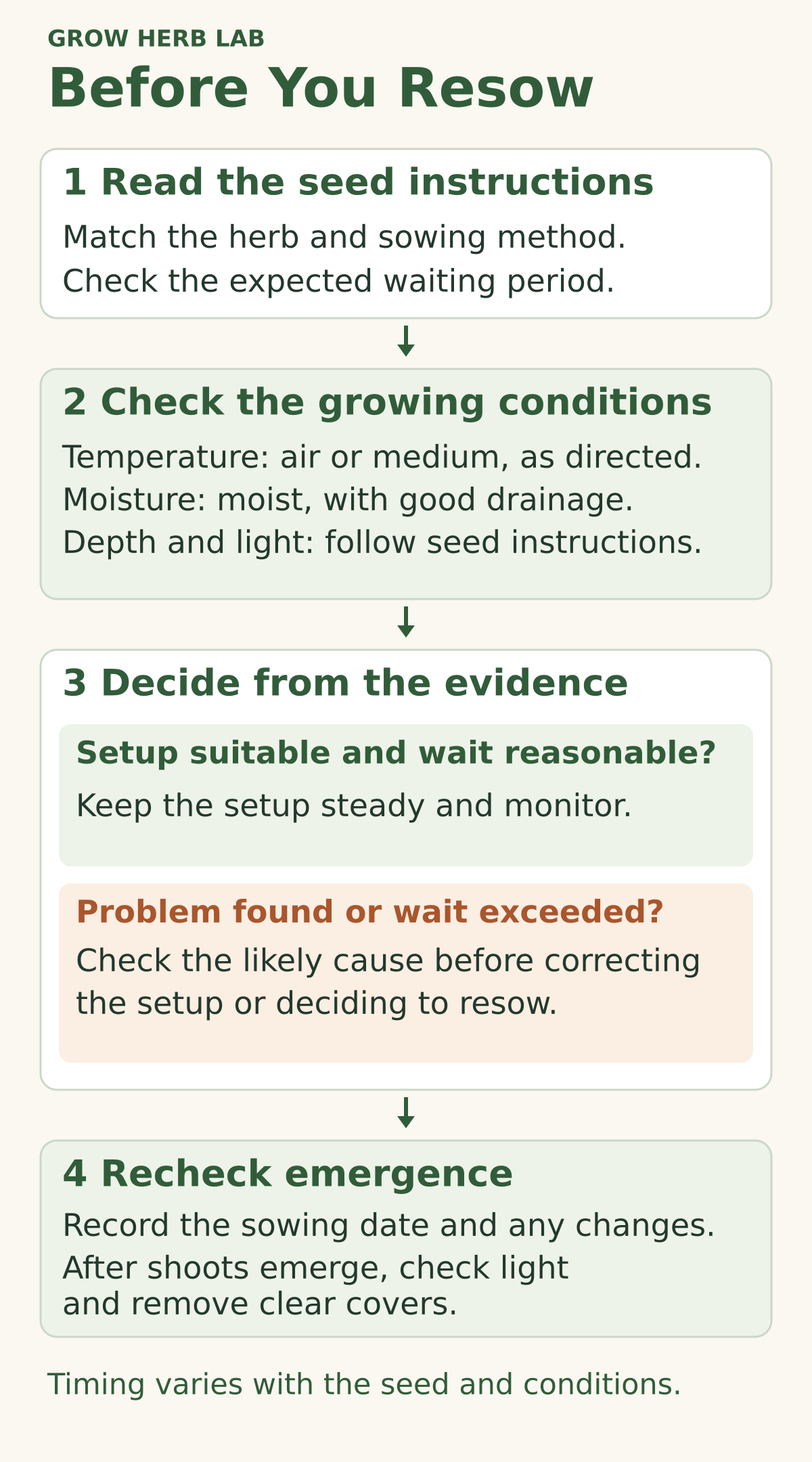
Use this observation → decision → action → review method before sowing and whenever progress seems slow.
- Observe. Record the herb, packet instructions, sowing date and location. Check moisture, drainage and temperature context. Is anything visibly wrong, or is emergence simply not due yet?
- Decide. Choose between sowing now, using a suitable protected setup, or waiting for better outdoor conditions. Once sown, decide whether the evidence supports patience or a specific correction.
- Act. Follow one appropriate depth or surface-sowing method. Correct the issue you found, such as excess standing water or an unsuitable location. Note the change so later results can be interpreted.
- Review. Compare the observed conditions with the relevant waiting window. Record first emergence and whether growth continues. Use the troubleshooting table if conditions or results remain unclear.
For example, a parsley tray with no visible seedlings after a few days has not established failure. First check the method, dates and conditions. Treat evidence of persistent saturation differently from a normally slow start; do not respond to both by pouring on more water.
🌱 Beginner checklist
- Identify the herb and variety; keep the packet for reference.
- Check sowing depth, temperature context, light requirements and any special treatment specified for that seed.
- Choose a tray, pot or final bed location appropriate to the method.
- For trays, use clean equipment, new suitable seed-raising mix and drainage holes. [10]
- Moisten the medium before sowing and let excess water drain. [1]
- Sow at the specified depth or on the surface, using gentle watering that does not wash seeds away. [13]
- Label the sowing with the herb and date; record the packet’s expected waiting time. [13]
- Check conditions regularly, then prepare suitable light and aftercare for the emerging seedlings.
Adapt the guidance to your growing space
Trays and containers
A fine seed-raising mix helps small seeds make contact with the medium. Use containers that drain freely and avoid packing the mix hard. [1] A large pot of mature-herb mix is not automatically the best sowing setup. The relevant choice is the mix and method suited to the seed, followed by an appropriate growing medium as the plant develops.
For later pot and bed decisions, see best soil for herbs. Avoid switching to a mature herb’s dry-soil routine while its seeds are still germinating.
Direct sowing in garden beds
Prepare a fine, reasonably level sowing surface, remove weeds and large stones, and use the packet depth and spacing. Water gently so seeds stay in place; mark the sown area and date. [13] Outdoor results also depend on the weather after sowing. Check the sown layer instead of assuming recent rain reached it adequately.
Coriander dislikes transplanting, so sowing in its intended position is often useful. [7] For the growing stage, use the coriander guide and dill guide.
Protected and indoor sowing
Choose a location you can monitor. A windowsill can swing between cold nights and strong daytime heat. [1] A clear cover can reduce moisture loss, but it is temporary: RHS recommends removing it when seedlings appear. [9] Keep checking the sowing layer during that transition rather than compensating with a permanently sealed, wet environment.
Assess light where the seedlings will grow. A bright-looking room is not always a suitable seedling position; supplemental lighting may be needed. [14] The herb sunlight reference explains the broader growing-stage light decisions.
Herbs outside the core comparison
Do not extend these five rows to all herbs. Thyme, oregano, mint and woody herbs can involve different propagation choices. RHS describes division or cuttings for several of them as well as seed sowing for some. [8] Use the correct species guidance and packet instructions before adding a new herb to your sowing plan.
📅 Seasonal growing calendar
Australia includes tropical, subtropical, arid and temperate settings, so one national sowing-month list is inadequate. [11] Use this seasonal decision calendar with the herb’s instructions, local forecasts and the actual growing conditions. The actions are practical adaptations of the germination principles above, not fixed regional planting dates.
| Local seasonal conditions | Decision to make | Practical response |
|---|---|---|
| Cool or frost-prone period | Can this herb germinate and continue growing in the current setup? | Wait for a suitable outdoor window or use appropriate protection. Plan for seedlings after emergence, not just a warm starting tray. |
| Mild, suitable sowing window | Do the packet conditions match the bed or container? | Sow using the species method; label and monitor the sowing layer. A comfortable air temperature alone is not sufficient evidence. |
| Hot, dry or windy period | Can you keep the sowing environment from overheating or drying out? | Choose a manageable position or delay sowing. Increase checks when conditions change; do not replace checking with a fixed watering volume. |
| Wet or humid period | Is drainage adequate, and can the medium retain air? | Avoid sowing into waterlogged conditions. Check trays and any covers, and reconsider the location if persistent saturation continues. |
Northern Hemisphere adaptation
Use the same decisions against your local spring, summer, autumn and winter conditions. UK and US sowing dates describe their own locations. A six-month calendar shift does not account for frost dates, altitude, rainfall or indoor growing. Keep the temperature and species requirements; replace location-specific timing with suitable local advice.
⚠️ Common mistakes
| Common mistake | Better approach |
|---|---|
| Using one temperature for every herb | Keep each example’s species, method and measurement label. Check your seed instructions. |
| Burying every seed the same way | Use the required cover or surface method; light-sensitive germination needs its own instructions. |
| Keeping the tray saturated | Check drainage and moisture at the sown layer before adding water. |
| Calling a sowing failed too early | Compare elapsed time with the relevant species and conditions, then check the setup. |
| Soaking or chilling every herb seed | Use special treatment only where reliable species or packet guidance specifies it. |
| Planning only for germination | Prepare light and seedling care before shoots appear; remove temporary covers appropriately. |
When correcting a mistake, record what changed. This makes the next sowing easier to interpret and prevents a slow result from turning into several untracked experiments.
🛠 Troubleshooting slow or failed germination
An observation suggests what to inspect; it does not identify a single cause. Check the simplest explanations first and avoid disturbing every seed to look for progress.
| What you observe | Possible explanation | First check or action |
|---|---|---|
| Nothing visible yet | Normal waiting time, unsuitable conditions, seed viability or another failure | Read the packet window; verify date, depth, moisture and temperature context. Do not conclude failure from elapsed time alone. |
| Patchy emergence | Uneven sowing, moisture or temperature; variable seed viability | Compare wetter/drier areas and position. Record the pattern before changing the whole tray. |
| Exposed sowing layer drying | The surface is losing moisture faster than expected | Check the sown layer and location. Moisten gently when needed without flooding the container. |
| Mix stays wet or water stands below the tray | Poor drainage or repeated watering beyond need | Empty excess standing water and check drainage. Stop adding water to persistently saturated mix. |
| Seedlings emerge, then soften or collapse | Damping off is possible; physical damage or other stress also needs checking | Inspect stem bases, moisture and hygiene. Remove affected seedlings and avoid carrying suspect mix or water into clean sowings. [10] |
| Seedlings become tall and thin | Insufficient light may be involved after emergence | Assess actual light at seedling level and suitable supplemental lighting. Do not treat stretching as proof of germination failure. [14] |
Damping off can also prevent emergence. Soft or constricted stems and collapse deserve attention, but no-emergence alone proves neither disease nor dead seed. Clean equipment, fresh suitable mix and good drainage reduce avoidable risk. [10]
If a sowing is beyond its expected window with no progress, review the seed lot and conditions before deciding to start again. Old or poorly stored seed may have lower viability. [12] Re-sowing is most useful when you also correct a known problem or use a sound replacement lot.
Once seedlings are growing, use how to water herb seedlings, transplants and newly repotted herbs for ongoing watering and establishment. That stage needs different observations from an unsprouted tray.
🌿 Frequently asked questions
Do all herb seeds need the same temperature?
No. Use the named herb and sowing method, and check what the temperature measures. The examples in this reference include air-temperature charts and bottom-heat advice; they should not be treated as one universal soil setting.
Must I soak every herb seed?
No. Start with the seed instructions. A species-specific treatment may be useful or necessary, but slow emergence alone does not establish a need for soaking or chilling. [3]
Do seeds need light before they emerge?
Some do, while others are covered. Follow the packet method and the relevant herb guidance. After emergence, seedlings need adequate light for growth, including those whose seeds were covered. [14]
How long should I wait before re-sowing?
Use the relevant estimate and recorded conditions, then inspect the setup. Parsley can take substantially longer outdoors than a short indoor example. [5] If progress remains absent beyond the expected window, review seed viability and correct conditions before starting again.
Can I use this calendar outside Australia?
Yes, as a decision framework. Use local seasons, forecasts and species instructions. The calendar does not prescribe Australian months or assume that opposite hemispheres have matching growing conditions.
🌿 Key takeaways
- Start with the herb’s seed instructions and retain the packet.
- Keep temperature labels, sowing method and waiting time together.
- Maintain moisture without losing drainage and aeration.
- Record conditions before deciding to wait, correct the setup or re-sow.
- Prepare light and seedling care for the stage after emergence.
🌿 What success looks like
You begin to see seedlings within a plausible window for that species, lot and setup. They remain upright and continue developing, while the medium drains instead of staying saturated. Emergence may be uneven; a whole tray need not appear on the same day.
The next useful sign is continuing healthy growth, not merely the first shoot. Once that transition is underway, shift to the herb’s seedling and establishment care rather than keeping the germination setup unchanged.
🌿 Continue learning
🌿 Related growing guides
Carry the germination decisions into herb-specific care with the basil, parsley, coriander and dill guides.
📚 Reference guidance
Use herb sunlight requirements to assess the growing position and best soil for herbs when choosing the later pot or bed medium.
🛠 Problem solving
For the next growth stage, follow the seedling watering and establishment guide.
📥 Free resources
For beginner checklists and broader herb-care references, visit the free herb growing kit.
🌿 Final thoughts
A useful sowing record turns a slow or disappointing result into a clearer next decision. Match the method to the seed, check the conditions you can observe, and change the setup for a reason you can identify.
Sources
- University of Minnesota Extension — Starting seeds indoors
- Iowa State University Extension — Germination Requirements for Annuals and Vegetables
- Penn State Extension — Seed and Seedling Biology
- Royal Horticultural Society — How to grow basil
- Royal Horticultural Society — How to grow parsley
- Royal Horticultural Society — How to grow chives
- Royal Horticultural Society — How to grow coriander
- Royal Horticultural Society — Herbs propagating
- Royal Horticultural Society — How to sow seeds indoors
- University of Minnesota Extension — How to prevent seedling damping off
- Bureau of Meteorology — Australian climate zones
- Royal Horticultural Society — Seed collecting and storing
- Royal Horticultural Society — How to sow seeds outdoors
- University of Minnesota Extension — Lighting for indoor plants and starting seeds