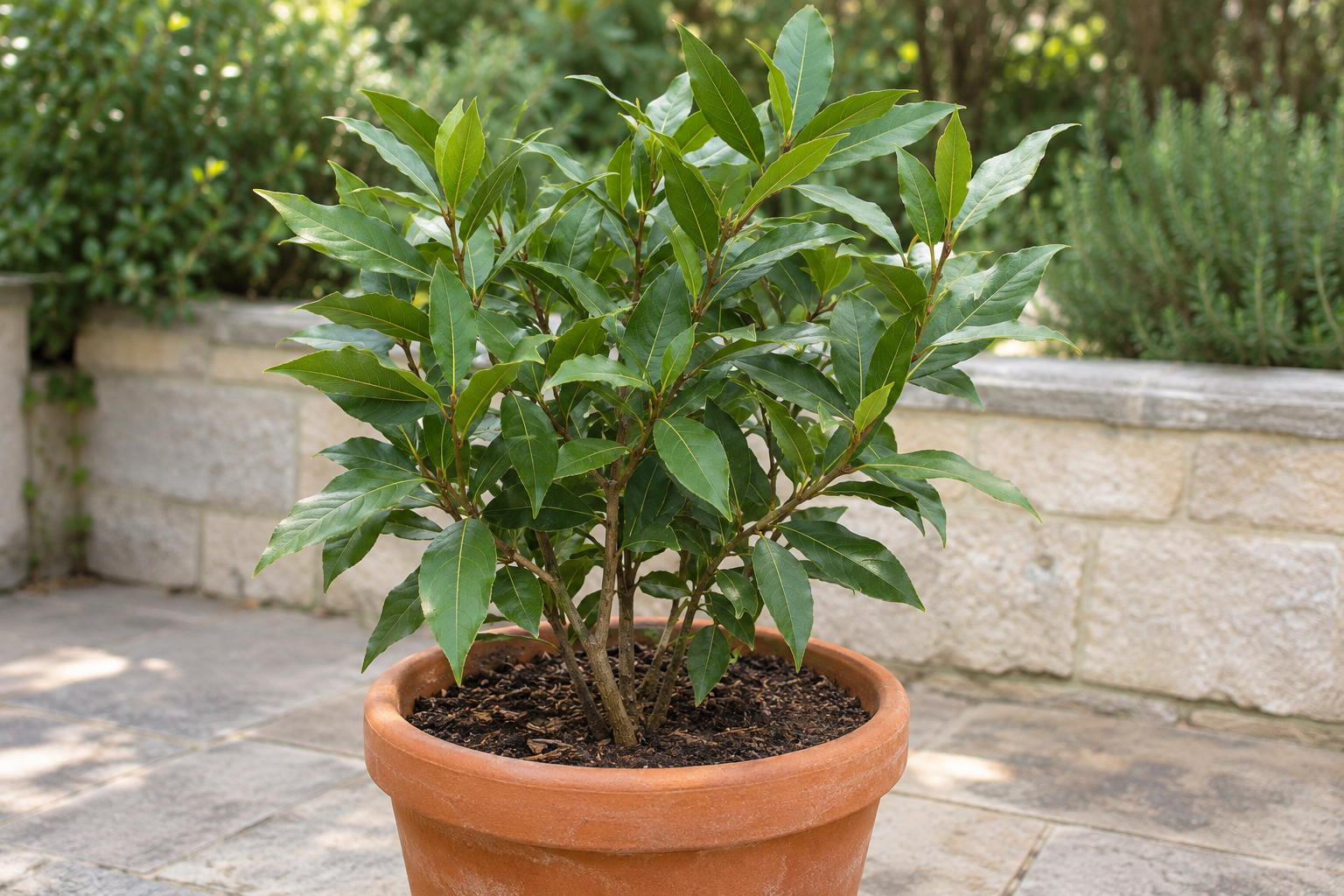
Grow culinary bay laurel (Laurus nobilis) in a sunny or lightly shaded position with well-drained soil. Start with a labelled young plant, allow for its woody growth and adjust watering to its roots and growing conditions. A pot can keep it manageable, but it still needs ongoing care. [1] [3]
Bay is a good choice when you want a lasting supply of cooking leaves rather than a quick seasonal crop. This guide takes you from choosing the right plant to managing its size, recognising problems and picking leaves without exhausting a small specimen.
🌿 In this guide
- Quick facts
- What bay laurel is and why grow it
- Beginner checklist
- Seasonal growing calendar
- Choosing a position and planting
- Watering and feeding
- Pruning, repotting and propagation
- Common mistakes
- Troubleshooting
- Harvesting, storing and using leaves
- Frequently asked questions
- Key takeaways
- Continue learning
🌿 Grow Herb Lab quick facts
| Growing detail | What to know |
|---|---|
| Botanical name | Laurus nobilis; also called bay laurel, sweet bay or bay tree. [5] [7] |
| Growth habit | A slow-growing evergreen woody shrub or tree, not a small annual herb. [6] |
| Position | Sun or light shade; consider heat, wind and winter exposure. [2] [3] |
| Soil and pots | Good drainage; use a suitable potting mix in containers. [3] |
| Water | Monitor new plants and pots; avoid persistent saturation and a completely dried-out root ball. [2] [3] |
| Size | Garden trees can become several metres tall and wide. A pruned pot specimen needs a separate size-management plan. [4] [6] |
| Easiest starting route | Buy a healthy labelled plant; seed and cuttings can be slow and unreliable. [3] |
| Main harvest | Healthy mature leaves for flavouring food; remove whole leaves before serving. [7] |
What bay laurel is and why grow it
Culinary bay belongs to the laurel family and comes from the Mediterranean region. Its leaves are leathery, aromatic and arranged alternately along the shoots. These features help you understand the plant, but they do not establish that an unfamiliar tree is safe to use. [5] [7]
Buy a plant labelled Laurus nobilis from a reliable nursery. A name such as “laurel” is insufficient: cherry laurel and Portugal laurel are different plants and are listed as harmful if eaten. Do not taste an unknown leaf or use its smell as proof of identity. [9]
Why grow it?
Bay combines culinary usefulness with an evergreen shape. You can maintain a bush, train a standard with a clear trunk, or give it more room in a suitable garden. It is useful for cooks who want to pick a few leaves as needed, while its woody structure offers a different growing experience from basil or coriander. [4] [7]
Ordinary green bay is a straightforward starting point. Golden and narrow-leaved forms also exist; check the botanical label rather than assuming all bays have identical leaf colour or shape. [1]
🌱 Beginner checklist
Before planting:
- Confirm the label says Laurus nobilis.
- Decide whether you can accommodate a garden tree or prefer a maintained pot plant.
- Check the intended position for light, wind, frost exposure and access.
- Make sure water can leave the growing area or container.
- Inspect the nursery plant for declining foliage, insects and badly congested roots.
- Choose a pot you can safely manage as the plant grows.
- Plan regular moisture checks rather than automatic watering.
- Keep the plant and fallen leaves away from pets that chew plants. [8]
You do not need a large topiary specimen to begin. A healthy young plant gives you time to learn how it responds in your conditions.
📅 Seasonal growing calendar
Use this as a starting point for temperate Australian conditions. The Northern Hemisphere column shows equivalent seasons, not a universal planting timetable. Choose workable conditions and watch the plant’s growth. Australian spring repotting guidance and overseas cold-climate advice support this seasonal approach. [2] [3] [4]
| Season | Temperate Australia | Northern Hemisphere adaptation | Main care decisions |
|---|---|---|---|
| Spring | September–November | March–May | Assess planting or repotting as growth resumes. Check drainage and shape established plants after local frost risk has eased. |
| Summer | December–February | June–August | Check pots more often in hot or windy weather. Pick modestly and lightly trim when needed; avoid major disturbance during extreme heat. |
| Autumn | March–May | September–November | Review root space, pests and the coming cold or wet period. Establish new plants only where local conditions allow time for recovery. |
| Winter | June–August | December–February | Check moisture before watering. Shelter vulnerable pots from severe cold and prevent prolonged wetness. Do not feed merely because a calendar says to. |
In warm subtropical, tropical or wet–dry climates, rainfall and heat may govern care more strongly than these months. The practical question is whether the plant can establish without prolonged saturation, drying or damaging exposure. Use the herb climate and hardiness guide to interpret your site.
Choosing a position and planting bay laurel
Choose a healthy plant
Look for sound stems, healthy foliage and a root ball the nursery can help you inspect. Ask about circling roots or a plant that has remained too long in its pot. Heavily congested roots may need correction; a healthy root ball does not automatically need cutting apart. [11]
A bush is practical for accessible leaf picking. A standard is mainly a training choice: it still needs suitable root space, support where necessary and maintenance.
Pot or garden bed?
| Growing choice | Useful when | Plan for |
|---|---|---|
| Container | You need control over placement or have unsuitable ground conditions | Moisture checks, stable support, periodic root assessment and ongoing size management |
| Garden soil | You have a suitable permanent location and enough future space | The eventual woody plant, access for maintenance and establishment watering |
For a sense of scale, ACT Government landscape guidance describes a bay tree 6 m tall and 5 m wide. Actual size depends on conditions and management. Bay is also recorded as a garden escape in Victoria, so check local suitability before planting near bushland or waterways. [5] [6]
A small-herb spacing figure is not a long-term allowance for a bay tree. The herb plant spacing guide explains the general planning principles, but bay also needs a woody-plant size assessment.
Light, heat and cold
Choose good light with shelter from harsh exposure. Light afternoon shade may help in hotter settings. Gradually adjust a plant moved from a protected indoor position to outdoor sun. [2]
Cold tolerance varies with the site and the plant’s circumstances. An established landscape tree and a young specimen with exposed pot roots are different situations. Seek local advice for severe frosts, and move a manageable pot to a protected position when needed. [1] [6]
Indoors, bay needs a genuinely bright position. A dim kitchen corner is unlikely to support satisfactory growth. A protected winter position in a cold region is different from expecting vigorous indoor growth throughout the year. [2] [3]
Planting in the ground
Choose a location that drains freely. Prepare a hole wider than the root ball, keeping the upper roots and the point where the trunk widens into roots close to the surrounding surface. Do not bury the stem to make the plant look more firmly anchored.
Remove the nursery container, check the roots, position the plant upright and backfill without leaving large air pockets. Water to settle the soil around the roots. Keep mulch away from the trunk. These are general woody-plant establishment principles; they do not justify planting bay into a persistently wet hole. [11]
Planting in a container
Choose a stable pot with open drainage holes and modest room for the next stage of root growth. Use fresh potting mix suitable for container shrubs. A decorative outer pot is acceptable only if the inner pot can drain and collected water is emptied. [14]
Set the plant at an appropriate depth, fill around the root ball and leave space below the rim for watering. Firm gently and water in. Do not put gravel in the bottom as a drainage remedy; it can leave a wetter zone closer to the roots. [15]
For the broader setup, see growing herbs in pots and best soil for herbs.
Watering and feeding
Match watering to the growing situation
Newly planted bay: check the original root ball as well as nearby soil. Roots need time to explore beyond it, so rainfall elsewhere in the bed does not necessarily mean the young plant has enough water. [11]
Established garden bay: it may need less intervention, but prolonged dry conditions still call for observation. Judge the root zone and recent weather rather than assuming a drought-tolerant description means water is never needed.
Potted bay: feel below the dry-looking surface and, where safely manageable, compare the pot’s weight before and after watering. When watering is needed, apply it slowly enough to wet the root ball and let excess drain. Check again if water races down gaps without wetting the mix. Empty standing water from a saucer or outer pot. [15]
Do not wait for the whole root ball to become bone dry. Equally, repeatedly watering an already wet pot can damage roots. [2] [3]
🌿 Grow Herb Lab Framework: Does my bay need water, drainage attention or a root-space check?
- Observe: feel the growing medium below the surface. Check drainage outlets, recent weather and whether the plant was recently moved or repotted.
- If the root zone is drying: water thoroughly and let excess escape. Check that the root ball actually becomes moist.
- If it remains wet: pause further watering and investigate blocked outlets, trapped drainage water or an unsuitable growing medium.
- If moisture seems appropriate but problems continue: inspect for pests and assess root congestion, light and exposure before adding water or fertiliser.
- Follow up: note whether the growing medium behaves normally and new damage slows. Use the herb watering guide for the general checking method.
This sequence combines moisture checks with the container and root guidance above. A wilted leaf is a reason to investigate; it does not identify the cause by itself. [3] [13] [15]
Feeding during active growth
Container plants have a limited supply of nutrients. Use an appropriate general-purpose fertiliser according to its label during active growth, allowing for any feed already included in the mix. Slow winter growth does not call for increasing the dose. [3] [15]
Ground-grown bay in suitable soil may need little extra feeding. Check moisture, roots and pests before treating yellow leaves as proof of deficiency. The same symptom can have several causes. [1] [13]
Pruning, repotting and propagation
Keep routine shaping modest
Use clean secateurs to shorten unwanted shoots and maintain access to the foliage. With a standard, remove unwanted shoots from the clear stem or base as appropriate to its trained form. Light spring or summer shaping and major size reduction are different jobs; plan heavier work for suitable growing conditions after local frost risk, rather than repeatedly stripping the plant. [1]
If a large tree needs substantial reduction, seek local pruning advice. Keeping a young bay manageable is easier than correcting a neglected tree in one session.
Assess the roots as well as the top
A bay that repeatedly dries very quickly, has densely circling roots or is unstable in its container needs a root-space assessment. Repotting can also refresh deteriorated growing medium. An Australian demonstration shows a congested bay being moved to a larger container in spring; it is an example of addressing a particular plant, not an instruction to cut every bay’s roots. [4]
Move up sensibly rather than surrounding a small root ball with a large volume of wet mix. If a mature plant must stay in the same container, root pruning is an experienced-grower option. Obtain guidance before removing a substantial amount of roots. [14] [15] [1]
Propagation is a slower project
For a first plant, buying nursery stock is the practical route. Bay can be raised from cuttings or by layering, while seed germination is variable. Cuttings may take months, and some fail; do not compare bay’s pace with quick-rooting soft herbs. [2] [3]
To try semi-ripe cuttings:
- Select healthy current-season growth with a firm base and a softer tip.
- Prepare a short cutting below a node using clean tools. Remove lower leaves and excessively soft tip growth.
- Insert it into a free-draining propagation medium, water and let it drain.
- Keep it in a sheltered, bright position out of direct sun, with humidity support and enough ventilation to limit decay. Keep the medium moist, not saturated.
- Wait for a root system before gradually acclimatising and potting on. [16]
The guide to growing herbs from cuttings explains the general process. Bay’s slower rooting remains an important qualification.
⚠️ Common mistakes
| Mistake | Better approach |
|---|---|
| Choosing an unidentified “laurel” for cooking | Obtain labelled Laurus nobilis. |
| Treating a young bay like a small seasonal herb | Plan its future shape, root space and access. |
| Watering automatically every few days | Check the growing medium and drainage first. |
| Using a sealed pot or leaving water in an outer container | Provide an outlet and empty collected water. |
| Cutting back heavily whenever the plant looks untidy | Maintain it gradually and plan substantial pruning separately. |
| Feeding every yellowing plant | Investigate roots, moisture and pests before choosing a remedy. |
| Taking a large harvest from a small new plant | Allow establishment and retain plenty of healthy foliage. |
These are practical prevention choices drawn from the growing guidance above. Correcting the setup often matters more than adding another product.
🛠 Common problems and troubleshooting
Inspect a few affected leaves and the growing setup before acting. Compare new and old growth, and consider when the change began.
| What you observe | Possible explanations | First checks and action |
|---|---|---|
| Yellow leaves or general decline | Wet roots, root congestion, pests or another growing-condition problem | Check moisture and drainage; inspect stems and leaf undersides before feeding. [1] [13] |
| Brown edges or leaf drop after a move or weather change | Exposure or moisture stress | Compare conditions before and after the change; stabilise care instead of changing everything at once. [2] [15] |
| Sticky leaves, attached bumps or black surface growth | Scale or other honeydew-producing insects; sooty mould may follow | Inspect shoots and leaf undersides. Identify the insect and its extent before choosing control. [10] [13] |
| Distorted young leaves | Insect feeding or another source of damage | Examine unfolding leaves and obtain a local identification if the cause is unclear. [7] |
| Little new growth | Seasonal slowdown, insufficient light, root congestion or poor health | Distinguish a stable slow-growing plant from progressive leaf loss or dieback. Check the setup before intervening. [2] [4] |
Scale and sooty mould
Scale can resemble small attached bumps. Some species produce honeydew, which supports dark sooty mould; not all scale species do. Australian bay-tree observations document this connection. [10] [13]
Monitor the plant, maintain suitable care and avoid unnecessary broad-spectrum spraying that disrupts beneficial insects. If the infestation is substantial, seek advice on an approach suitable for culinary bay in your location. Identification should come before treatment.
For persistent wet-root decline, use root rot in herbs. For a broader diagnostic path, see yellow leaves on herbs. Rapid dieback, repeated decline or an uncertain pest warrants local horticultural help.
Harvesting, preserving and using bay leaves
Pick without exhausting the plant
Let a young or recently repotted bay settle before taking more than an occasional leaf. Once established, choose healthy mature leaves and spread picking around the plant rather than stripping one shoot. Bay retains foliage through the year, so the harvest need not be a single large event. [3]
Dry and store a small batch
Rinse suitable leaves, remove excess moisture and arrange them separately with good airflow. Dry them away from harsh direct sunlight. Package only when thoroughly dry; leaves should feel crisp rather than leathery from retained moisture. Store in a clean airtight container in a cool, dry, dark place. In humid conditions, a food dehydrator used according to its instructions gives better control over drying conditions. [12]
Freezing is another option for keeping a small supply. Follow the recipe’s guidance when choosing fresh or dried leaves; their flavour is not interchangeable by one reliable universal ratio. [1]
Use the right leaves appropriately
Culinary bay flavours stocks, soups, sauces and slow-cooked dishes. Remove whole leaves before serving: they stay tough and can pose a choking or obstruction risk. Do not substitute leaves from an unidentified tree. [7] [9]
Bay laurel is listed as toxic to dogs, cats and horses. Keep plants, picked leaves and pruning waste out of their reach. If a pet eats it, contact a local veterinarian promptly. [8]
🌿 Frequently asked questions
Can bay stay in a pot long term?
Yes, with ongoing attention to root space, growing medium, moisture and shape. A permanent pot is a maintenance commitment, not a way to stop the plant growing indefinitely. [2] [4]
Can I grow it indoors?
It can be grown indoors with adequate light and suitable care. A bright protected winter position is more realistic than a dim room expected to supply vigorous growth. [2] [3]
Why has my bay stopped growing?
First distinguish normal seasonal pace from decline. Check light, roots, moisture and pests. More fertiliser is not automatically the answer.
Can I grow bay from supermarket dried leaves?
Dried cooking leaves are not suitable propagation material. Start with a nursery plant or a fresh stem cutting from a correctly identified healthy plant; seed is a separate, slower route. [3] [16]
Do I need male and female plants to harvest leaves?
No. Bay bears male and female flowers on separate plants, but you can harvest leaves without the plant producing fruit. [5] [7]
Is a tree labelled simply “laurel” suitable for cooking?
That label does not establish its identity. Confirm Laurus nobilis rather than guessing from a common name or a similar-looking leaf. [5] [9]
🌿 Key takeaways
- Start with confirmed culinary bay and plan for a woody plant.
- Choose a setup that drains and remains practical to maintain.
- Adjust watering to the roots, weather and growing situation.
- Investigate decline before adding water, feed or treatments.
- Maintain size gradually and harvest with the plant’s condition in mind.
🌿 What success looks like
A well-managed bay has stable foliage, appropriate seasonal growth and a root zone that drains normally. You can inspect it, maintain its shape and pick a modest supply of leaves without leaving the plant sparse. Slow growth alone is not failure; ongoing deterioration is the signal to investigate.
🌿 Continue learning
🌿 Related growing guides
- Rosemary growing guide — another perspective on maintaining a woody culinary herb.
📚 Reference guidance
- Herb watering guide — build a repeatable moisture-checking method.
- Herb climate and hardiness — interpret exposure and regional suitability.
🛠 Problem solving
- Root rot in herbs — follow up persistent wet-root decline.
📥 Free resources
- Beginner Herb Growing Kit — practical support for your wider herb-growing routine.
🌿 Final thoughts
Give bay a setup you can manage for the long term. A clear understanding of its roots, growing conditions and woody habit will help you make better care decisions as the plant develops.
Sources
2 — University of Wisconsin Extension — Sweet bay
3 — Illinois Extension — Bay laurel
4 — ABC Gardening Australia — Bay Watch
5 — Royal Botanic Gardens Victoria — Laurus nobilis
6 — ACT Government — Laurus nobilis landscape fact sheet
7 — NC State Extension — Laurus nobilis
9 — RHS — Potentially harmful garden plants
10 — ABC Gardening Australia — Autumn Jobs
11 — University of Minnesota Extension — Planting and transplanting trees and shrubs
12 — National Center for Home Food Preservation — Herbs
14 — Iowa State University Extension — How to select quality plant containers
15 — Iowa State University Extension — How to care for houseplants