Start with the final spacing recommended for the herb variety you’re growing. Measure from the centre of one planting spot to the centre of the next. In a shared pot, also check the usable width and depth of the potting mix and choose herbs with similar light and watering needs. For spreading or shrubby herbs, use their expected mature width to plan how much room to leave. [1, 2, 3, 4]
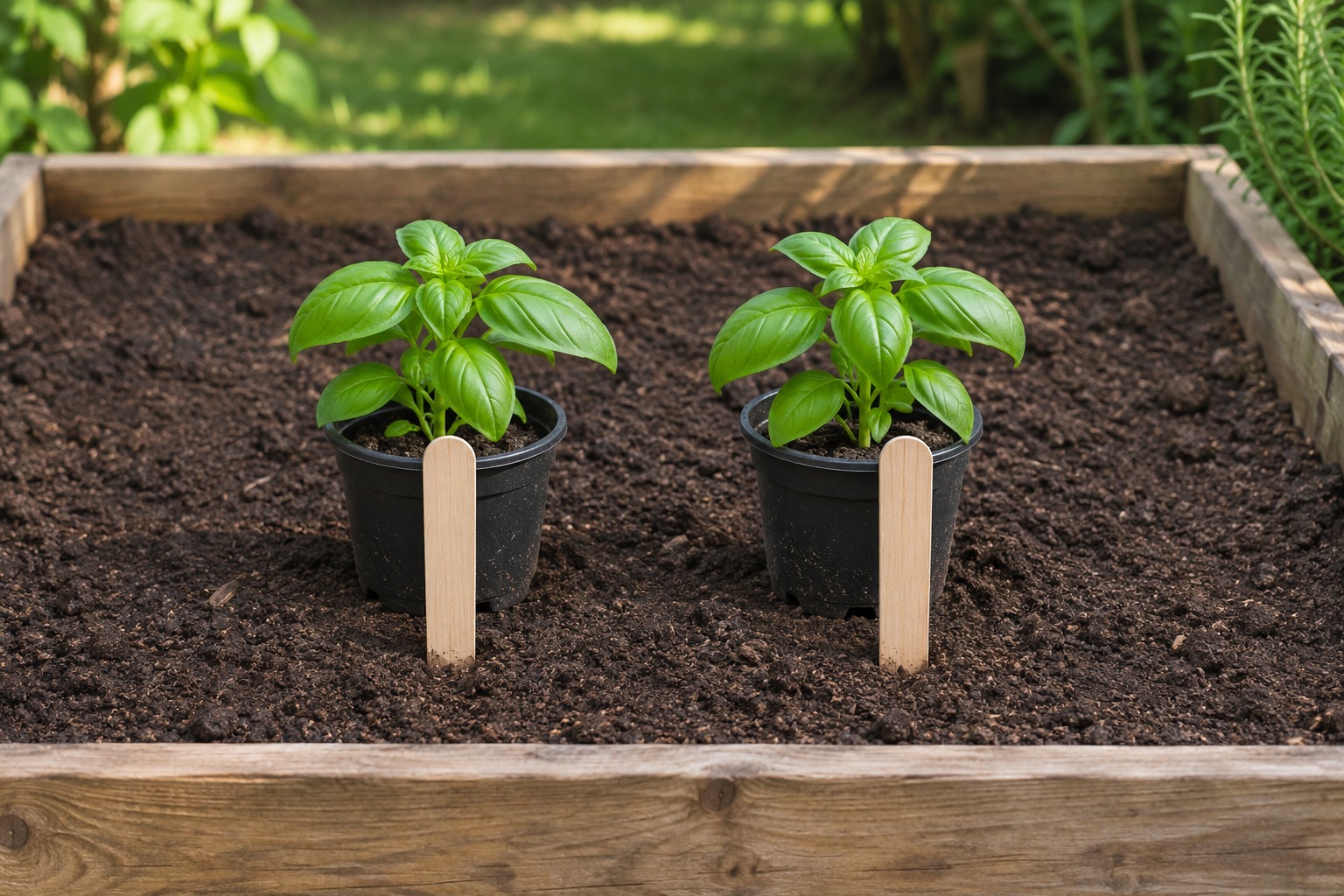
A nursery pot shows how much space a young herb uses today. This guide helps you mark out the space it will need as it grows, whether you’re planting seedlings in a bed or fitting herbs into a balcony trough.
🌿 In this guide
- Grow Herb Lab Quick Facts
- How to measure herb spacing
- Herb plant spacing chart
- Grow Herb Lab Framework
- How to space herbs in garden beds
- How to space herbs in pots
- Beginner checklist
- Common mistakes
- What success looks like
- Frequently asked questions
- Sources
🌿 Grow Herb Lab Quick Facts
| What to check | What to do |
|---|---|
| Distance between herbs | Measure between the centres of neighbouring planting spots. [1] |
| Seed packet or label | Look for the final plant spacing or thinning instruction for the variety. Check sowing depth and row spacing separately. [2, 10] |
| Mature size | Allow room where wider or trailing plants will grow, especially beside smaller neighbours. [1, 4] |
| Shared pot | Check the inside width, depth, drainage and whether the herbs can share a watering routine. [3] |
| Mint | Use a separate pot if you want to contain its spread. [9] |
How to measure herb spacing
Plant spacing is the distance between the centres of neighbouring plants. Use the point where each plant or clump meets the soil. If you mark one spot at 15 cm and another at 45 cm along a tape measure, the planting spots are 30 cm apart. Row spacing is the distance from the centre line of one row to the centre line of the next. [1, 10]
Mature spread is the expected width of the plant as it grows. If a label gives mature spread alone, picture that width centred over the planting spot. For a plant expected to grow about 40 cm wide on all sides, allow about 20 cm of reach from its centre in each direction. Add room where you need to get a hand in to harvest or where you want a gap between plants. For a trailing plant, check which way you want the stems to grow. [1, 4]
If you direct sow, read the sowing depth and thinning directions separately. Seeds may start close together and be thinned once you can tell which seedlings to keep. Seedlings that come in a clump, such as common chives grown this way, are spaced from clump centre to clump centre. [2, 7, 10]
Herb plant spacing chart
Use these figures as starting points for final spacing in a garden bed. If the packet or label for your variety gives a different final spacing, use that figure. For herbs whose mature width varies widely, plan from the actual variety’s spread.
| Herb | Garden-bed starting point | What to check |
|---|---|---|
| Sweet basil | About 30 cm apart. [2] | Check the label for compact or larger forms. Leave room for air to move between plants in damp, sheltered spots. [11] |
| Parsley | About 30 cm apart. [2, 6] | If direct sown, check the final gap after thinning. |
| Coriander | 20–25 cm apart as a starting range from two Australian council guides. [2, 5] | Use your packet’s instructions for the variety and harvest stage you’re growing for. |
| Common chives | At least 15 cm between clumps. [7] | Count each clump as one planting position. |
| Upright culinary thyme | About 20–30 cm apart, depending on the variety. [8] | Check the expected spread of trailing or mat-forming thymes. |
| Culinary sage | Use the variety’s expected mature width to mark out its space. [12] | Check whether it is a compact form or a wider shrub. |
| Rosemary | Use the labelled mature width to plan its position. [4] | Give a trailing form room in the direction you want it to grow. |
| Mint | Give it its own pot if you want to contain the spread. [9] | Spreading stems can extend beyond the original planting spot. |
🌿 Grow Herb Lab Framework: How much room will this herb need?
- Look at the label. Identify the variety and check whether it grows upright, forms a clump or spreads. Note the final spacing or mature width. [1, 4]
- Choose the distance. Use the variety’s final planting distance when it is given. Otherwise, use the chart for a comparable plant or lay out the expected canopy using its mature width. [1, 2, 8]
- Mark the centres and check the fit. Look at the bed edge, access and taller neighbours. In a shared container, confirm that the roots have room and the plants suit the same light and watering conditions. [1, 3]
- Adjust before planting. Leave a planting spot empty, move a centre or use another pot if the layout is too tight. Use the growing guides below if you need more detail on a particular herb. [1, 3]
How to space herbs in garden beds
Mark the centres before you dig
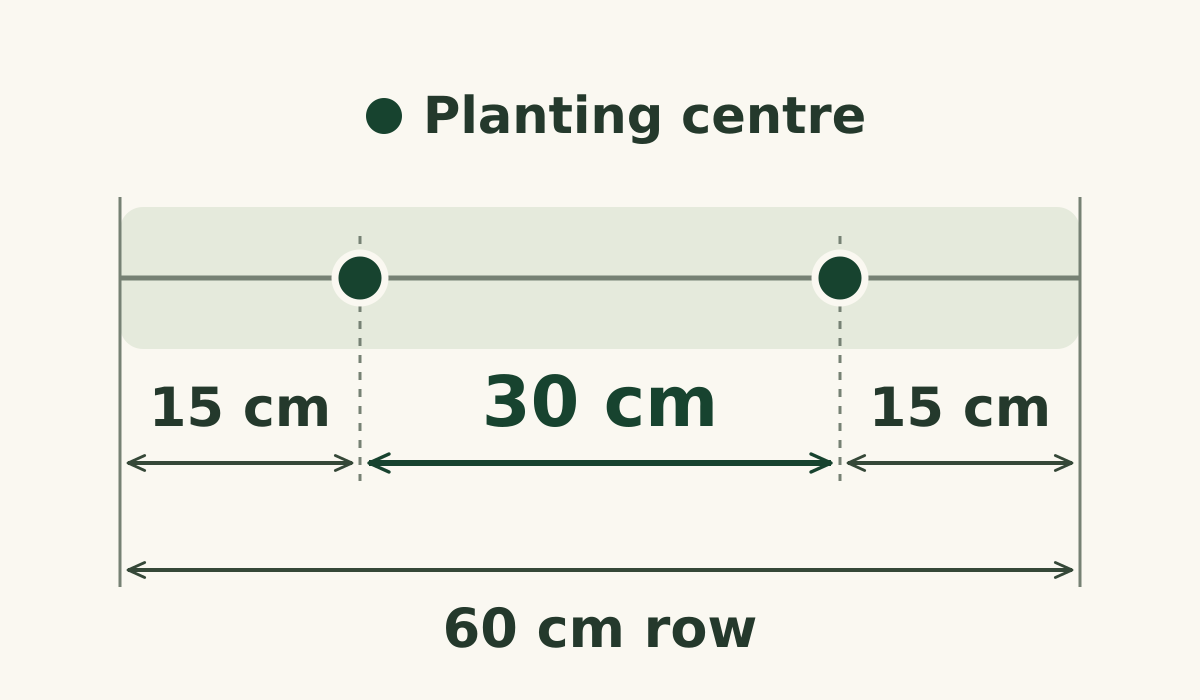
Suppose you have a 60 cm run of bed and two sweet basil seedlings from a variety suited to 30 cm spacing. Place markers at 15 cm and 45 cm. That gives 30 cm between centres and 15 cm between each outer centre and its nearest end. Now check the space on either side of the row and look at the mature size of neighbouring plants. Move the row or leave extra room if you would have to reach through foliage to pick the basil. [1, 2]
With taller herbs, check where their shadow falls during the part of the day your bed receives sun. Place shorter herbs where they can still receive the light they need as their neighbours grow.
Thin direct-sown seedlings to the final distance
For a patch of parsley sown closer than its final spacing, measure along the row and choose the strongest well-placed seedlings to keep. Remove the excess seedlings once you can tell them apart, following the timing and spacing on your seed packet. Check the full row after thinning so you catch crowded pairs between the wider gaps. For sowing and emergence guidance, see Herb Seed Germination. [6, 10]
How to space herbs in pots
Start with one plant if space is tight
For a single upright thyme, check the new pot’s usable width and depth, the drainage holes and the mature size of the variety. Measure inside the pot at the intended potting-mix level, especially if the pot narrows below the rim. The garden-bed spacing in the chart describes a gap between plants. For help choosing the container itself, see Growing Herbs in Pots. [3, 8]
Test a shared trough before filling it
Suppose you’re considering two compact upright thymes whose labels suit 25 cm spacing. In a trough with 55 cm of usable inside length, try marking the centres at 15 cm and 40 cm. Check the trough’s width and depth as well as its length. Can both root balls fit with room for potting mix around them? Will both plants have room as they grow? If the container is too narrow or shallow, try one thyme or use separate pots. [1, 3, 8]
Choose herbs with similar care needs for a shared container. Thyme and rosemary can suit similar free-draining conditions, but a large rosemary can soon take most of the available space. Basil and parsley prefer more consistent moisture than thyme or rosemary. When the herbs need different care or one is likely to outgrow the pot, separate pots let you adjust each plant’s conditions. [3, 4]
🌱 Beginner checklist
- Identify each herb and variety.
- Read the final spacing or mature width on the label.
- Measure the usable bed or pot dimensions.
- Mark the centres and check the room each plant will have as it grows.
- For shared pots, match light and watering needs and check the space available for roots.
- Plant at the marked centres or thin seedlings to the intended final spacing.
If the planned layout feels tight, go back to the spacing framework and try fewer plants before you plant them out.
⚠️ Common mistakes
- Layout by seedling size. Check the plant’s expected width before deciding how much of a bed it can share. [1]
- Measuring between leaf edges. Mark centres so the distance stays clear as foliage grows. [1]
- Buying a pot from the spacing figure alone. Check its inside dimensions and root space as well as the distance you can mark across the top. [3]
- Counting each chive stem as a plant. Space chives by the clump. [7]
- Squeezing basil into a sheltered, damp corner. Leave room for air to move around the foliage, especially where leaves tend to stay wet. [11]
🛠 Troubleshooting crowded herbs
| What you see | What to do |
|---|---|
| Seedlings have come up in a thick row | Thin according to the packet, checking the final gap along the whole row. [10] |
| A shared pot has filled and one plant is pushing into the other’s space | Check the growth habit and move one herb into its own suitable container if both need more room. [3, 4] |
| A taller neighbour is shading a smaller herb | Check the real light pattern first. Move the shorter herb or its container to a position that suits it if shade is the problem. [3] |
If a plant is yellowing or growing poorly, check light, watering and drainage alongside spacing. A crowded layout is one clue. The Best Soil for Herbs guide can help you check whether the growing medium drains suitably.
🌿 What success looks like
The herbs fit the space you set aside for them and shorter plants still get the light they need. You can reach the base of each plant to water it and pick leaves without pushing neighbouring plants aside. Check again as the canopies fill out. A mat-forming thyme can cover the patch you set aside for it while leaving the next herb accessible. [1, 8]
🌿 Frequently asked questions
How many herbs can I fit in a 30 cm pot?
Start with one plant if you’re unsure, and check whether the pot suits that variety. To assess a shared pot, measure at mix level, mark the planting centres and check depth and care needs. The diameter alone gives only one of those measurements. [3, 8]
Can rosemary and thyme share a pot?
They can share a sufficiently roomy, free-draining container if the chosen varieties fit as they grow. A vigorous rosemary can be easier to manage in its own pot. Check the mature spread before pairing it with thyme. [3, 4, 8]
When should I thin closely sown herb seedlings?
Follow the timing on the packet. If it gives a final spacing but little timing guidance, wait until the seedlings are large enough to tell apart and thin while they’re still small. Use the final spacing to decide which to keep. [6, 10]
Is it all right for mature herbs to touch?
Light contact at the edges can be fine if each plant has enough light and room to grow and you can still water and harvest. Give more room where foliage is packed together or slow to dry, particularly around basil in humid conditions. [1, 11]
🌿 Key takeaways
- Measure final spacing from planting centre to planting centre.
- Allow for mature spread before deciding where to put spreading or shrubby herbs.
- For shared pots, check root space, light and watering compatibility before choosing how many herbs to plant.
🌿 Continue learning
- 🌿 Related growing guides — Use Growing Thyme to plan for the habit of your variety, or Growing Sage to choose a suitable container or bed position.
- 📚 Reference guidance — Use Herb Seed Germination when starting a new row or Best Soil for Herbs when preparing a bed or container.
🌿 Final thoughts
Before you dig, put the pots or planting markers where you expect the herbs to grow. It’s easier to move a marker today than to move an established rosemary out of a crowded bed.
Sources
- 1 — UF/IFAS Extension — Landscape Design: Drawing a Planting Plan
- 2 — City of Ryde — Seasonal Planting Guide
- 3 — University of Maryland Extension — Growing Vegetables in Containers and Salad Tables
- 4 — RHS — How to grow rosemary
- 5 — Wyndham City — Seed Growing Instructions
- 6 — ABC Gardening Australia — Hillside Herbs
- 7 — RHS — How to grow chives
- 8 — RHS — How to grow thyme
- 9 — RHS — How to grow mint
- 10 — UC Master Gardener Program — Thinning
- 11 — University of Maryland Extension — Downy Mildew on Basil in the Home Garden
- 12 — RHS — How to grow sage