Sunlight is one of the first things to check when a herb grows weakly, but the answer is more useful than a label saying “sun” or “shade”. Most culinary herbs grow best with several hours of direct sun. Rosemary and thyme usually need a bright, open position; mint has more flexibility. In a hot Australian summer, the timing of that light and the heat around the plant matter too.
Use this guide to measure your site, choose herbs that suit it, and adjust a struggling plant without assuming that every symptom is caused by light.
| Question | Practical answer |
|---|---|
| What is full sun? | A position receiving at least six hours of direct sunlight a day; some sun-loving herbs perform best with more. |
| What is partial sun? | Around four to six hours of direct sunlight. The time of day and local climate affect how a herb performs. |
| Can herbs grow in shade? | Some tolerate bright partial shade, but deep shade is unsuitable for most productive culinary herbs. |
| Which herbs should get the sunniest position? | Start with rosemary, thyme, oregano, sage and lavender, allowing for local heat and plant establishment. |
| What is the first step? | Observe and count actual direct-sun hours at the intended growing spot. |
These are starting points, not a guarantee. The plant’s variety, season, climate, pot size, moisture and surrounding surfaces can change the result.
What full sun, partial sun and shade mean
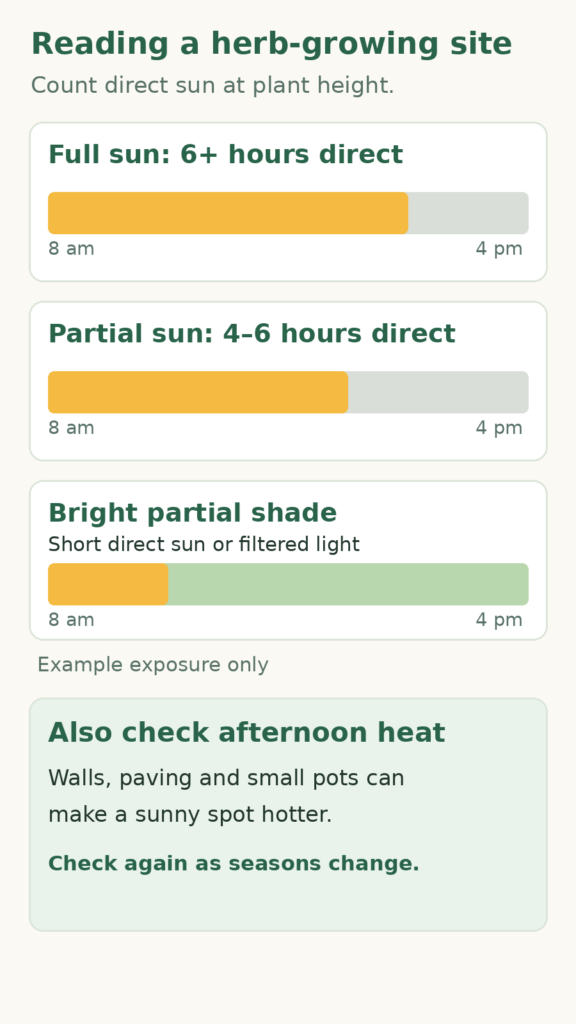
Direct sun falls on the plant without a roof, wall or dense canopy blocking it. Full sun usually means at least six hours of direct sunlight in a day. Many sun-loving herbs benefit from six to eight hours when other growing conditions are suitable. Partial sun commonly means roughly four to six hours. Bright partial shade may receive a shorter period of direct sun or filtered light through an open canopy. Deep shade receives little useful direct light and is a poor choice for most culinary herbs.
These categories describe exposure, not temperature. Six hours of morning sun can be gentler than six hours ending in a hot afternoon, especially beside reflective paving or a west-facing wall. “Shade tolerant” means a plant can cope with less light than some other herbs; it does not mean it will produce well in a dark corner.
Measure your own space
- Check the proposed spot in the morning, around midday and in the afternoon on a clear day. Record when direct light reaches the plant, rather than when the surrounding area looks bright.
- Add the periods of direct sun. Note whether later sun is intensified by a wall, paving, balcony glazing or a confined courtyard.
- Check again in another season. The sun’s path and shadows from buildings or trees change through the year.
- Match the herb to the measured spot. If it is in a pot, you may be able to move it as conditions change.
- Observe new growth over the following weeks. Compact growth is encouraging; stretching toward light suggests the plant may need a brighter position.
Do not move a shade-grown plant straight into intense summer sun. Introduce brighter conditions gradually and watch for scorch or wilting.
Choose herbs for the light you have
The table is a placement guide, not a rigid prescription. Check an individual plant’s response and local advice, especially in very hot or humid climates.
| Herb or group | Sensible starting position | Adjustment to consider |
|---|---|---|
| Rosemary, thyme, oregano, sage, lavender | Full sun with good airflow and drainage | Newly planted or container-grown specimens may need careful establishment and monitoring in extreme heat. |
| Basil | Full sun or a bright position with substantial direct light | In intense summer heat, some afternoon protection may reduce stress if the plant still receives enough light. |
| Dill | Sun or a bright morning-sun position | Sow in a suitable season; heat can shorten the leafy harvest regardless of light hours. |
| Parsley, coriander, chervil | Sun to partial sun, depending on climate and season | Coriander prefers a sunny position in cool weather; morning sun and protection from severe afternoon heat can help leafy herbs in warm conditions. |
| Chives | Sun to partial sun | Compare growth and moisture needs across the seasons. |
| Mint, lemon balm | Sun to partial shade | Keep the site bright; growth and harvest may be weaker in heavier shade. Mint usually needs more consistent moisture than Mediterranean herbs; a container helps restrain its spread. |
| Vietnamese mint | Bright partial shade or a position protected from harsh heat | Keep moisture needs in mind; it should not be managed like rosemary. |
Coriander may bolt in hot weather even in a carefully chosen position. Moving it into deep shade is not a reliable cure; choose a cooler growing period and maintain suitable moisture. Likewise, a plant wilting in strong sun may be dry, overheated, recently transplanted or suffering from root problems. Check the soil and roots before changing its light exposure.
Hot, sunny garden bed
Start with rosemary, thyme, oregano and sage where drainage and airflow are also suitable. Lavender can work in a well-drained position, but it is not interchangeable with every culinary herb. Avoid crowding plants: neighbouring growth can remove the sun you counted when planting.
Sunny patio or balcony
Containers offer flexibility. Basil, rosemary, thyme, chives and parsley can all be considered, but a small pot beside a hot wall can dry or heat rapidly. Measure light at plant height and check the potting mix before watering. Move a pot or use temporary afternoon protection if heat stress becomes a pattern.
Morning sun with afternoon shade
This is a useful starting point for parsley, coriander, chervil, lemon balm and mint in warm weather. Basil may also be worth trying if the morning exposure provides enough direct light. Compare new growth and harvest quality rather than relying only on the label.
Bright shade
Mint, lemon balm and Vietnamese mint are more promising than rosemary or thyme. Expect slower growth if direct sunlight is very limited. If there is almost no direct light, choose a brighter location or consider an appropriate indoor growing light rather than promising a productive shade garden.
Understand the time of day
Morning sun often provides useful light before the hottest part of the day. Midday and afternoon sun can provide strong light, but hot weather, reflected heat, limited soil moisture and small containers can make a position stressful. Filtered light can help a plant avoid severe heat, yet dense overhead cover may leave too little light for strong growth.
The useful question is: How much direct light does this particular herb receive, and how does it respond in this season? Water, temperature and airflow are part of that answer. A sunny position does not compensate for waterlogged soil; extra watering does not replace insufficient light.
Diagnose a light problem before acting
| What you notice | Light-related possibility | Check first and act carefully |
|---|---|---|
| Long, weak stems and leaning toward a window | Too little useful light | Check direct-sun hours and move gradually to a brighter position. Indoors, assess whether a suitable grow light is needed. |
| Slow growth or sparse harvest | Inadequate light is one possibility | Also check season, temperature, nutrition, root space and watering. |
| Pale leaves | Light may be involved, but many causes are possible | Inspect new versus old leaves, soil moisture and roots; use the yellow-leaves guide for a fuller diagnosis. |
| Bleached or brown patches after a sudden move outdoors | Possible sun scorch | Protect from the harshest exposure and acclimatise gradually; damaged tissue will not turn green again. |
| Afternoon wilting | Heat or water stress may be involved | Check the potting mix below the surface and see whether the plant recovers in the evening. Do not water automatically. |
| Poor flowering | Light may be limiting | Check the herb’s season, maturity, pruning and growing conditions before moving it. |
A simple decision path
Is new growth long, weak or leaning toward the light? Measure direct-sun hours. If exposure is low for that herb, increase light gradually and reassess new growth. If the plant already has suitable light, inspect watering, roots, season and temperature. Are leaves scorched after a move or heatwave? Protect from the harshest exposure, check moisture and reintroduce sun gradually. One symptom alone is not a diagnosis.
Sunlight, harvest and flavour
Adequate light supports photosynthesis and healthy growth. In some aromatic herbs, light and other growing conditions also influence the compounds behind aroma and flavour. It is too simple to promise that more sun always means stronger flavour: species, maturity, water stress, temperature and harvest timing matter. Aim for the exposure in which the plant grows well, rather than pushing a stressed herb into harsher sun for a supposed flavour gain.
Common mistakes
- Treating every herb as a full-sun Mediterranean herb.
- Calling a bright-looking position “full sun” without counting direct-light hours.
- Assuming “shade tolerant” means productive in deep shade.
- Moving an indoor or shaded plant into hot outdoor sun in one day.
- Blaming light for wilting or yellow leaves without checking moisture and roots.
- Forgetting that walls, paving and balcony glazing intensify heat.
- Ignoring seasonal shadows and plants that grow large enough to shade their neighbours.
Beginner checklist
Before planting, count the direct-sun hours, identify the hottest part of the day, and check the position in another season if possible. Choose the herb for the site, then check its water and drainage needs separately. If conditions change, alter one factor at a time and watch the new growth. This makes it easier to tell whether your change helped.
Right Plant, Right Light, Right Place: choose a herb suited to the actual exposure before trying to correct a mismatch with more water or fertiliser.
Frequently asked questions
Can herbs get too much sun?
A sun-loving herb can still be stressed by extreme heat, reflected heat, dry potting mix or an abrupt change from shade to direct sun. Check the whole situation before adding shade. Established rosemary in open ground and a newly purchased basil plant in a small pot need different responses.
Which herbs cope best with partial shade?
Mint and lemon balm are useful starting choices. Parsley, chives, coriander and chervil may also suit a site with adequate morning light, depending on the season and climate. Bright shade may support some growth; deep shade is much less reliable.
Why is my indoor basil stretching?
Insufficient useful light is a common cause, especially when stems lean toward a window. Check the available light and consider a suitable grow light if a brighter window is unavailable. Also check spacing and overall plant health.
Does winter sunlight count?
Yes. Count the direct light that actually reaches the plant in winter. Shorter days and changed shadows may reduce the total, and growth may slow with lower temperatures even where the site remains sunny.
Key takeaways
- Most culinary herbs prefer a bright position; many need at least six hours of direct sun for strong growth.
- Rosemary, thyme, oregano and sage generally deserve the sunniest suitable spots.
- Mint and lemon balm can handle some partial shade, but deep shade limits productive choices.
- In Australian heat, the timing of sun and reflected heat can matter as much as the daily total.
- Measure your site, observe the plant and change conditions gradually.
- Diagnose watering, roots, season and temperature alongside light.
Continue learning
For the next decision, use the Herb Watering Reference Guide to assess moisture alongside light. For herb-specific detail, continue with basil, mint, rosemary or thyme. If foliage is discoloured, use Why Are My Herb Leaves Turning Yellow? to check the wider causes. For container placement, see Growing Herbs in Pots.
Continue learning: Why Are My Herb Leaves Turning Yellow?
Continue learning: Growing Herbs in Pots
Diagnosis table, pale-leaves row: yellow-leaves guide