Knowing how to water herbs in pots becomes more complicated when their growing environment changes.
A basil plant growing in a small outdoor pot during hot, windy weather can lose moisture rapidly. The same plant moved indoors may use water much more slowly. Rosemary growing in a well-drained terracotta container may need a very different approach from mint growing in a larger moisture-retentive pot.
This is why simply asking “How often should I water my herbs?” does not tell the whole story.
The container, location and weather all affect how quickly moisture moves through the root zone.
In this guide, you will learn how to adjust herb watering according to:
- Pot size and material.
- Drainage.
- Indoor and outdoor conditions.
- Light levels.
- Heat and air conditioning.
- Sun and wind.
- Rainfall and humidity.
- Seasonal changes.
The objective is not to create another fixed watering schedule.
It is to understand why your herbs dry at different rates and how to adjust before problems develop.
Grow Herb Lab Principle: The right watering frequency changes when the growing environment changes.
Quick Facts — Watering Herbs in Different Growing Conditions
| Question | Quick Answer |
|---|---|
| Do herbs in pots need more water? | Often they need more frequent checking because containers have a limited root zone, but actual watering frequency depends on the herb, pot and conditions. |
| Do indoor herbs need less water? | Often, but not always. Lower light and reduced airflow can slow drying considerably. |
| Do outdoor herbs need daily watering? | Not automatically. Hot, sunny or windy conditions may require frequent checking, but check the root zone before watering. |
| Does pot size affect watering? | Yes. Small pots generally dry faster, while oversized pots can remain wet for much longer. |
| Does pot material matter? | Yes. Porous materials such as unglazed terracotta generally lose moisture faster than plastic or glazed containers. |
| Should pots have drainage holes? | Yes. For most container herbs, adequate drainage is essential. |
| Does rain replace watering? | Sometimes. Check how deeply rainfall has actually penetrated the container before deciding. |
| Should watering change with the seasons? | Yes. Adjust according to temperature, light, plant growth, rainfall and how quickly the root zone dries. |
| What is the main rule? | Check the root zone and current growing conditions rather than watering according to a fixed calendar. |
Before You Start — Know Your Herb
Environment changes how quickly an herb reaches its watering point, but the herb itself still determines what moisture conditions it prefers.
Leafy herbs such as basil, mint and parsley generally prefer more consistent moisture.
Mediterranean herbs such as rosemary, thyme and oregano generally benefit from more drying between waterings.
That means two containers sitting beside each other may legitimately need water on different days.
If you need the complete method for deciding whether a herb actually needs water, start with:
How Often Should You Water Herbs?
That is the main Grow Herb Lab watering guide. This article goes one step further by explaining how pots, indoor environments and outdoor conditions change that watering decision.
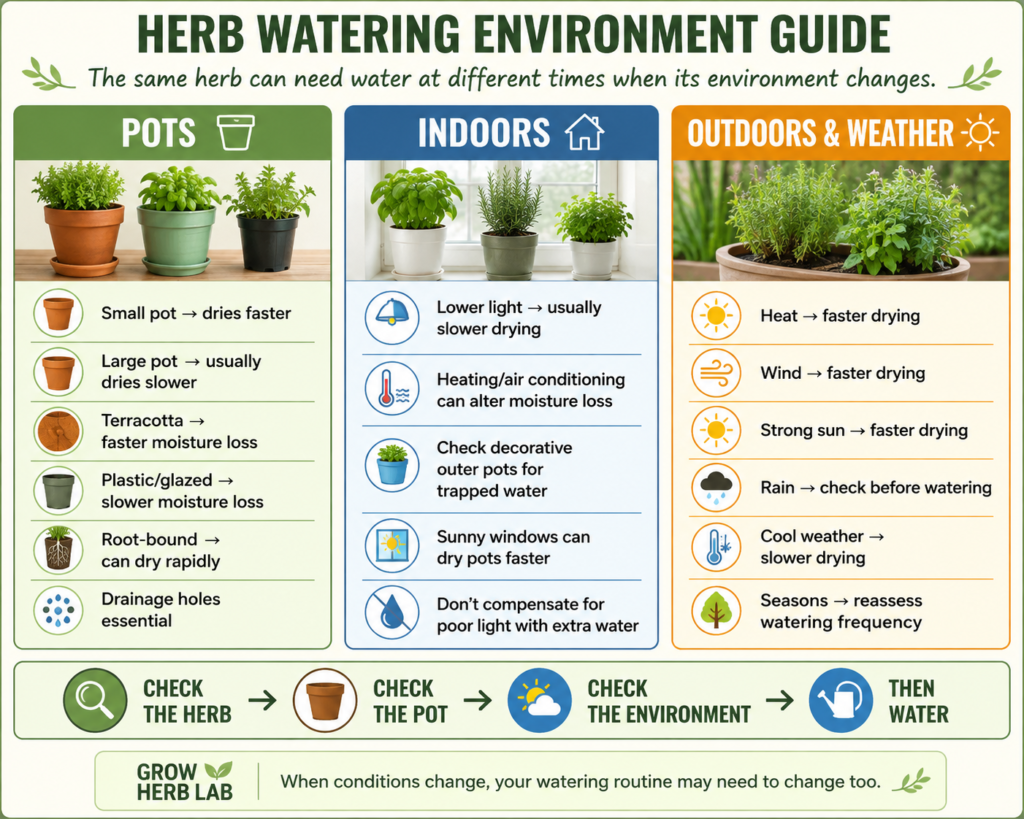
Watering Herbs in Pots
Container-grown herbs require a different watering approach from herbs growing in garden beds.
A pot creates a limited root environment.
The plant can only access the moisture contained within that container, and the growing medium can dry much faster than surrounding garden soil.
At the same time, a poorly drained pot can trap excess moisture around the roots.
This creates two opposite risks:
Small or exposed container → dries too quickly
Large or poorly drained container → stays wet too long
Successful container watering therefore depends on more than how often you use the watering can.
Why Herbs in Pots Need Closer Monitoring
Container herbs are affected by several factors at once:
- Pot size.
- Pot material.
- Number and size of drainage holes.
- Growing medium.
- Root-system size.
- Plant size.
- Sun exposure.
- Wind.
- Temperature.
- Rainfall.
- Whether the pot is indoors or outdoors.
Even two pots containing the same herb can dry at very different rates.
For example, basil in a small terracotta pot exposed to afternoon sun may require much closer monitoring than basil growing in a larger plastic container in a sheltered position.
This is why container watering should always begin with checking the individual pot.
Drainage Holes Are Essential
For most container-grown herbs, drainage holes are one of the most important features of the pot.
When you water thoroughly, excess water needs somewhere to escape.
Without adequate drainage, moisture can accumulate at the bottom of the container and create a persistently saturated root zone.
Check that:
- The container has drainage holes.
- The holes are not blocked.
- Water can leave the pot freely.
- The pot is not permanently sitting in collected water.
Grow Herb Lab Tip
If you love a decorative container that has no drainage holes, use it as an outer pot.
Keep the herb in a separate inner container with proper drainage.
Remove the inner pot when watering, allow it to drain, then return it to the decorative container.
Does Adding Gravel Improve Drainage?
A common piece of gardening advice is to place gravel, stones or broken pot pieces in the bottom of a container to improve drainage.
For ordinary container growing, this is generally unnecessary.
What matters more is:
- An appropriate growing medium.
- Adequate drainage holes.
- A suitably sized container.
- Correct watering.
Adding a thick layer of gravel also reduces the amount of growing medium available for the roots.
Focus on the drainage system of the whole container, rather than trying to create a drainage layer at the bottom.
Pot Size Changes How Quickly Herbs Dry
Container size has a major influence on watering frequency.
Pots that are too small
A small pot contains relatively little growing medium.
As the herb grows, its roots occupy more of that limited space and the available moisture can disappear quickly.
Signs that a container may be becoming too small include:
- The pot dries extremely quickly.
- Roots emerge from drainage holes.
- Growth slows despite appropriate care.
- The plant becomes top-heavy.
- Water runs through very rapidly.
- The root system densely fills the container.
A root-bound herb may require increasingly frequent watering simply because there is too little growing medium left to hold adequate moisture.
Bigger Is Not Always Better
Moving a small herb directly into a very large container can create the opposite problem.
A large volume of growing medium surrounding a relatively small root system can remain wet for much longer than expected.
If watering continues too frequently, the roots may remain surrounded by excess moisture.
Choose a container that provides room for healthy root development without creating an unnecessarily large reservoir of wet growing medium.
Root-Bound Herbs and Watering
As roots fill a container, watering behaviour can change.
A severely root-bound plant may:
- Dry much faster than it previously did.
- Wilt frequently.
- Require increasingly frequent moisture checks.
- Allow water to run rapidly through the pot.
- Become difficult to water evenly.
If you find yourself watering an established herb far more frequently than before despite similar weather, inspect whether the plant has outgrown its container.
Repotting into an appropriately larger container may solve the underlying problem better than simply increasing watering frequency indefinitely.
Pot Material Matters
Different container materials lose moisture at different rates.
Terracotta pots
Unglazed terracotta is porous.
Water can evaporate through the container walls, which means the growing medium often dries more quickly.
Advantages can include:
- Greater moisture loss for herbs that dislike prolonged wetness.
- A useful margin against persistently saturated growing medium.
But during hot or windy conditions, terracotta containers may require more frequent checking.
Plastic pots
Plastic is much less porous.
Moisture loss through the container walls is minimal, so growing medium can remain moist for longer.
This can reduce watering frequency but also means growers should be careful not to water automatically before the root zone has dried appropriately.
Glazed ceramic pots
Glazed containers behave more like non-porous pots because the glaze limits moisture movement through the sides.
Their weight can make them stable for larger herbs, but drainage holes remain essential.
Fabric pots
Fabric containers allow substantial air movement through their sides.
They can provide excellent aeration but may dry considerably faster than conventional containers, particularly in hot or windy conditions.
Monitor moisture closely.
Dark Pots Can Become Hot
Container colour and position can also influence root-zone temperature.
Dark containers exposed to intense sunlight can become surprisingly hot.
This can:
- Increase evaporation.
- Increase plant stress.
- Cause the growing medium to dry faster.
- Raise temperatures around sensitive roots.
Where containers receive intense summer sun, consider both the herb’s light requirements and the temperature of the root environment.
Saucers: Useful but Easy to Mismanage
Saucers protect surfaces and collect drainage water.
The problem occurs when the pot remains standing in water for prolonged periods.
After thoroughly watering a container:
Allow drainage → check the saucer → remove significant standing water
This is especially important indoors where drainage water cannot evaporate or escape as readily.
Decorative Outer Pots Can Hide Water
A nursery pot placed inside a decorative container can look perfectly normal from above while several centimetres of water remain hidden underneath.
This is a common indoor-herb problem.
Periodically remove the inner container and check.
If water has accumulated:
- Empty it.
- Allow the herb to drain.
- Check whether watering is occurring too frequently.
Do not assume that because you cannot see standing water, it is not there.
Should Pots Be Raised Off the Ground?
Containers positioned directly on a flat surface can sometimes drain less effectively if the drainage holes are pressed tightly against that surface.
Pot feet or a suitable raised arrangement can improve drainage and airflow beneath some outdoor containers.
This can be particularly useful on:
- Patios.
- Paving.
- Balconies.
- Other flat, non-porous surfaces.
The goal is simply to ensure that water can leave the drainage holes freely.
Self-Watering Pots
Self-watering containers can be useful, particularly for herbs that prefer more consistent moisture.
They generally use a reservoir that allows water to move into the growing medium as needed.
Potential advantages include:
- More consistent moisture.
- Reduced rapid drying.
- Less frequent manual watering.
- Convenience during warm conditions.
However, they are not automatically suitable for every herb.
Mediterranean herbs that prefer greater drying between waterings may perform poorly if the root zone remains continuously moist.
The same rule applies:
Match the watering system to the herb.
Do not assume that a self-watering pot removes the need to monitor plant health and moisture.
Grouping Pots Changes Their Environment
Several herb containers positioned close together can create a slightly more sheltered microclimate than isolated pots.
Grouping may reduce exposure to drying wind and intense heat around some containers.
However, do not use grouping as a substitute for checking each herb individually.
A group containing basil, rosemary and mint may include plants with very different moisture requirements.
They do not automatically need water at the same time simply because they are sitting together.
Hanging Pots and Elevated Containers
Hanging baskets and elevated containers often experience:
- Greater airflow.
- More wind exposure.
- Faster evaporation.
- Smaller growing-medium volumes.
They can therefore dry rapidly.
During hot or windy weather, check hanging herbs more frequently than sheltered containers.
Again:
check more frequently does not necessarily mean water more frequently.
Water only when the root zone indicates it is needed.
Container Herbs During Rain
Outdoor pots receive rainfall differently from garden beds.
Dense foliage can prevent rain from reaching much of the growing medium.
Containers under:
- Eaves.
- Balconies.
- Trees.
- Patio covers.
may receive very little rain even during wet weather.
Conversely, exposed containers can become saturated during prolonged rainfall.
After significant rain, check the growing medium rather than assuming either:
“The rain watered it.”
or
“It still needs its normal watering.”
When Water Runs Down the Side of the Pot
Very dry potting mix can shrink away from the container walls.
Water may then follow the gap between the root ball and the pot and escape through the drainage holes.
From the outside it appears that the plant has been thoroughly watered.
Inside, much of the root zone may still be dry.
Possible clues include:
- Water drains almost immediately.
- The pot remains unusually light.
- The herb wilts again quickly.
- The growing medium has visibly pulled away from the sides.
Water slowly in several passes to allow the growing medium to absorb moisture.
Where appropriate, temporary bottom watering may help rehydrate a severely dry root ball.
When Water Sits on the Surface
The opposite problem can also occur.
Water may remain on the surface rather than draining through normally.
Possible causes include:
- Compacted growing medium.
- Poor-quality or deteriorated potting mix.
- Blocked drainage.
- Severe root congestion.
- Very poor soil structure.
Do not solve this by simply adding more water.
Investigate why drainage has slowed.
How to Water a Container Herb Properly
For most conventional pots:
Step 1 — Check
Test the growing medium below the surface.
Step 2 — Decide
Consider the herb’s moisture preference and current conditions.
Step 3 — Water
If watering is required, apply water gradually across the growing medium.
Step 4 — Continue thoroughly
Moisten the root zone rather than giving a small surface splash.
Step 5 — Drain
Allow excess water to leave through the drainage holes.
Step 6 — Empty standing water
Check saucers and decorative outer containers.
Step 7 — Wait
Do not water again until the root zone reaches the appropriate moisture level for that herb.
Container Watering Troubleshooting Table
| Problem | Possible Cause | What to Check |
| Pot dries extremely quickly | Small pot, root-bound plant, heat, wind or porous container | Roots, pot size, position and weather |
| Pot stays wet for many days | Oversized pot, poor drainage, dense growing medium or low plant water use | Drainage, pot size, light and growing medium |
| Water immediately runs through | Very dry/root-bound growing medium or channels around root ball | Pot weight, roots and moisture inside root ball |
| Water sits on surface | Compaction, poor medium or blocked drainage | Growing-medium condition and drainage holes |
| Herb wilts despite wet soil | Root stress, poor drainage or root damage | Root-zone moisture, drainage and roots |
| Herb repeatedly wilts when dry | Pot too small, root-bound plant or rapid environmental drying | Pot size, roots, heat and wind |
| Water collects in outer pot | Hidden drainage water | Remove inner pot and empty outer container |
| Soil stays wet after rain | Excess rainfall or poor drainage | Drainage holes, pot position and growing medium |
🌿 Grow Herb Lab Container Rule
When a potted herb develops a watering problem, investigate four things:
PLANT → POT → MIX → POSITION
PLANT
What herb is it, how large is it and what does it prefer?
POT
Is the container appropriately sized and adequately drained?
MIX
Does the growing medium absorb water while still allowing drainage and aeration?
POSITION
How much sun, heat, wind and rain does the container receive?
Watering frequency is the result of these four factors interacting.
Do Not Fix Every Container Problem With More Water
If a pot dries excessively quickly, the long-term solution may be:
- A larger container.
- Fresh growing medium.
- Repotting a root-bound plant.
- Moving the container away from extreme reflected heat.
- Providing protection from severe drying wind.
If a pot remains excessively wet, the solution may be:
- Better drainage.
- A more appropriate container size.
- Improved growing medium.
- Emptying standing water.
- Adjusting watering frequency.
The watering can is only one part of container management.Sometimes the correct watering fix is to fix the container.
Watering Herbs Indoors
Indoor herbs can be deceptively difficult to water correctly.
They are protected from rain and strong outdoor winds, but that does not necessarily make their watering requirements simpler.
Inside a home, water use is influenced by:
- Light levels.
- Room temperature.
- Heating.
- Air conditioning.
- Humidity.
- Airflow.
- Container size.
- Potting mix.
- Seasonal changes.
- The herb species itself.
One of the most common mistakes is assuming that because an indoor herb is protected from the weather, it should be watered on a predictable schedule.
The same Grow Herb Lab principle applies indoors:
Water the Soil, Not the Calendar.
Why Indoor Herbs Are Easy to Overwater
Many indoor herbs receive less light than they would outdoors.
Lower light generally means slower photosynthesis and slower growth.
A slower-growing plant often uses water more slowly.
At the same time, indoor containers are commonly:
- Kept inside decorative outer pots.
- Placed on saucers.
- Protected from drying wind.
- Grown in relatively stable temperatures.
- Watered according to a routine.
These conditions can cause the growing medium to remain moist much longer than expected.
If you continue adding water before the root zone has dried appropriately, excess moisture can accumulate around the roots.
Light and Watering Are Closely Connected
Light is one of the most important factors affecting indoor herb watering.
Consider two identical basil plants.
One sits beside a bright window and is actively producing new growth.
The other sits several metres inside the room where light levels are much lower.
Even if the room temperature is identical, the plants may use water at very different rates.
The lower-light plant may:
- Grow more slowly.
- Develop weaker or stretched growth.
- Use water more slowly.
- Remain wet for longer after watering.
Increasing watering will not compensate for inadequate light.
In fact, low light combined with excessive watering can make the situation worse.
If an indoor herb’s growing medium remains wet for unusually long periods, assess its light as well as its watering.
Windows Create Their Own Microclimates
A windowsill may appear to provide stable indoor conditions, but temperatures can fluctuate considerably.
Depending on the window’s orientation and season, herbs may experience:
- Strong direct sunlight.
- Considerable daytime heat.
- Cold glass during winter.
- Rapid temperature changes.
- Increased evaporation.
- Reduced evaporation during cloudy periods.
A pot beside a sunny window may therefore dry much faster than another herb elsewhere in the same room.
Check each container individually.
Heating Can Increase Drying — But Not Always as Much as Expected
Indoor heating can reduce humidity and increase moisture loss.
Herbs positioned close to:
- Heaters.
- Heating vents.
- Radiators.
- Fireplaces.
may dry more quickly.
However, there is an important complication.
During winter, available sunlight may also decrease significantly.
A warm room does not necessarily mean an actively growing herb.
If light is poor, plant water use may remain relatively low even though the air feels warm.
Therefore, do not respond to indoor heating by automatically increasing watering frequency.
Check the root zone.
Air Conditioning Can Change Water Use
Air-conditioned rooms may have relatively dry air.
Plants exposed directly to moving air from an air-conditioning vent can also lose moisture more quickly.
Avoid placing sensitive herbs directly in strong hot or cold airflow.
If the indoor environment changes because heating or air conditioning has started being used regularly, reassess how quickly the containers are drying.
Indoor Humidity
Humidity can influence plant water loss.
Dry indoor air can increase moisture loss from foliage.
Higher humidity can slow it.
However, humidity should never be considered alone.
An herb in:
Bright light + warm temperature + dry air
may use water relatively quickly.
An herb in:
Low light + moderate temperature + high humidity
may dry much more slowly.
The root-zone moisture remains the deciding factor.
Decorative Pots Are a Major Indoor Watering Trap
Indoor herbs are frequently placed inside decorative containers with no drainage holes.
This is fine when the decorative pot is used only as an outer cover.
The problem occurs when water drains from the inner nursery pot and collects invisibly inside the outer container.
The herb may then sit in water for hours or days.
From above, everything can appear normal.
Check regularly
Lift the inner pot out.
If water has collected underneath:
- Empty the outer container.
- Allow the nursery pot to drain.
- Return it only after excess water has escaped.
Never assume that drainage water has disappeared simply because you cannot see it.
A Practical Indoor Watering Method
For an indoor container herb:
Step 1 — Check the growing medium
Insert a finger into the upper few centimetres where practical.
Do not judge from surface colour alone.
Step 2 — Check pot weight
For manageable containers, lift the pot.
Compare its weight with how it feels after watering.
Step 3 — Look at the herb
Check for:
- Wilting.
- Yellowing.
- Dry leaf edges.
- Weak growth.
- Leaf drop.
Remember that these symptoms can have several causes.
Step 4 — Check the environment
Consider:
- Light.
- Temperature.
- Heating.
- Air conditioning.
- Seasonal changes.
- Recent relocation.
Step 5 — Water if appropriate
Water the growing medium thoroughly enough to moisten the root zone.
Step 6 — Allow drainage
Do not leave excess water trapped beneath the container.
Step 7 — Check again later
Do not decide the next watering date in advance.
Let the root zone tell you.
Should Indoor Herbs Be Watered Less Than Outdoor Herbs?
Often they are watered less frequently, but this is not a universal rule.
Outdoor containers can dry rapidly because of:
- Sun.
- Heat.
- Wind.
Indoor containers are usually protected from these factors.
However, an indoor herb beside a hot, sunny window in a small terracotta pot may dry faster than an outdoor herb growing in a large sheltered container.
The correct comparison is therefore not:
Indoor vs outdoor
but:
How quickly is this particular root zone drying?
Indoor Basil Watering
Basil generally prefers reasonably consistent moisture.
Indoors, allow the upper growing medium to begin drying, then check moisture below the surface.
Do not repeatedly allow the entire root ball to become severely dry.
But equally, do not keep basil continuously saturated.
If indoor basil is:
- Yellowing.
- Wilting despite wet soil.
- Growing slowly.
- Remaining wet for many days.
check both drainage and light levels before adding more water.
Indoor Mint Watering
Mint generally prefers more consistent moisture than Mediterranean herbs.
Container-grown mint can become stressed if allowed to become severely dry.
Check it regularly, particularly when growing:
- In small containers.
- Beside bright windows.
- In warm rooms.
However, indoor mint still requires drainage.
Consistent moisture does not mean waterlogged soil.
Indoor Parsley and Coriander
Parsley and coriander generally prefer reasonably consistent moisture.
Avoid large fluctuations between:
extremely dry → saturated → extremely dry
Check the growing medium regularly and water as appropriate.
Coriander can also respond poorly to heat, so wilting in a hot indoor position should not automatically be diagnosed as underwatering.
Check both temperature and soil moisture.
Indoor Rosemary, Thyme and Oregano
Mediterranean herbs require particular care indoors.
Rosemary, thyme and oregano generally prefer more drying between waterings than leafy herbs such as basil or mint.
Indoors, the combination of:
low light + slow drying + frequent watering
can create significant problems.
Provide strong appropriate light and allow the growing medium to dry sufficiently between waterings.
Good drainage is especially important.
Misting Is Not a Substitute for Watering
Spraying the leaves with a fine mist does not adequately water the root system.
A herb obtains most of the water it requires through its roots.
Misting should therefore never replace proper root-zone watering.
Routine misting is also unnecessary for most common culinary herbs.
If indoor air is excessively dry, improving the growing environment is more useful than repeatedly wetting foliage.
Should You Use a Moisture Meter?
Moisture meters can provide another clue, particularly in larger containers where finger testing only reaches the upper growing medium.
However, inexpensive meters can vary in accuracy.
Do not allow a single meter reading to override everything else you observe.
Use it alongside:
- Soil feel.
- Pot weight.
- Plant condition.
- Drainage.
- Recent watering history.
Think of the meter as additional evidence, not the final diagnosis.
Going Away for Several Days
Do not heavily overwater indoor herbs immediately before leaving simply to create a larger water reserve.
This can leave roots saturated.
Instead:
- Water plants that genuinely need it.
- Allow excess water to drain.
- Move particularly vulnerable containers away from extreme heat if appropriate.
- Consider grouping plants where suitable.
- Use an appropriate self-watering system for herbs that benefit from consistent moisture if absence will be prolonged.
For longer periods away, watering arrangements should reflect the individual herb rather than treating every container identically.
Common Indoor Herb Watering Mistakes
Watch for these:
- Watering every plant on the same day.
- Assuming indoor herbs need a fixed weekly watering.
- Watering because the soil surface looks dry.
- Leaving water inside decorative pots.
- Keeping saucers permanently full.
- Treating wilting as proof of underwatering.
- Trying to compensate for poor light with more water.
- Watering Mediterranean herbs as frequently as basil or mint.
- Ignoring seasonal changes.
- Misting instead of watering the roots.
- Allowing small pots beside sunny windows to become severely dry.
Indoor Herb Watering Troubleshooting Table
| What You Notice | Investigate First |
| Soil remains wet for many days | Light, drainage, pot size and watering frequency |
| Herb wilts while soil is wet | Root stress, drainage and possible root damage |
| Pot dries very quickly | Sun exposure, heating, small pot or root-bound plant |
| Yellow leaves | Soil moisture, light, roots and other environmental stress |
| Weak, stretched growth | Insufficient light rather than lack of water |
| Water inside decorative pot | Drainage water not being removed |
| Dry crispy leaves + dry soil | Possible underwatering or excessive drying |
| Rosemary remains constantly damp | Excessive watering, poor drainage or insufficient drying |
| Basil repeatedly becomes very dry | Pot size, heat, light and watering frequency |
🌿 Grow Herb Lab Indoor Watering Framework
For indoor herbs, remember:
LIGHT → SOIL → POT → PLANT
LIGHT
Is the herb receiving enough light to support healthy growth?
SOIL
How wet or dry is the actual root zone?
POT
Can water drain freely, including from any decorative outer container?
PLANT
What does this particular herb prefer?
Only then decide whether to water.
How Weather and Seasons Change Herb Watering
A herb’s watering needs are not fixed throughout the year.
Even when the plant, pot and growing medium remain unchanged, environmental conditions can dramatically alter how quickly water is lost.
This is why a watering routine that works perfectly during one season can cause problems during another.
The key principle remains:
Adjust watering according to current growing conditions — not according to what worked last month.
Why Weather Changes Watering Needs
Water leaves the growing environment in two main ways:
Evaporation — moisture is lost from the growing medium and surrounding surfaces.
Transpiration — water moves through the plant and is released through the leaves.
Conditions that increase either process can cause the root zone to dry more quickly.
Conditions that slow them can leave the growing medium wet for longer.
The major factors are:
- Temperature.
- Sunlight.
- Wind.
- Humidity.
- Rainfall.
- Plant growth rate.
- Seasonal changes.
These factors often interact.
A hot, sunny and windy day can dry a container much faster than temperature alone would suggest.
Watering Herbs During Hot Weather
Higher temperatures generally increase moisture loss.
Container-grown herbs are particularly vulnerable because their roots are confined to a relatively small volume of growing medium.
During hot weather:
- Check container herbs more frequently.
- Pay particular attention to small pots.
- Check herbs growing against hot walls or paved surfaces.
- Monitor leafy, actively growing plants closely.
- Check plants exposed to afternoon sun.
- Do not assume yesterday’s watering will still be adequate today.
Some containers may require daily checking during very hot conditions.
Remember:
Daily checking does not automatically mean daily watering.
Use the moisture test before deciding.
Watering Herbs During a Heatwave
A heatwave can change watering requirements very quickly.
Plants that normally cope well may suddenly lose moisture faster than their roots can replace it.
Before and during extreme heat:
- Check soil moisture regularly.
- Water appropriately before plants become severely dehydrated.
- Give priority to small containers and recently planted herbs.
- Check plants exposed to strong afternoon sun.
- Ensure containers can drain properly.
- Recheck vulnerable plants later if conditions remain extreme.
Do not compensate for hot weather by permanently keeping every herb saturated.
Drought-tolerant herbs still require oxygen around their roots.
The objective is to prevent severe dehydration, not create waterlogging.
Morning Checks Become More Important in Summer
During warm periods, morning is a useful time to inspect outdoor herbs.
If watering is required, plants can enter the hottest part of the day with adequate moisture available.
Morning watering can also reduce the amount of time foliage remains wet compared with watering late in cool conditions.
However, plant need remains more important than the clock.
If a container is severely dry later in the day, water it rather than waiting unnecessarily until the following morning.
Wind Can Dry Herbs Surprisingly Quickly
Wind is an often-overlooked cause of rapid moisture loss.
Moving air can increase water loss from foliage and accelerate drying of containers.
This is particularly important for herbs growing:
- On balconies.
- On exposed patios.
- In hanging containers.
- On rooftops.
- Near open coastal areas.
- In small pots.
A moderate-temperature day with strong wind can sometimes create greater moisture stress than expected.
If windy conditions develop, check exposed containers sooner than usual.
Sunlight Changes More Than Temperature
Strong sunlight can increase both plant activity and container temperature.
Dark-coloured pots exposed to direct sun can become particularly warm.
Containers positioned beside reflective walls, paving or glass may also experience additional heat.
This means two identical pots on the same property may dry at very different rates simply because one receives stronger sunlight.
When moving an herb into a sunnier position, expect its watering needs to potentially change.
Humidity Affects Moisture Loss
Humidity describes the amount of moisture present in the air.
In dry conditions, plants can lose moisture more rapidly.
Higher humidity may reduce moisture loss, although temperature, airflow and plant activity still matter.
This is one reason watering recommendations cannot reliably be based on temperature alone.
For example:
Hot + dry + windy conditions can produce rapid moisture loss.
Warm + humid + sheltered conditions may result in much slower drying.
Always check the root zone.
What Rain Means for Outdoor Herbs
Rain does not automatically mean every outdoor herb has received enough water.
Light rain may wet only the upper surface of:
- Dense containers.
- Large pots.
- Hanging baskets.
- Soil protected by foliage.
- Containers positioned beneath eaves.
After rain, check how deeply the moisture has penetrated before deciding whether additional watering is necessary.
The opposite problem can also occur.
Several days of rain can leave poorly drained containers or garden soil excessively wet.
During prolonged wet weather:
- Stop unnecessary irrigation.
- Empty saucers and outer pots.
- Check drainage holes.
- Watch for persistent wilting despite wet soil.
- Inspect vulnerable herbs for root problems if growth declines.
Grow Herb Lab Tip
Rain should change your watering decision, not simply be added on top of your normal watering routine.
Watering Herbs During Cooler Weather
As temperatures fall, many herbs use water more slowly.
Evaporation also decreases.
Growing medium that dried in two days during summer may remain moist for considerably longer during cooler conditions.
This creates a common seasonal mistake:
The weather changes, but the watering schedule does not.
Continuing warm-weather watering frequency during cool conditions can leave roots persistently wet.
Instead:
- Check moisture before watering.
- Expect longer intervals between waterings.
- Pay particular attention to Mediterranean herbs.
- Ensure outdoor pots are not accumulating rainwater.
- Reduce watering frequency as plant growth slows.
Winter Watering
Winter does not mean stop watering completely.
Evergreen and actively growing herbs may still require water.
Container-grown plants are particularly dependent on the moisture available within their pots.
However, many herbs use considerably less water during cool, low-growth periods.
Winter watering therefore usually requires more restraint rather than complete neglect.
Check:
- Is the growing medium actually drying?
- Has there been recent rain?
- Is the plant actively growing?
- Is the container sheltered from rainfall?
- Does the herb prefer relatively dry conditions?
- Is drainage functioning correctly?
For many herbs, prolonged cold and wet conditions are more dangerous than moderate temporary dryness.
Indoor Herbs During Winter
Indoor herbs require separate consideration.
Heating can create warm, dry air, while reduced winter sunlight can slow plant growth.
This combination can be misleading.
The room may feel warm, but the herb may still use water slowly because light levels are low.
Do not assume indoor heating automatically means the plant requires frequent watering.
Check the growing medium.
Also watch for containers placed:
- Beside heaters.
- Near heating vents.
- Against cold windows.
- In poorly lit rooms.
Each position can create different watering requirements.
Spring Watering
As temperatures rise and daylight increases, many herbs begin stronger growth.
New leaves and stems increase the plant’s demand for water.
During spring:
- Begin checking moisture more frequently.
- Watch recently planted herbs closely.
- Adjust watering as growth accelerates.
- Consider whether plants have outgrown small containers.
- Continue allowing appropriate drying for drought-tolerant herbs.
Do not suddenly switch from a winter schedule to heavy summer watering.
Allow the plant and conditions to guide the transition.
Summer Watering
Summer often requires the closest monitoring, particularly for container-grown herbs.
Potential challenges include:
- High temperatures.
- Strong sunlight.
- Wind.
- Rapid container drying.
- Heatwaves.
- Increased plant growth.
Small pots can move from adequately moist to severely dry surprisingly quickly.
Check frequently, but continue making the water-or-wait decision individually.
Autumn Watering
As temperatures and daylight begin declining, plant growth often slows.
Containers may take progressively longer to dry.
This is the time to start reducing watering in response to slower drying, rather than waiting until winter arrives.
Autumn rainfall can also increase the risk of persistent moisture outdoors.
Check drainage and adjust irrigation accordingly.
Seasons Depend on Where You Live
Grow Herb Lab is designed for growers in both hemispheres.
The month itself is therefore less useful than the season and local conditions.
Southern Hemisphere
For growers in Australia, New Zealand and other Southern Hemisphere locations:
- Summer: December–February
- Autumn: March–May
- Winter: June–August
- Spring: September–November
Northern Hemisphere
For growers in North America, Europe and other Northern Hemisphere locations:
- Summer: June–August
- Autumn/Fall: September–November
- Winter: December–February
- Spring: March–May
These are broad seasonal guides.
Local climates can behave very differently.
Tropical, subtropical, Mediterranean, temperate and cool climates may have completely different rainfall and temperature patterns during the same nominal season.
Climate Matters More Than the Calendar
Two growers can both be growing rosemary in summer and still require very different watering practices.
One may live in a:
Hot, dry climate
where containers lose moisture rapidly.
Another may live in a:
Warm, humid climate
where moisture persists considerably longer.
A third may experience:
Regular summer rainfall
and require little supplemental irrigation.
This is why Grow Herb Lab should never tell every reader:
“Water rosemary once every seven days.”
That advice ignores the conditions actually controlling water loss.
Seasonal Herb Watering Guide
| Conditions | Likely Effect | What to Do |
| Hot weather | Faster drying | Check moisture more frequently |
| Heatwave | Rapid moisture loss | Monitor vulnerable pots closely |
| Strong wind | Faster plant and container drying | Check exposed herbs sooner |
| Strong sunlight | Increased water use and pot heating | Monitor sunny containers |
| High humidity | Potentially slower moisture loss | Check before watering |
| Rain | Adds moisture | Reduce or skip irrigation when appropriate |
| Prolonged rain | Root zone may remain excessively wet | Check drainage |
| Cooler weather | Slower drying | Increase time between waterings as needed |
| Reduced winter growth | Lower water demand | Water more cautiously |
| Increasing spring growth | Increasing water demand | Check progressively more often |
🌿 Grow Herb Lab Seasonal Watering Rule
When the season changes, do not ask:
“What is my new watering schedule?”
Ask:
“How has the rate of drying changed?”
If the root zone is drying faster:
Check more frequently.
If the root zone is drying more slowly:
Water less frequently.
This single principle automatically adjusts for much of the variation caused by weather and season.
After Sudden Weather Changes
Pay particular attention after abrupt changes such as:
- The first very hot days of summer.
- A sudden heatwave.
- Several days of heavy rain.
- A sharp temperature drop.
- Strong drying winds.
- Moving containers into stronger sunlight.
- Moving outdoor herbs indoors.
These are times when an established watering routine is most likely to stop working.
Grow Herb Lab Environment Watering Checklist
Before watering a container herb, ask:
- Is this herb growing indoors or outdoors?
- What moisture conditions does this particular herb prefer?
- How large is the pot compared with the plant?
- Does the container drain freely?
- Is the growing medium still moist below the surface?
- Has the pot become noticeably lighter?
- Has the temperature recently increased or decreased?
- Has the plant received stronger sunlight?
- Has it been windy?
- Has there been significant rain?
- Has indoor heating or air conditioning changed?
- Has the season changed how quickly the pot is drying?
You do not need every answer to be perfect.
The purpose of the checklist is to notice when the plant’s environment has changed enough that its previous watering routine may no longer be appropriate.
When the Environment Changes, Recheck Your Watering
A herb does not know that you normally water it every Tuesday.
Its roots respond to the conditions around them.
A container that normally takes four days to dry may take two days during hot, windy weather — or more than a week during cool, low-light conditions.
Moving the same herb indoors can change its water use again.
Whenever you change:
- Pot size.
- Pot material.
- Location.
- Light exposure.
- Indoor or outdoor position.
or whenever the weather changes significantly, treat the herb’s previous watering frequency as old information.
Check the root zone again and establish a new pattern.
Where to Go Next
How Often Should You Water Herbs?
If you need the complete Grow Herb Lab system for deciding when a herb actually needs water, use:
How Often Should You Water Herbs?
This is the main watering guide and explains soil testing, pot weight, plant signals, watering technique and differences between herb types.
Overwatering or Underwatering?
If your herb is already wilting, yellowing or declining and you cannot tell whether it has received too much or too little water, continue with:
Overwatering vs Underwatering Herbs: How to Tell the Difference
Watering Problems
If water runs straight through the pot, the soil remains wet for days, your herb repeatedly wilts or other watering problems continue, use:
Herb Watering Problems: Troubleshooting & Solutions
Seedlings and Newly Repotted Herbs
Seeds, seedlings, transplants and recently repotted herbs require closer moisture monitoring while their root systems establish.
Continue with:
How to Water Herb Seedlings, Transplants and Newly Repotted Herbs
Final Thoughts
There is no single watering schedule for herbs grown in pots, indoors or outdoors.
Containers change the amount of moisture available to roots.
Indoor conditions change light, airflow and evaporation.
Outdoor conditions introduce sun, wind, rain and rapidly changing temperatures.
Seasonal changes alter all of those factors again.
The solution is not to memorise more watering schedules.
It is to understand what controls how quickly the root zone dries.
Check the herb.
Check the pot.
Check the growing medium.
Check the environment.
Then adjust.
Grow Herb Lab Rule: When the growing environment changes, reassess the watering — don’t automatically repeat the old routine.