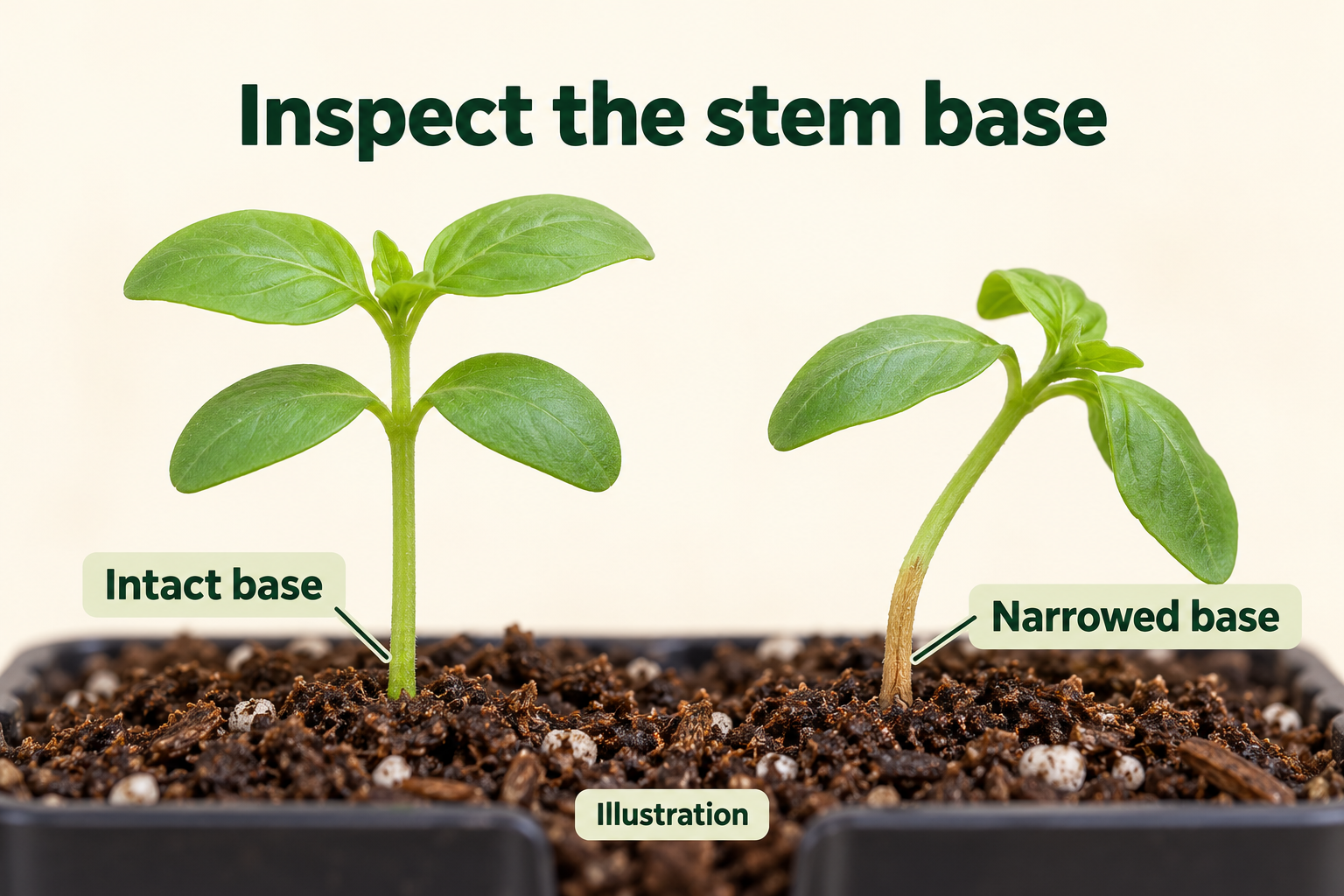
Damping off is a group of diseases that can rot seeds before emergence or cause young seedlings to decay and collapse. If a herb seedling falls over, inspect its stem base and the growing mix before adding water or trying a treatment. A narrowed, soft or rotting base is more concerning than leaning alone. [1] [2]
The immediate aim is to identify the likely problem, keep suspect material away from clean sowings and decide whether a fresh start is more sensible. This guide helps with seedlings in trays, pots and garden beds; it does not replace a laboratory diagnosis.
🌿 In this guide
- 🛠 Recognise damping off and rule out lookalikes
- 🌱 Beginner checklist
- Why damping off develops
- 🌿 Grow Herb Lab Framework: Choose the next seedling action
- What to do when seedlings collapse
- Prevent damping off in the next sowing
- 📅 Seasonal growing calendar
- ⚠️ Common mistakes
- 🌿 Frequently asked questions
🌿 Grow Herb Lab quick facts
| Question | Useful starting point |
|---|---|
| When can it happen? | Before a seedling appears or during early growth. [1] |
| What should I inspect? | The stem at mix level, roots of affected plants, moisture and drainage. [2] |
| Does every fallen seedling have it? | No. Light, moisture stress and physical damage can produce other kinds of collapse. [4] [8] |
| Can a badly rotted seedling recover? | Do not plan on saving a seedling whose stem base has rotted and collapsed. [6] |
| What matters for the next sowing? | Clean equipment, suitable fresh mix and conditions that support establishment. [3] |
🛠 Recognise damping off and rule out lookalikes
Pre-emergence damping off happens before shoots appear. Seeds or emerging shoots decay, leaving gaps in the sowing. Failed emergence alone does not prove disease: seed quality, depth and growing conditions also need checking. Use the herb seed germination guide for that wider assessment. [1] [8]
Post-emergence damping off affects visible seedlings. The base may become discoloured, soft, water-soaked or thin enough to lose support. Root decay can also be involved. Whitish growth may occur in humid conditions, but it is not a compulsory sign. [1] [2]
Use several observations together. This comparison points to a next check, rather than confirming a pathogen.
| What you see | What to check | First direction |
|---|---|---|
| A collapsed seedling with a narrowed or decayed base | Inspect the base and affected roots; look for similar losses nearby. | Treat damping off as a possibility and contain suspect material. [2] |
| Long, thin stems leaning with an intact base | Check light and crowding. | Investigate stretching; review herb sunlight requirements. [4] |
| Wilting with dry mix | Check moisture around the small root zone. | Investigate water shortage before assuming infection. [4] |
| Wilting or bending while mix stays wet | Check drainage, roots and the stem base. | Investigate excess moisture and root stress; disease may coexist. [4] |
| A visibly cut stem or chewed seedling | Look for feeding damage and pests. | Investigate pest injury rather than assuming damping off. [3] |
🌱 Beginner checklist
Before changing the setup:
- Photograph the affected seedlings and their position in the tray.
- Inspect the base of an affected stem. Is it firm, cut, stretched, narrowed or decayed?
- Check moisture and drainage, including any water trapped beneath the container.
- Note whether losses are isolated or continuing, and whether mix or irrigation is shared.
- Review recent changes in light, temperature, handling and watering.
- Use the seedling response framework to choose the next action.
Start with affected plants; avoid repeatedly pulling healthy seedlings out simply to inspect their roots.
Why damping off develops
Several organisms can cause damping off. They include true fungi such as Rhizoctonia and Fusarium, and fungus-like water moulds such as Pythium. The name describes a disease problem, not one organism that can be recognised by eye. [2] [6]
Contaminated soil or mix, plant debris, pots and tools can carry pathogens. Some can move in splashing or shared irrigation water. A clean bag of propagation mix can therefore be contaminated during use. [1] [2]
Wet conditions often favour the problem, especially when seedlings establish slowly. However, “cold and overwatered” is not a complete definition: different pathogens suit different temperatures, and Rhizoctonia can be favoured by moderately wet conditions. Match the growing environment to the herb rather than trying to prevent every case by adding heat or withholding water. [1]
🌿 Grow Herb Lab Framework: Choose the next seedling action
Use this observation → decision → action sequence alongside the comparison above:
- Inspect the base. A decayed or constricted base calls for the containment steps below. A firm, intact base keeps other explanations in consideration.
- Check moisture and growth. For dry-root-zone wilt, investigate watering. For intact stretched stems, investigate light. For wet-root-zone wilt, investigate drainage and root stress.
- Decide what shares the risk. Consider common mix, water, tools and handling; do not assess only the seedling that has fallen.
- Contain and correct. Remove suspect material appropriately and correct the conditions you can identify.
- Monitor or restart. Watch separate, apparently unaffected sowings. Restart an affected shared sowing cleanly, or seek diagnostic advice when the cause remains unclear.
This is a practical decision aid, not a disease test. If observations conflict, preserve photographs and ask for advice before treating.
What to do when seedlings collapse
1. Keep suspect material away from clean sowings
Separate the affected container from clean propagation work. Do not transfer its runoff, mix or dirty tools into another sowing. Remove affected seedlings with the mix around them rather than dropping them onto the bench. [2] [7]
If damping off is suspected in a shared flat of mix, a conservative home-growing response is to discard that sowing and its mix and restart. UMass Extension warns that healthy-looking plants from an affected flat may carry contamination and develop problems later. Simply transplanting the upright seedlings does not make them clean. [8]
Separate pots that have not shared suspect mix or water are a different situation: inspect and monitor them rather than assuming the whole growing area is infected. Keep discarded material out of fresh propagation mix.
2. Correct conditions for remaining sowings
Check drainage and stop unnecessary watering of already wet mix. Improve spacing and gentle air movement; reassess a humidity cover after emergence. Avoid a strong fan blasting delicate seedlings or letting tiny root zones dry severely. [7]
Watering still needs to match the seedling and its mix. For the ongoing method, use how to water herb seedlings, transplants and newly repotted herbs.
3. Restart losses with a clean setup
Use suitable fresh seed-starting mix and clean containers, tools and work surfaces. Do not pour new mix over contaminated material or reuse the failed sowing mix. Choose sound seed and follow the packet’s sowing method. [3] [6]
Review the germination conditions for herb seeds before resowing so that a fresh start also addresses an unsuitable setup.
4. Seek advice when losses continue
If successive clean sowings fail, or symptoms do not fit the observations here, contact a local plant-diagnostic service or qualified horticultural adviser. Provide photographs, the herb name, mix and seed details, watering history and the pattern of losses. Establishing the cause is more useful than repeatedly applying an unspecified treatment. [8]
Prevent damping off in the next sowing
- Start with appropriate mix. Use a fresh, free-draining propagation mix suitable for seed raising. Garden soil and reused sowing mix can introduce avoidable problems into containers. [3] [6]
- Keep clean materials clean. Store mix and tools away from dirty floors, plant waste and splash. Keep watering outlets off contaminated surfaces. [2] [8]
- Clean before sanitising. Remove old mix and wash reusable equipment first. Follow a suitable disinfectant’s directions for the material and use. Replace trays that cannot be reliably cleaned; Wisconsin guidance specifically discourages reusing plastic pots implicated in damping off or root rot. [4] [6]
- Give seedlings room and light. Sow at suitable spacing, thin where appropriate and provide the light needed after emergence. Weak, stretched seedlings need their growing conditions checked. [4] [5]
- Reassess moisture as conditions change. Keep the sowing appropriately moist with drainage. Do not maintain saturation simply because seeds or seedlings are small. [3] [7]
For direct-sown beds, concentrate on suitable sowing conditions, drainage and spacing. Do not try to disinfect a whole garden bed as though it were a seed tray. [3]
📅 Seasonal growing calendar
Use this as a timing panel rather than a fixed monthly schedule. Damping off can occur at any time; a UK spring warning should not be turned into an Australian calendar rule. [5]
| Growing situation | What to reassess |
|---|---|
| Australia — cool-season sowing or slow emergence | Check whether the particular herb has suitable growing-medium conditions; avoid leaving sowings persistently wet while growth is slow. [1] [3] |
| Australia — wet or humid propagation periods | Recheck drainage, spacing, covers and ventilation rather than assuming warm weather removes disease risk. [1] [5] |
| Northern Hemisphere — local sowing seasons | Apply the same checks around your herb’s local season. Indoor starts still need suitable light and moisture management. [5] [7] |
| Any location — after emergence | Reassess cover use, airflow and watering as seedlings develop. More heat is not an automatic solution. [7] |
⚠️ Common mistakes
- Watering every wilt: check the root zone and stem first.
- Diagnosing from surface mould alone: inspect the seedling and the wider symptom pattern.
- Propping up a rotted stem: support cannot restore destroyed tissue.
- Reusing suspect mix: start the replacement sowing cleanly.
- Moving runoff or dirty tools between trays: protect clean propagation work.
- Changing several things without recording them: note the problem and corrections so recurring losses can be investigated.
🌿 Frequently asked questions
Can a seedling with a rotted stem base recover?
A seedling lost to damping off is not a realistic rescue project. Concentrate on containment and the next sowing; a leaning seedling with an intact base may have a different, correctable problem. [4] [6]
Does white mould prove damping off?
No. Whitish growth can accompany the disease, but colour alone does not establish what is growing or why a seedling is failing. Inspect the stem, roots and conditions; diagnosis may require specialist advice. [2] [8]
Can bottom watering spread it?
Bottom watering is not disease-proof. Some damping-off pathogens can move in shared irrigation water, so do not use suspect tray water for clean sowings. The method does not replace hygiene. [2]
Should I discard every seedling?
Distinguish an affected shared sowing from separate containers. Restarting an implicated flat is the conservative option; healthy appearance alone does not clear its remaining seedlings. Inspect separately maintained sowings and investigate continued losses. [8]
When is a clean restart more sensible?
When seedlings have rotted bases, losses continue through a shared sowing or repeated handling would move suspect material into clean containers, focus on a fresh setup rather than attempted salvage. [6] [8]
Should I try a household remedy or fungicide first?
Begin with inspection, containment and clean propagation. This guide does not recommend a household treatment or a pesticide recipe. If a product is being considered, ask for current advice appropriate to the edible herb, problem and location; do not copy a commercial or overseas chemical programme. [1]
🌿 Key takeaways
- Inspect the stem base and growing conditions before deciding why a seedling fell.
- Distinguish suspected damping off from stretching, water stress and physical injury.
- Protect clean sowings and restart an affected shared sowing with fresh materials.
- Build prevention into the next propagation setup.
🌿 What success looks like
In the sowings you retain or restart, look for firm stem bases, continued suitable growth and no continuing pattern of collapse. Keep monitoring while seedlings establish. An encouraging spell without losses is useful feedback, not proof that every pathogen has gone.
🌿 Continue learning
- 📚 Reference guidance: herb seed germination for a better restart and herb sunlight requirements for light-related weakness.
- 🛠 Problem solving: watering herb seedlings, transplants and repotted herbs for ongoing moisture decisions.
- 📥 Free resources: the Beginner Herb Growing Kit for broader starting guidance.
🌿 Final thoughts
A collapsed seedling deserves a closer look. Use the observations to choose a response, keep the next sowing clean and seek advice when the pattern remains unexplained.
Sources
- [1] Damping off — Business Queensland
- [2] How to prevent seedling damping off — University of Minnesota Extension
- [3] Damping-off diseases in the garden — UC Statewide IPM Program
- [4] Troubleshooting seedling issues — University of Minnesota Extension
- [5] Damping off — Royal Horticultural Society
- [6] Damping off — University of Wisconsin Extension
- [7] Starting vegetable seeds indoors IV Seedling culture and transplanting — Utah State University Extension
- [8] Damping-off of bedding plants and vegetables — University of Massachusetts Amherst Extension