The best fertiliser for herbs is one that supplies the nutrients your plant needs without adding more than it can use. There is no single product or feeding schedule that suits every herb, pot and garden bed. Start with the herb, its growing conditions and the nutrients already in its soil or potting mix.
A productive basil plant harvested regularly may benefit from feeding during active growth. An established rosemary growing well in a fertile garden bed may need little additional fertiliser. A yellow, struggling herb needs a diagnosis before it needs another dose.
This guide helps you decide whether feeding is appropriate, compare the main options and use a measured plan. The aim is healthy growth and useful harvests, with drainage, light and water working alongside nutrition.
Quick feeding decisions
| Your situation | Check first | Practical next step |
|---|---|---|
| Established garden herb growing well | Soil fertility and previous additions | Avoid adding fertiliser simply because a calendar says it is time. |
| Actively growing herb harvested often from a pot | Existing feed, potting-mix age and product directions | Use a suitable feeding plan if the existing nutrient supply needs supplementing. |
| Herb recently planted in fresh potting mix | Whether the mix contains fertiliser and how long it is intended to last | Account for that feed before adding another product. |
| Yellow leaves or weak growth | Moisture, drainage, roots, light, temperature and pests | Investigate the cause before assuming nutrient deficiency. |
| Plant declining shortly after feeding | Product, amount, dilution and other nutrient sources | Pause further feeding while you assess the problem. |
Do herbs actually need fertiliser?
Every herb needs nutrients, but that does not mean every herb needs an extra purchased fertiliser. Garden soil, mature compost and fertiliser included in a potting mix may already supply what the plant requires.
Container herbs grow in a limited volume of medium. Harvest removes plant material, and watering can carry some nutrients out of the pot. This makes a planned nutrient supply especially useful for productive container plants. However, a newly filled pot containing a suitable fertiliser charge is different from an older pot whose nutrient supply is declining.
In a garden bed, previous feeding, compost additions and the soil itself matter. A herb growing well does not need extra nutrients simply because a neighbouring plant is being fed. For persistent problems in beds, a suitable soil test can help identify fertility or pH issues before you add individual nutrients.
Diagnose before you feed
Pale leaves and slow growth can occur with nutrient shortage, but they can also reflect waterlogged roots, insufficient light, cold conditions, pests or natural ageing. Fertiliser will not repair poor drainage or supply missing sunlight.
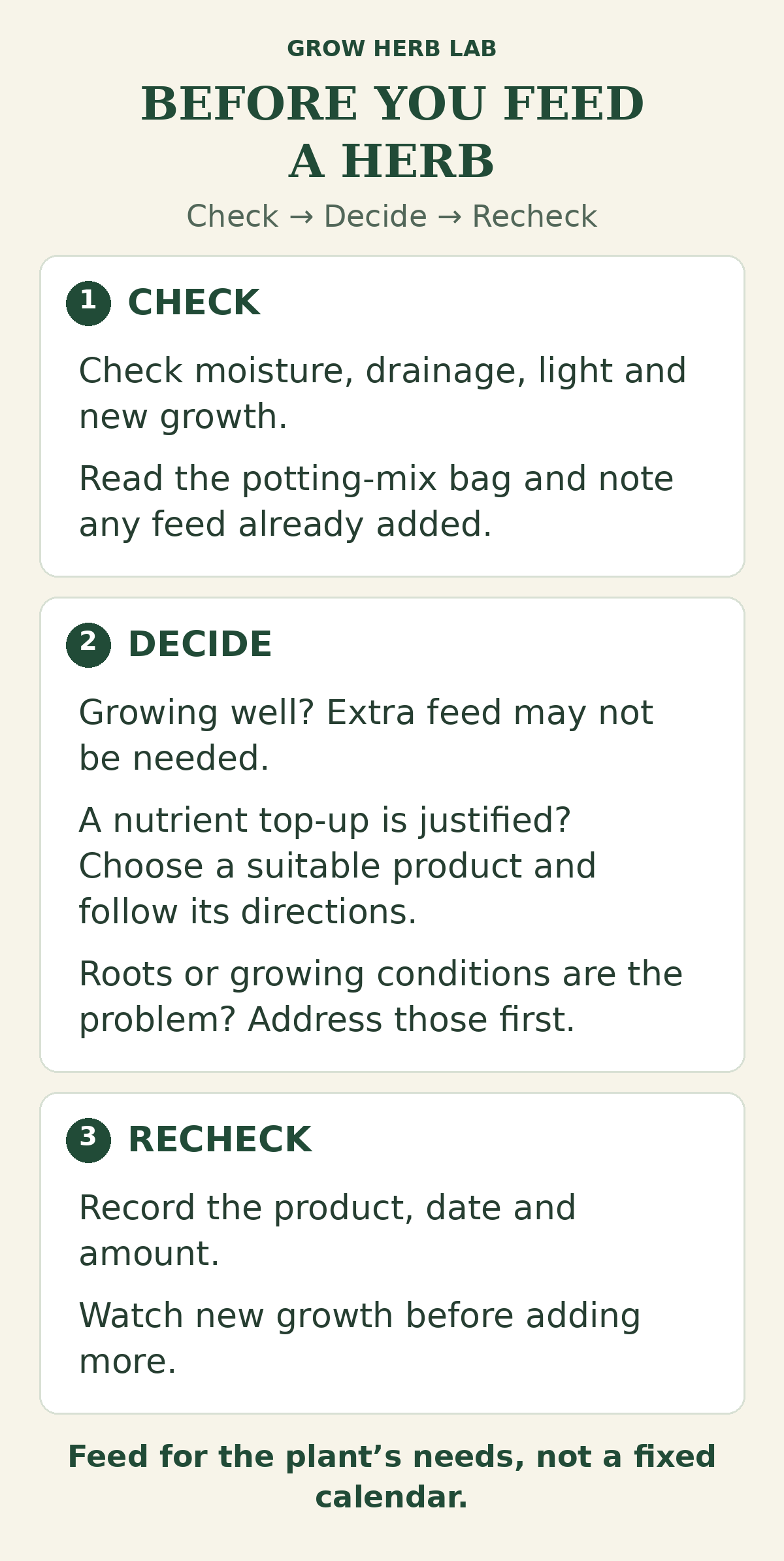
Check the growing medium and roots where practical, review recent changes and inspect new growth. If several conditions are wrong, address the obvious growing problem before using feed as a rescue treatment. The Yellow Leaves on Herbs guide provides a wider diagnostic pathway.
Read the label before choosing a fertiliser
A fertiliser supplies plant nutrients. A soil conditioner primarily improves the growing medium, while a tonic or biostimulant may be intended to support plant processes. Some products combine these functions. Read the nutrient analysis rather than relying on a name such as “natural”, “seaweed” or “plant food”.
The three nutrients commonly highlighted are nitrogen, phosphorus and potassium, abbreviated to N, P and K. Nitrogen supports leafy growth; phosphorus and potassium also have important roles in plant development. Plants need other nutrients too, including calcium, magnesium and trace elements.
For an Australian explanation of these categories and nutrient labels, see Gardening Australia’s Fertiliser 101.
These letters are a starting point, not a recipe for selecting the highest numbers. A concentrated product requires a different quantity from a dilute one. There is no universal NPK ratio that every culinary herb must receive.
Check that the directions suit your intended use, including edible plants, containers or garden beds as applicable. Then check the rate, dilution, application method and repeat interval. Use the directions on the Australian product you have, rather than copying a rate or nutrient ratio from an overseas guide.
Check existing feed: before buying anything, read the potting-mix bag and review what you have already added. A liquid feed, granular fertiliser and nutrient-rich amendment may overlap even when they have different names.
Compare the main fertiliser options
| Option | Where it can be useful | Main limitation |
|---|---|---|
| Liquid or soluble nutrient fertiliser | Measured feeding of actively growing container herbs | Dilution and repeat applications must suit the product and plant. |
| Controlled-release fertiliser | A planned nutrient supply in containers | Release varies with the product and growing conditions; avoid unnecessary extra feed. |
| Organic pellets or meals | Feeding according to product directions in beds or suitable pots | Nutrient content and release vary; organic products can still be overapplied. |
| Mature compost | Improving garden soil while adding some nutrients | Composition varies; it is not a precise substitute for every missing nutrient. |
| Seaweed-based tonic or combined feed | An optional supplement, or a nutrient source if formulated as a fertiliser | Seaweed-only tonics should not be assumed to supply a complete nutrient programme. |
Liquid and soluble fertilisers
A liquid concentrate or soluble powder can be convenient when you want to measure a feed for an actively growing pot. Prepare it according to the directions; do not estimate the concentrate or make a stronger solution to obtain faster results.
Fish-based products are one option in this group, but their formulations differ. Some supply a broader range of nutrients than others. Check the analysis, suitable uses and smell considerations rather than assuming every fish product performs the same role.
Liquid fertiliser is an option, rather than the automatic best choice for all herbs. A plant already receiving an appropriate granular feed may not need it as well.
Granular and controlled-release products
These can reduce the need to prepare frequent liquid feeds, but the quantity and placement still matter. Follow the directions for the specific pot size or garden area and account for fertiliser already present in the mix.
“Slow-release” and “controlled-release” describe different release approaches across products. Do not assume that every granule has the same lifespan or responds identically to temperature and moisture. A stated feeding period is a guide to that formulation, rather than proof that a struggling plant has exhausted its nutrients.
Compost and other organic additions
Mature compost can support soil structure and contribute nutrients in a garden bed. Its value extends beyond feeding, but composition varies. Avoid treating compost as an unlimited addition or assuming every herb needs a rich bed.
Containers need a suitable potting mix with drainage and air space. Do not replace it with garden compost alone simply because compost contains nutrients. For the growing-medium decision, use Best Soil for Herbs.
Is seaweed enough?
Check the formulation. A seaweed extract sold as a tonic or biostimulant may not provide the nutrients required to correct a shortage. A product that combines seaweed with fertiliser is different: its nutrient analysis and directions determine its feeding role.
Biostimulants are optional. They do not replace appropriate light, drainage, watering or a needed nutrient supply, and benefits are not guaranteed for a herb already growing under suitable conditions. You do not need to buy a separate seaweed product to complete every beginner setup. The RHS explains the distinction between supplements and nutrient feeds in its biostimulant guide.
Match feeding to the herb and its harvest
Established rosemary, thyme, sage and oregano generally call for a restrained approach. Avoid pushing lush growth with unnecessary fertility, especially where the soil already supports healthy plants. Restrained feeding does not mean deliberately starving a container herb.
Basil, parsley and mint producing repeated leafy harvests may need more active nutrient management. Even here, consider the medium and current growth before choosing a dose. A productive outdoor basil in warm conditions is different from a small basil indoors with limited light.
Herb groupings help you compare needs, but they are not fixed feeding categories. Consider these four factors together:
- The species and its current growth stage.
- Whether it is growing in a bed or container.
- Nutrients already supplied by the medium and previous feeding.
- How much healthy growth you regularly harvest.
Excess fertility can encourage lush growth and affect aroma in some herbs. That is a reason to avoid excess, rather than a claim that fertiliser always reduces flavour. Nitrogen is essential for growth; the problem is a supply that exceeds or mismatches the plant’s needs.
Fertilising herbs in pots, indoors and garden beds
Pots
Keep a simple record of the potting mix, its included feed and any later additions. Before applying more fertiliser, check whether the roots have usable space and the pot drains freely. A root-bound or waterlogged herb may respond poorly to extra nutrients.
Avoid layering several feeding programmes without a reason. For example, a controlled-release product and a regular liquid feed may together exceed what a lightly growing herb needs. Use the product directions and the plant’s response to decide whether supplementation is warranted.
For container setup and root space, see Growing Herbs in Pots.
Indoors
Useful light limits how much growth an indoor herb can make. More feed will not prevent stretching caused by insufficient light. Review the position and actual growth before repeating a feeding schedule designed for a productive outdoor plant.
A herb growing slowly indoors may need less frequent feeding than the same herb outdoors in suitable conditions. Review the Herb Sunlight Reference Guide when light is the uncertain part of the decision.
Garden beds
Consider fertility history, soil condition and the plant’s performance. Beds that already support healthy herbs may need little additional feed. Poor soil structure or drainage needs its own correction.
When a deficiency is suspected, identify it before applying a specific nutrient. Repeated additions of phosphorus or trace elements without evidence can create a new problem. A soil test and local advice are more useful than guessing from one leaf.
When to feed and how much to use
Feed according to the selected product and the herb’s active growth. A fixed instruction such as “every two to three weeks” is too broad for all herbs, formulations and growing conditions.
Read the rate and repeat interval, then consider whether the plant is growing and whether another source is already supplying nutrients. Measure the amount each time. Do not adopt a universal half-strength rule or change a product’s directions simply because another guide used that dilution for a different formulation.
Australian seasons also vary. Winter can slow growth in a cool garden, while some herbs remain active in milder climates. Heat, low light or other stress can slow growth at other times. Respond to the plant and its conditions rather than importing one national calendar.
After repotting, check the new mix’s fertiliser content before feeding. Repotting is not an automatic trigger for an extra dose. Let the plant’s establishment and the existing nutrient supply guide the decision.
Apply fertiliser correctly
For a root-applied feed, use this sequence:
- Check the product and existing feed. Confirm the directions suit the plant and growing situation.
- Assess the plant and medium. Do not use feeding as the first treatment for severe drought stress or waterlogging.
- Measure accurately. Follow the stated dilution or quantity for that product and application.
- Apply as directed. Keep granules away from foliage or stems where specified, and avoid excess runoff.
- Record and reassess. Note the date, product and amount, then watch new growth before adding more.
Some products permit foliar application; others are intended for the growing medium. Follow the specified method instead of automatically spraying leaves or forbidding every foliar feed. For edible herbs, follow relevant application and harvest directions on the exact product.
Keep watering decisions separate from feeding. Do not repeatedly soak a pot merely to deliver another dose. The Herb Watering Guide helps you assess moisture and drainage.
Suspected overfeeding and poor response
| What you notice | What to investigate | Sensible response |
|---|---|---|
| Leaf edges scorch soon after feeding | Concentration, amount, application conditions and other feeds | Pause further feeding while checking the cause. |
| Pale or slow growth continues | Roots, drainage, light, temperature, pests and nutrient history | Revisit diagnosis rather than increasing the dose automatically. |
| Unusually soft growth | Fertility alongside light and growing conditions | Review excess or overlapping feeding. |
| A crust appears on the mix or pot | Fertiliser deposits, water quality and drainage | Identify the likely source; deposits alone do not prove fertiliser damage. |
| Plant wilts in wet mix | Root health and aeration | Address the root-zone problem before considering feed. |
Do not assume every scorched leaf or white deposit proves overfeeding. These observations need context. Stop adding more while you check what was used and whether the timing fits the decline.
If excess fertiliser or salt accumulation is suspected, remove accessible excess granules where practical without damaging roots, and seek advice on the product and growing medium before attempting a rescue. Flushing a freely draining pot can be appropriate in some confirmed salt problems, but repeated flushing is not a universal rescue method. Adding more water to a poorly draining or already waterlogged pot can worsen root stress. Severe or persistent decline may require assessment of the roots and growing medium rather than another treatment.
Damaged leaves may not recover their original appearance. Judge progress by healthy new growth and improving plant condition.
Common feeding mistakes
The most useful correction is often simplifying the plan. Avoid feeding every yellow herb, adding nutrients to fresh pre-fed mix without checking, or buying liquid feed, seaweed and compost as a compulsory bundle.
Other mistakes include treating organic products as impossible to overapply, using a seaweed-only tonic to correct missing nutrients, and following the same frequency for basil, rosemary and a low-light indoor pot. A product can be suitable while its rate or timing is unsuitable.
Frequently asked questions
What is the best fertiliser for potted herbs?
Choose one whose directions suit your herbs and containers, with a nutrient supply appropriate to their current growth and existing feed. Liquid or soluble fertilisers offer measured applications; suitable granular products can provide a longer supply. Neither is universally best.
Is organic fertiliser better for flavour?
Organic does not guarantee better flavour. Herb type, growing conditions, harvest timing and overall fertility matter. Compare formulation and use rather than assuming the origin of the fertiliser determines the result.
Should I feed a newly purchased herb straight away?
Check the label or ask what nutrients its mix already contains. Assess light, water, roots and establishment first. A new plant does not automatically need an additional feed.
Should basil and rosemary receive the same schedule?
Not automatically. Their growth and harvesting needs differ, and the medium and product may differ too. Follow an appropriate plan for each plant rather than applying one calendar to every pot.
Can I harvest after feeding?
Follow the product’s edible-plant directions, including any application or harvest restrictions. Fertilisers and pesticides have different purposes; do not assume the same restrictions apply to every product. Wash harvested herbs appropriately, while following any stated directions.
Grow Herb Lab Final Checklist
- Check growing conditions before diagnosing nutrient shortage.
- Identify fertiliser already in the soil or potting mix.
- Choose a suitable nutrient plan without unnecessary overlap.
- Measure and follow the product’s directions.
- Match feeding to active growth and reassess new shoots.
Continue learning
For the growing medium, use Best Soil for Herbs. Check moisture with the Herb Watering Guide and placement with Herb Sunlight Requirements.
If yellow leaves remain the main problem, continue with Yellow Leaves on Herbs. For species-specific care, compare the Basil guide and Rosemary guide.