To manage thrips on herbs, first check that thrips are present and associated with fresh damage. Inspect young growth and leaf surfaces, separate affected pots where practical, and begin with suitable physical removal and care adjustments. Keep checking the plant before deciding whether further action is needed. [1, 4]
Silvery marks or curled leaves are a reason to investigate, rather than an instruction to spray. This guide helps you distinguish likely thrips damage from other problems, choose a response for a small edible-herb collection and assess progress. Any pesticide use needs directions appropriate to the herb, pest and growing situation. [7]
🌿 In this guide
- 🛠 Recognise possible thrips damage
- 🛠 Thrips or a lookalike?
- 🌱 Beginner checklist
- 🌿 Why thrips can persist or return
- 📅 Seasonal growing calendar
- 🌿 Grow Herb Lab Framework
- 🛠 What to do about thrips on herbs
- ⚠️ Sprays and harvesting edible herbs
- 🌿 Prevent another infestation
- ⚠️ Common mistakes
- 🌿 Frequently asked questions
- 🌿 What success looks like
- 🌿 Continue learning
- 📚 Sources
🌿 Grow Herb Lab quick facts
| Check | What matters |
|---|---|
| What they are | Tiny, slender insects; appearance varies between species and life stages. [3] |
| Useful clues | Pale or silvery scars, distorted new growth and dark droppings warrant inspection. [2, 11] |
| Where to look | Growing tips, folded foliage, leaf surfaces and flowers where present. [2] |
| Helpful equipment | White paper and a hand lens. [2] |
| First decision | Connect pest activity with fresh injury before choosing treatment. [1] |
| Edible-herb precaution | Check the actual product directions and picking restrictions before using a spray. [7] |
Recognise possible thrips damage on herbs
Thrips feeding can leave pale scars and distorted leaves as damaged young tissue expands. Herbs including basil, mint and French tarragon can be affected. That does not mean every marked leaf on these herbs is caused by thrips. [2]
Look for several pieces of evidence together:
- Irregular silvering or pale marks on foliage.
- Damaged or misshapen young leaves and flowers.
- Small dark droppings near feeding injury.
- Slender insects associated with the affected growth. [2, 11]
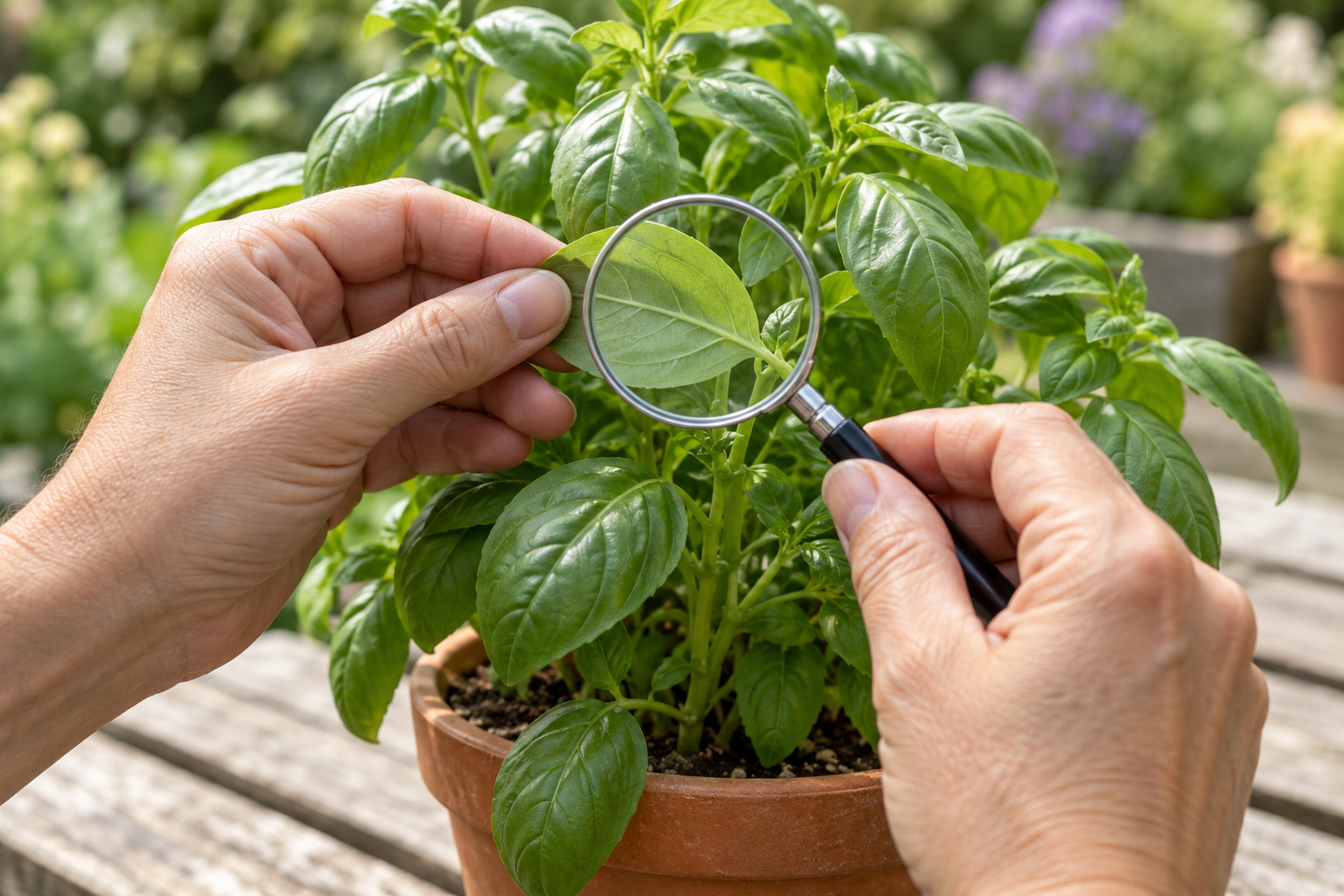
Inspect several shoots, including nearby growth that still looks healthy. Gently tap foliage or a flower over white paper, then examine anything dislodged with a hand lens. Look into folds and growing points as well as across the open leaf surface. [2]
A moving insect on the paper is something to identify. It is not, by itself, proof that it caused the damage. Some thrips are harmless in a particular setting, and others are predators. Identifying a thrips species reliably can require expert examination; colour alone is insufficient. [1]
🛠 Thrips or a lookalike?
Use this comparison to decide what to inspect next.
| What you notice | Possible explanation | Useful next check |
|---|---|---|
| Silvery scars, distorted young growth and slender insects | Plant-feeding thrips | Inspect affected shoots and compare pest activity with fresh injury. [2] |
| Fine pale stippling, tiny mites beneath leaves and sometimes webbing | Spider mites | Inspect leaf undersides; compare with Spider Mites on Herbs. [9] |
| Groups of soft-bodied insects, sometimes with sticky honeydew | Aphids | Examine stems and young growth; use Aphids on Herbs for the next checks. [4] |
| Small dark flies associated with damp potting mix | Fungus gnats | Investigate the mix and insects with Fungus Gnats on Herbs. This observation alone does not explain silvery leaf scars. [10] |
| Marks without a consistent pest finding | Physical injury, growing stress or another cause | Review when damage appeared and recent handling or care changes before treating for thrips. [1] |
More than one problem can occur on the same plant. Keep investigating if the explanation does not fit all the evidence.
🌱 Beginner checklist
Before choosing a treatment:
- Compare older marks with the condition of the newest leaves.
- Inspect more than one shoot and both affected and nearby herbs.
- Try the white-paper check and use magnification.
- Record what you found, rather than only writing “thrips”.
- Separate affected pots where practical, while maintaining suitable light and care.
- Note recent sprays, fertilising, pruning and changes of position.
- Assess how much useful healthy growth remains.
- Arrange identification help if the evidence is unclear.
For example, “two slender insects tapped from a folded shoot; fresh scars on expanding leaves” gives you something to compare at the next inspection. The checklist organises the observations; it does not identify a species or authorise a pesticide.
Why thrips can persist or return
Thrips can arrive on infested plants and remain in sheltered feeding sites. A new pot may look tidy while insects are concealed in its foliage. Continue checking new arrivals after the first inspection. [11]
Some common pest thrips lay eggs within plant tissue, while later non-feeding stages occur in growing media or sheltered places on the plant. A foliage rinse or contact treatment therefore may not reach every stage. Do not assume that all thrips pupate in soil or that replacing the mix will solve the problem. [3, 5]
This is why a single clean-looking inspection is encouraging but incomplete. Compare repeated observations before concluding that management has succeeded.
📅 Seasonal growing calendar
Use local conditions and plant activity rather than a fixed Australian treatment month. Temperature, the thrips involved and the growing setup affect development; protected spaces can support activity beyond the outdoor growing season. [3, 5]
| Growing situation | What to check | Practical response |
|---|---|---|
| Fresh growth during active outdoor growing | Expanding leaves, shoot tips and any flowers | Investigate new marks promptly; compare nearby plants. |
| Indoor or sheltered herbs | Persistent activity despite a quieter outdoor season | Continue inspection where pests or fresh damage have been found. |
| New plants or cuttings arriving | Concealed insects and developing injury | Inspect before mixing them into the collection, then check again. |
| Slower growth or cooler conditions | Whether injury is old or still developing | Keep decisions tied to pest evidence, rather than assuming the problem has disappeared. |
Northern Hemisphere adaptation
Apply the same checks during your local growing season and in protected spaces. Do not copy Australian months into a Northern Hemisphere schedule. This calendar guides observation, not pesticide application dates.
🌿 Grow Herb Lab framework: What evidence is present, and what response fits?
Use observe → confirm → respond → recheck to organise the decision.
| Evidence | Next action |
|---|---|
| Cause uncertain | Inspect more growth and consider lookalikes; seek identification help before treating. |
| Thrips associated with limited fresh injury | Separate pots where practical, use suitable physical management and monitor. |
| Activity and fresh injury continue to spread | Reassess neighbouring plants and your management approach; check appropriate treatment options or obtain advice. |
| Severe decline or unusual symptoms persist | Decide whether replacement or local diagnostic advice is the more useful next step. |
| Old marks remain, but current activity is unclear | Recheck the newest growth and pest evidence before repeating treatment. |
This is a practical decision aid, not a numerical threshold. The next useful question is what has changed since the previous check.
What to do about thrips on herbs
Separate affected pots and inspect neighbours
Move an affected pot away from the rest of the collection where practical. Keep its growing conditions suitable, and inspect neighbouring herbs rather than assuming that moving one pot has contained the problem. Check new arrivals too. [11]
For plants in a bed, focus on inspecting nearby foliage and handling affected growth carefully. Keep notes about which plants show activity so you can compare the same area again.
Rinse suitable foliage and remove selected damaged growth
A suitable water rinse can help remove exposed insects. Selective pruning can reduce a localised infestation; neither approach guarantees complete control. Retain enough healthy growth for the herb to continue growing. [4]
Adjust the rinse to the plant: support delicate shoots and avoid tearing leaves. As a practical adaptation for potted herbs, keep foliage cleaning from becoming repeated saturation of the root zone. Allow water to drain and check the mix separately.
Remove badly affected shoots only where the herb can tolerate that pruning. Contain removed material as you work. Repeatedly stripping leaves or cutting a woody herb progressively harder is not a substitute for checking what remains.
Correct care problems without forcing growth
Provide conditions suited to the herb. Avoid excessive nitrogen feeding as a recovery shortcut. A plant can tolerate damage better when its growing conditions are appropriate, but good care does not guarantee freedom from pests. [1]
Use the Herb Watering Guide to assess moisture separately from the pest problem. For herb-specific care, the French Tarragon Growing Guide provides a relevant example.
Use traps and natural enemies in context
Blue or yellow sticky cards can help detect flying adult thrips in protected growing areas. Trap catches do not tell you that eggs, immature stages or concealed insects have been removed. Continue checking the plant itself. [2]
Avoid routinely placing sticky traps throughout an outdoor herb garden: they can catch many other invertebrates. They may also catch useful insects in protected spaces, so check compatibility when using purchased biological controls. [11]
Protect naturally occurring predators. Purchased biological controls need a suitable growing system and advice about the pest, conditions and previous sprays; a glasshouse recommendation is not a guarantee for an exposed balcony pot. [1, 3]
Recheck activity, fresh injury and new growth
Keep a simple record of those three things. Revisit comparable shoots and inspect sooner when new injury is developing quickly. Your inspection frequency and any pesticide application interval are separate decisions.
If observations do not fit the original diagnosis, reconsider it. Repeated treatment without knowing what is still active can make progress harder to judge.
Know when to seek help or replace the plant
Certain thrips transmit plant viruses, but neither a thrips finding nor mottled foliage proves infection. Symptoms vary between hosts and conditions. Persistent unusual new-growth symptoms warrant local diagnostic advice; killing the insects cannot cure an existing virus infection. [5, 6]
For a small herb with little viable growth left, replacement may be more practical than prolonged treatment. A valued perennial or uncertain diagnosis may justify professional advice first. [4]
⚠️ Sprays and harvesting edible herbs
If further treatment is needed, check the current directions on the actual product before applying it. An ornamental-plant recommendation does not establish suitability for an edible herb. [7]
Work through the label information:
- Plant or crop: does the direction cover your herb or the relevant crop group?
- Pest: does it cover thrips, including any species restriction?
- Situation: are the growing location and any regional conditions covered?
- Use directions: what rate, coverage, repeat interval and maximum-use restrictions apply?
- Precautions: what protective, plant-injury, environmental or other restrictions must be followed?
- Harvesting: what does it say about picking after treatment? [7, 8]
If the use is unclear, ask the manufacturer or an appropriate local adviser. Do not transfer rates or schedules from an overseas guide, a different product or an old permit list.
Follow the specified withholding period and other picking restrictions. Washing harvested leaves does not replace following those directions. If you cannot establish what was applied and whether the use was appropriate, obtain advice before harvesting. [8]
Avoid homemade washing-up-liquid or soap mixtures, which can injure foliage. A household cleaning product is not interchangeable with a formulated insecticide. [4]
Prevent another infestation
Inspect incoming herbs and continue checking after arrival. Remove infested debris from the growing area, and check nearby plants when activity is found. [11]
Make these checks part of ordinary care rather than waiting for extensive injury. Record a clear observation and a useful next step; for example, inspect a recently purchased pot again when its next leaves expand.
Maintain herb-appropriate light, moisture and nutrition, and protect natural enemies. These habits support management without requiring every insect in the garden to be eliminated. [1, 3]
⚠️ Common mistakes
| Mistake | Better approach |
|---|---|
| Spraying because one leaf is silver | Inspect for a consistent pest-and-damage pattern. |
| Identifying the species by colour | Obtain identification help where the species matters. |
| Treating sticky-card catches as a cure | Inspect the plant and assess fresh injury. |
| Repotting automatically | Establish whether changing the mix would address the actual problem. |
| Removing every marked leaf | Retain useful healthy growth and assess the whole plant. |
| Copying an ornamental spray direction | Check the edible crop, pest, situation and harvest instructions. |
| Repeatedly treating unchanged scars | Compare active pests and newly developing injury. |
🌿 Frequently asked questions
Can my herb have thrips when I cannot see insects?
They can be concealed in developing growth. Inspect several shoots and try the white-paper check with magnification. An unsuccessful quick look does not establish the cause either way. [2]
Are silvery marks always thrips?
No. Marks need to be assessed alongside pest evidence and other plausible causes. Use the lookalike comparison before choosing a treatment. [1]
Are sticky traps enough?
They can help with monitoring flying adults, especially in protected growing. Continue inspecting foliage; a trap is not a check of every life stage. [2, 3]
Must I replace the potting mix?
Not automatically. Some stages can be sheltered in or around the plant, and changing the mix does not address insects remaining in foliage. Base the response on the diagnosis. [3, 5]
Can I use neem or insecticidal soap?
The name alone does not establish a suitable use. Check the specific product’s current directions for your edible herb, thrips and growing situation, including picking restrictions. [7, 8]
Can I still harvest?
Check the herb’s condition and any treatment history. Follow the applicable product directions; this guide does not establish a universal waiting period after spraying. [7, 8]
When is replacement sensible?
Consider the remaining useful growth, continuing injury and the effort involved. Seek advice first when a valued plant or an uncertain diagnosis changes that decision.
🌿 Key takeaways
- Connect the leaf injury with pest evidence before treatment.
- Use a response suited to the herb and growing setup.
- Check edible-crop and harvesting directions before spraying.
- Judge progress through repeated observations of activity and fresh growth.
🌿 What success looks like
Across repeated checks, you find less pest activity, fewer newly damaged leaves and useful new growth. Nearby herbs have been inspected too. Existing scars can remain even when management improves. [1]
There is no fixed deadline for recovery or a single trap result that establishes eradication. The trend across the plant is the more useful basis for the next decision.
🌿 Continue learning
🌿 Related growing guides
- French Tarragon Growing Guide — match ongoing care to the herb.
📚 Reference guidance
- Herb Watering Guide — assess the root zone while managing foliage.
🛠 Problem solving
- Spider Mites on Herbs — investigate mites and stippled foliage.
- Aphids on Herbs — compare a different pest on young growth.
- Fungus Gnats on Herbs — investigate flies associated with potting mix.
📥 Free resources
- Beginner Herb Growing Kit — practical guidance for everyday herb care.
🌿 Final thoughts
A careful inspection gives you a better starting point than a treatment chosen from leaf colour alone. Keep a record, choose the next action for the evidence you have and use the following check to decide whether that action helped.
Sources
- [1] UC Statewide IPM Program — Thrips
- [2] University of Connecticut IPM — Pest management for herb bedding plants grown in the greenhouse
- [3] Royal Horticultural Society — Thrips
- [4] University of Minnesota Extension — Managing insects on indoor plants
- [5] NSW DPI — Western flower thrips and tomato spotted wilt virus
- [6] Business Queensland — Spotted wilt and related viruses
- [7] APVMA — Home garden and domestic pest-control products
- [8] APVMA — Understanding pesticide chemical labels
- [9] Agriculture Victoria — Two-spotted mite
- [10] University of Minnesota Extension — Fungus gnats identification
- [11] Royal Horticultural Society — Indoor plants: sap feeders